Last Updated on February 12, 2022 at 6:13 pm
Lakshmi asks, “I am now 30 years with very little savings. I wish to retire by 50. How should I plan for retirement?” She and her husband are both earning but do not have job security. Therefore, we will assume that they do not wish to be salaried beyond the age of 50 and assume a life expectancy of 90 for the younger spouse (husband, age 28).
We shall use the robo advisory template to create this retirement plan. The user can modify all assumptions in the template. Let us list the inputs and assumptions made. Please note: All inputs and outputs used in this study are specific to individuals mentioned above and should not be copied by others.
- Current monthly expenses that will persist in retirement Rs. 40,000
- Annual expenses that will persist in retirement Rs. 80,000
- Your age at the end of current year 30
- Age you wish to retire 50
- Years to retirement 20
- Total average monthly expenses (annual/12) Rs. 46,667
- Percentage by which your monthly investments can increase each year (until you have accumulated enough for retirement) 10%
- Post-tax return expected from equity investments % 10
- Rate of return expected from current tax-free fixed income % 7
- Value of current equity investments ( stocks and equity mutual funds) Rs. 2,00,000
- Total Value of current tax-free fixed income investments (PPF + EPF etc.) Rs. 5,00,000
The template can also include lump sum retirement benefits and up to three monthly incomes (pension, rent) after retirement. However, as retirement is still 20 years away for the couple, we will not include any lump sum benefits now. This calculation must be revised each year with fresh inputs.
- Inflation before retirement (%) 8
- The assumed life expectancy of the younger spouse 90
- Inflation during retirement (%) 6
- Years to retirement 20
- Monthly expenses in the first year of retirement 2,17,511
- Years in retirement (until younger spouse reaches age 90) 42
- Retirement corpus required at retirement (assuming the money will be invested in different buckets. This is after accounting for the future value of current investments, post-retirement benefits, any post-retirement income specified) Rs. 8,27,25,934
- Initial monthly investment required, including EPF/NPS contributions (scroll down to see investment schedule) Rs. 58,229
- Percentage by which your monthly investments can increase each year (until you have accumulated enough for retirement) 10%. The cash flow schedule is tabulated below.
| Age | Monthly investment in equity | Monthly investment in fixed income including total EPF/NPS contribution. |
| 31 | 34,937 | 23,291 |
| 32 | 38,431 | 25,621 |
| 33 | 42,274 | 28,183 |
| 34 | 46,501 | 31,001 |
| 35 | 51,152 | 34,101 |
| 36 | 56,267 | 37,511 |
| 37 | 61,893 | 41,262 |
| 38 | 68,083 | 45,388 |
| 39 | 70,901 | 53,918 |
| 40 | 73,601 | 63,699 |
| 41 | 76,133 | 74,897 |
| 42 | 78,435 | 87,698 |
| 43 | 80,436 | 1,02,311 |
| 44 | 82,053 | 1,18,968 |
| 45 | 83,189 | 1,37,935 |
| 46 | 83,731 | 1,59,504 |
| 47 | 83,551 | 1,84,009 |
| 48 | 82,497 | 2,11,819 |
| 49 | 80,396 | 2,43,351 |
| 50 | 77,050 | 2,79,071 |
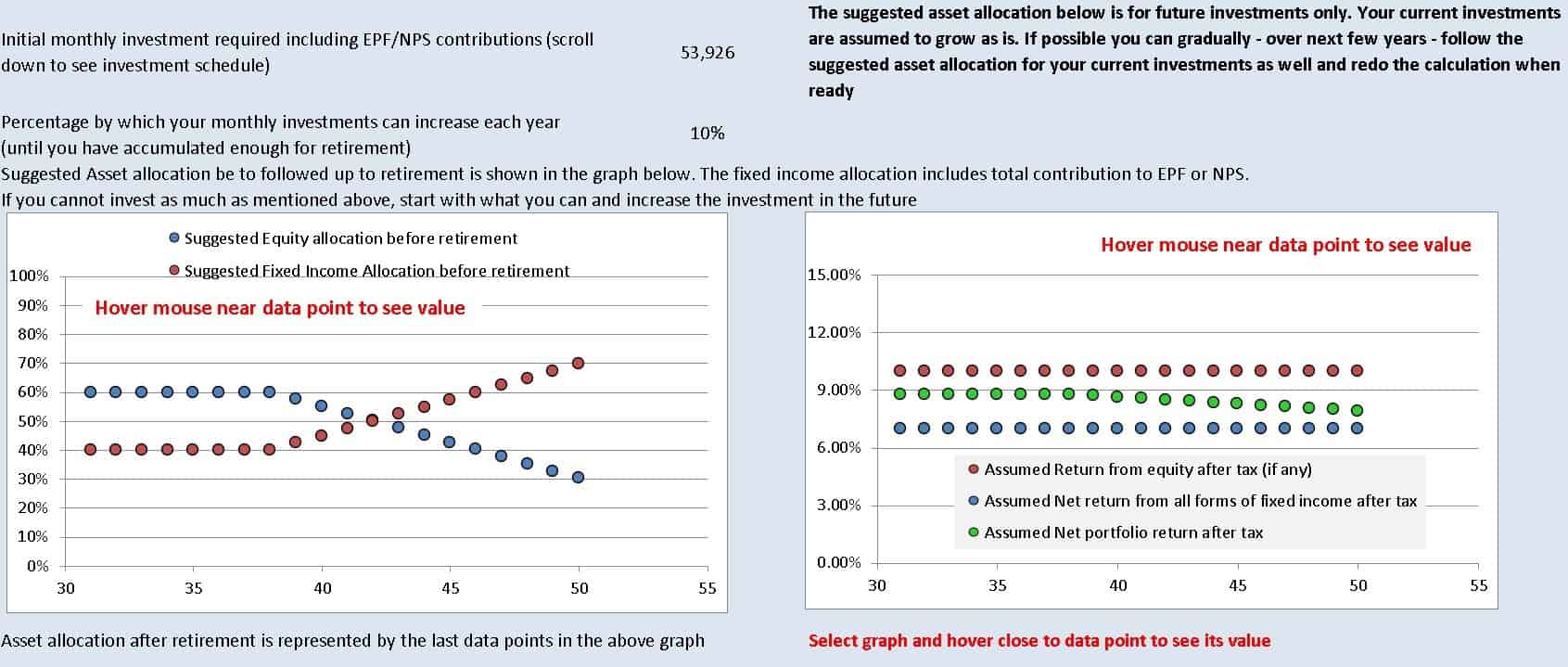
The retirement corpus is assumed to be invested in five buckets.
🔥Secure your future with our Robo-advisory tool trusted by over 3,500 investors and advisors. From effortless retirement planning to funding your children’s biggest dreams, turn your financial goals into reality. 🔥
Subscribe for money management solutions via email! (Link takes you to our email sign-up form) Join 32,000+ readers in our community.
👉 New Tool Alert! NaviPlan: A Privacy-Focused Multi-asset Tracker and Goal Planner 👈
- An emergency bucket to handle unexpected expenses.
- Income bucket providing guaranteed income for the first 15 years in retirement. During this time, investments are made in the following three buckets.
- Corpus from a low-Risk bucket that provides income from year 16 to year 26 in retirement. To provide this income, the low-risk bucket will have an asset allocation of 30% equity 70% debt during the investment period (year 1 to 15 of retirement).
- Corpus from a medium risk bucket will provide income from year 27 to 34 in retirement. To provide this income, this bucket shall have an asset allocation of 50% equity and 50% debt during the investment period (year 1 to year 26)
- Corpus from a high-risk bucket will provide income from year 35 to 42 in retirement. To provide this income, this bucket shall have an asset allocation of 70% equity and 30% debt during the investment period (year 1 to year 34)
That is, the retirement corpus will be divided into five parts.
- 5% in an emergency bucket
- 47% in an income bucket will provide guaranteed risk-free income inflation-protected income for the first 15 years. The rest of the parts will be invested in three buckets: low-risk (26%), medium-risk (12%) and high-risk (9%) in the asset allocations indicated above. During this investment period, the buckets will be actively managed to reduced risk: rebalancing and also profit booking from one bucket to another. To understand how this works, try this: The Retirement Bucket Strategy Simulator.
- After 15 years, the low-risk bucket will be turned into 100% debt and provide income for about 11 years. After that, the other buckets will also be progressively used.
Lakshmi and her husband should focus on
- investing as close as an amount as indicated above as possible (Rs. 58,229)
- They should increase this amount by at least 10% each year.
- They should increase their equity allocation to 60% as quickly as possible.
- They can use index funds or aggressive hybrid funds. Fund recommendations are available here: Handpicked List of Mutual Funds Apr-Jun 2021 (PlumbLine)
You might ask why both with retirement buckets now? Why do a rough estimate of the retirement corpus as done by many calculators online? Rough estimates would underestimate the corpus and do not educate the user about the nature of retirement planning.
Most calculators simply assume some post-retirement return, but there is a lot more to it than that. Understanding the bucket strategy process is crucial to beating inflation in retirement. In addition, the robo advisory template takes into account pension or rental income as applicable and further reduce the retirement corpus. It also helps planning for other recurring and non-recurring goals in independent or unified portfolios. More than 460 users (investors and financial advisors) are currently utilizing the template.