Last Updated on December 29, 2021 at 6:16 pm
Axis Quant Fund is an open-ended equity scheme following a quantitative model. The fund is currently in its NFO period: 11th June to 25th June 2021. In this review, we discuss the model used by the fund and whether it makes sense to invest in this.
A quant fund uses a mathematical model to either choose stocks/bonds or decide the portfolio’s asset allocation. Axis Quant Fund belongs to the former category. We have discussed these funds in detail: Can we invest in Quantitative Mutual Funds (Quant Mutual Funds)? Also, see: Tata Quant Fund Review: Is AI necessary to beat the market? And DSP Quant Fund Review.
Quat models like 200 DMA, PE, momentum etc., to define asset allocation as used by dynamic asset allocation funds and balanced advantage funds have a reasonably clear strategy. However, the fund houses tend to keep changing models.
Axis claims in the scheme presentation that the quant model offers “Better risk-adjusted robust performance”, “Performance across market cycles”, and “robust investment process”. If that is the case, what about their existing diversified equity funds, which are at least not official “quant”?!
🔥Secure your future with our Robo-advisory tool trusted by over 3,500 investors and advisors. From effortless retirement planning to funding your children’s biggest dreams, turn your financial goals into reality. 🔥
Subscribe for money management solutions via email! (Link takes you to our email sign-up form) Join 32,000+ readers in our community.
👉 New Tool Alert! NaviPlan: A Privacy-Focused Multi-asset Tracker and Goal Planner 👈
There are well-known quant models for stock selection like factor-investing, which we have covered extensively (links below). However, AMCs are reluctant to introduce index funds tracking a simple factor such as low volatility. Instead, they prefer ETFs and introduce actively managed quant funds such as this new offering from Axis.
Actively managed quant funds mix quantitative and qualitative strategies for deciding stocks or asset allocation. This means the fund strategy is largely a black box and no different from any other actively managed diversified equity fund.
The scheme document of Axis Quant Fund says the fund will follow a “fundamental factor-based approach” (quality, growth and valuation) and mentions these as an “indicative list”: Return on Equity; Sales growth; Cash flow; Debt to equity ratio; Earnings growth; Price to book; Price to earnings; Dividend yield; Earnings yield. These factors would be combined in some manner to create a composite score.
Now, most stock investors would use parameters such as these! Does that mean they are following a “quant strategy?” All equity fund manager fund use these. Does that mean a flexi-cap fund or a small cap fund is also a “quant fund?”
The scheme presentation refers to “rule-based criteria”. Presumably, these refer to Liquidity, Stock price momentum, Volatility, Historical performance, beta, risk ratios. These factors will be used to create a risk score. The stock weights in the portfolio will depend on the composite score and risk score.
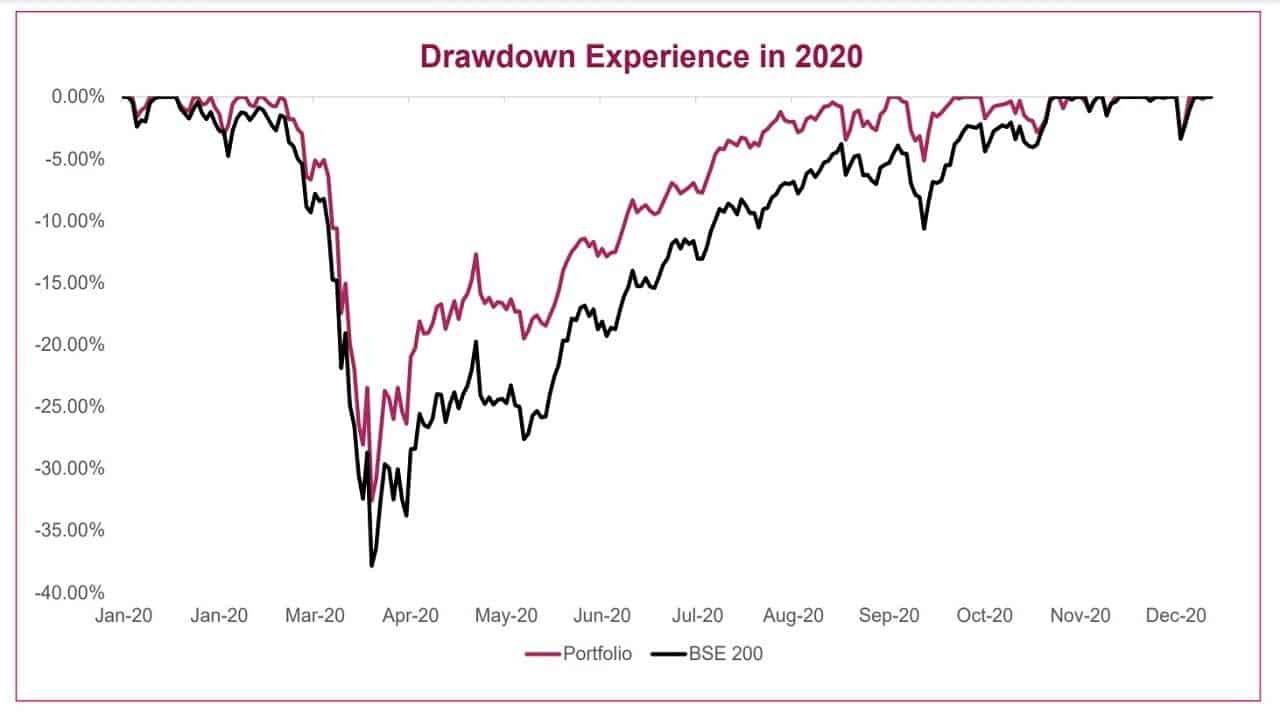
The scheme presentation (linked above) shows this backtest. The AMC claims the model fell less than the benchmark and recovered faster. The model’s drawdown is not significantly lower than that of the index, and any diversified fund that had different weights from that of the index would have recovered faster. See: Nifty 50 equal-weight index surges past Nifty 50 due to market rally. So there is nothing special about this.
In summary, we feel that there are too many unknowns in the semi-quant model of Axis Quant Fund. Many other Axis funds claim to buy “quality” stocks (Bluechip, long term equity). Active quant funds are too vague in design to warrant any serious consideration. We recommend that investors avoid Axis Quant Fund.
Resources to learn more about factor-based investing
- NIFTY100 Alpha 30 Index Review: How good a “factor” is alpha?
- How new stock investors can quickly start investing using NIFTY Multi-Factor Indices
- Are Nifty Smart Beta (strategic) Indices better than the Nifty Next 50?
- How good are the top 10 stocks of the NIFTY Quality Low-Volatility 30 Index?
- Watch my talk on momentum and low volatility stock investing in India
- Low volatility stock investing: Does it work? Higher returns at lower risk?
- Momentum Stock Investing in India: Does it work?
- Data Mining in Index Construction: Why Investors need to be cautious