Last Updated on October 1, 2023 at 5:43 pm
Stock momentum investing is a fascinating and counterintuitive concept like low-volatility stock investing. Momentum investing is essentially chasing stocks with good past performance! In this post, we find out if momentum investing in India works by analysing the S&P BSE Momentum Index. That is, we find out if the strategy can yield better returns than a market cap based index. We also compare momentum investing with low volatility investing to understand how they differ and which works better. This is the first in a series on momentum investing (something that I have always wanted to do). Let us start with the basics.
What is momentum investing?
At its very essence, momentum investing is spotting stocks that have delivered good returns (moved up = upward momentum) over the last few months and investing in them. When the stock price reverses direction, it is sold and replaced with another with upward momentum. There are of course various ways in which one can qualify the momentum and filer stocks. We will consider those in subsequent posts.
Why is it against logic (counterintuitive)?
If you see a gambler on a winning streak or a batsman hitting a 50 in every match in the T20 world cup, it is referred to as a hot hand. Since one cannot expect the gambler to keep winning all the time and the batsman to hit a 50 in the T20WC semi-final and final, this is referred to as a hot-hand fallacy. This is also true of mutual funds when people assume past performance will be repeated or when people believe that they do not have to plan for retirement as they will work until they die.
So if you look at the momentum strategy, it looks like another case of a hot-hand fallacy. Well yes and no. It is a hot-hand fallacy if you do not choose the time window right. It has been seen that momentum works for a 6-12 month period and not for durations lesser or longer! See references 7,8,9 in this wonderful alpha architect article by the Jack Vogel the author of Quantitative Momentum (co-author Wesley Gray).
🔥Secure your future with our Robo-advisory tool trusted by over 3,500 investors and advisors. From effortless retirement planning to funding your children’s biggest dreams, turn your financial goals into reality. 🔥
Subscribe for money management solutions via email! (Link takes you to our email sign-up form) Join 32,000+ readers in our community.
👉 New Tool Alert! NaviPlan: A Privacy-Focused Multi-asset Tracker and Goal Planner 👈
In general, momentum investing is a high-risk, high -reward strategy with higher drawdowns (larger falls ) than market cap based index.
What is low volatility investing?
Since we will be comparing momentum vs low volatility investing, it is better to define that as well. In this case, we look at for stocks with low daily price up and down movement (volatility as measured by the standard deviation) in the last one year and invest in them. I have written about this extensively and the interested reader can consult:
- Low volatility stock investing: Does it work? Higher returns at lower risk?
- 30 Low Volatility Stocks from Nifty 100: Aug 2018
- Twenty Stocks With Consistently Low Price Volatility July 2018
- Picking Stocks With Low Volatility: A simple, but effective strategy?
Why is it counterintuitive?
Popular (does not mean right!) market analysis math is established around that idea that one should take higher risk to get a higher reward (return). Low volatility investing has shown without a doubt that one can get a higher return (than a market cap based index) at lower risk (than the same market cap index).
The connection between momentum and low volatility
I shall explore this quantitatively in the coming months but let me record my thoughts so that we can come back and check if was I right or wrong. In the above-mentioned article and book, they talk about momentum quality. That is, not just stocks that gave good returns in the past 6-12 months, but stocks that did so with a higher number of positive daily returns.
In other words, stocks that moved smoothly up are preferred to stocks that moved up but fluctuated in the middle. So in other words, high volatility momentum stocks are rejected and low volatility momentum stocks are preferred. This idea is also closely related to selecting stocks that trade close to their all-time highs. See this for a discussion: A list of stocks that have traded close to their “all-time” high
Low volatility per se does not mean high returns. A stock can keep heading south or trade flat with low volatility! Momentum per se does not mean smooth upward movement. So Momentum Quality essentially seems to imply choosing low volatility upward moving stocks. These are of course my thoughts without having studied or analysed anything about this. I am sure there should be a lot of material on this. After writing this, I found a more than 50% (current) overlap between momentum and low volatility India indices (see below)
Momentum Investing in India
S&P has a BSE Momentum Index with 30 stocks from S&P BSE LargeMidCap with the highest risk-adjusted price momentum. To calculate this, the price change (absolute return) over the last 12 months is computed. This is then divided by the daily volatility over the 12 months
So stocks with low volatility and/or high price change will have the highest risk-adjusted momentum value. The impact of outliers from this dataset (too high or too low momentum scores) is minimized by a process known as winsorization to compute the final momentum score. Thus the BSE momentum index combines momentum and low volatility in its stock selection. Let us now begin the comparison. We will also use BSE low volatility index (30 least volatile stocks in BSE Largemidcap index)
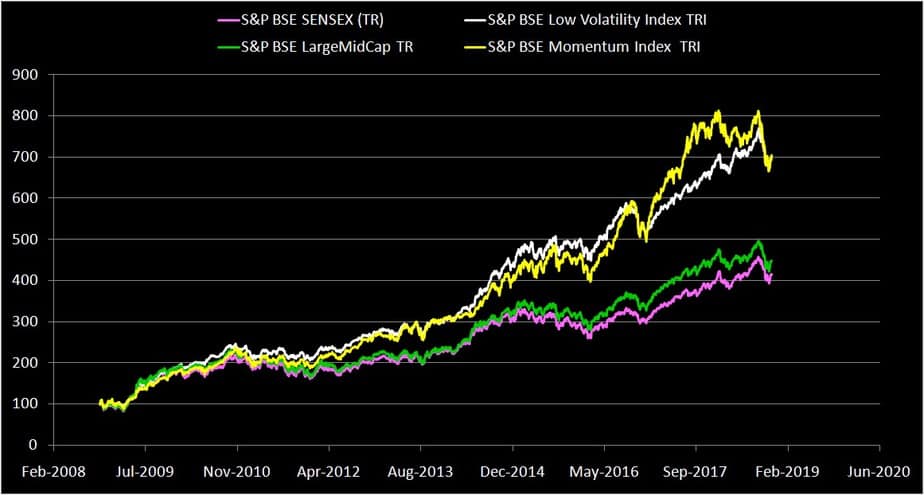
Noice how the momentum and low volatility indices pull away from Sensex and BSE large midcap. You can also visibly see that the drawdowns (fall from peak) is higher for the momentum index compared to the low volatility index.
BSE momentum index vs BSE LargeMidcap
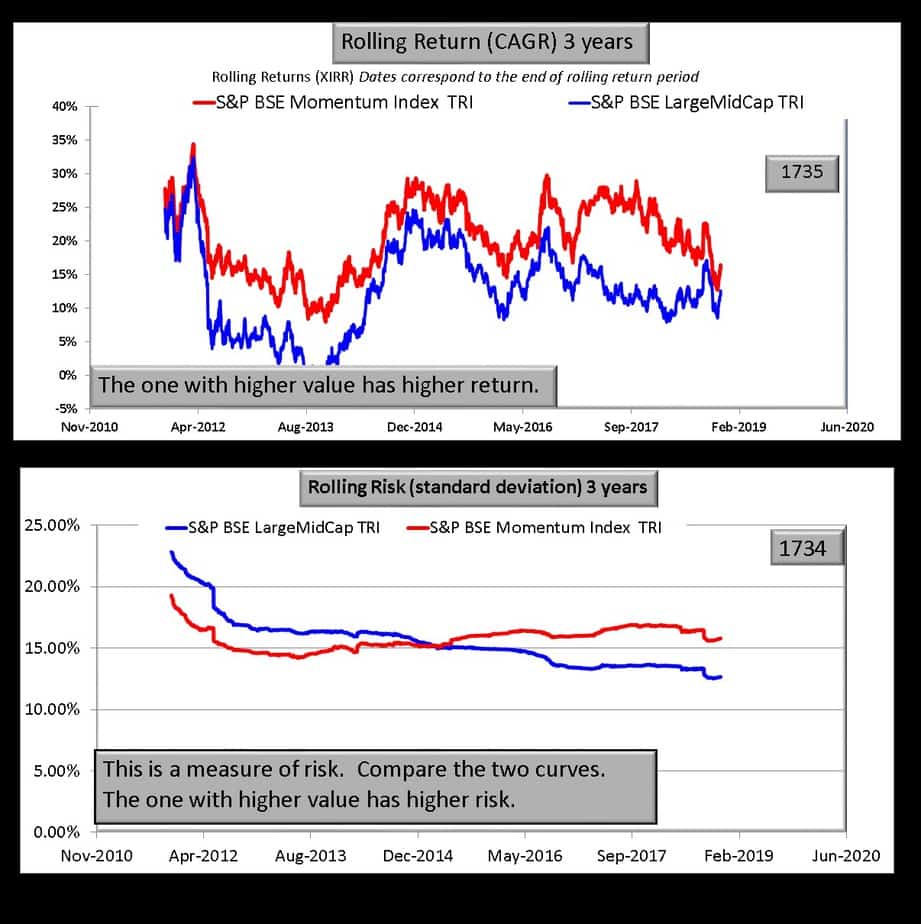
Three years
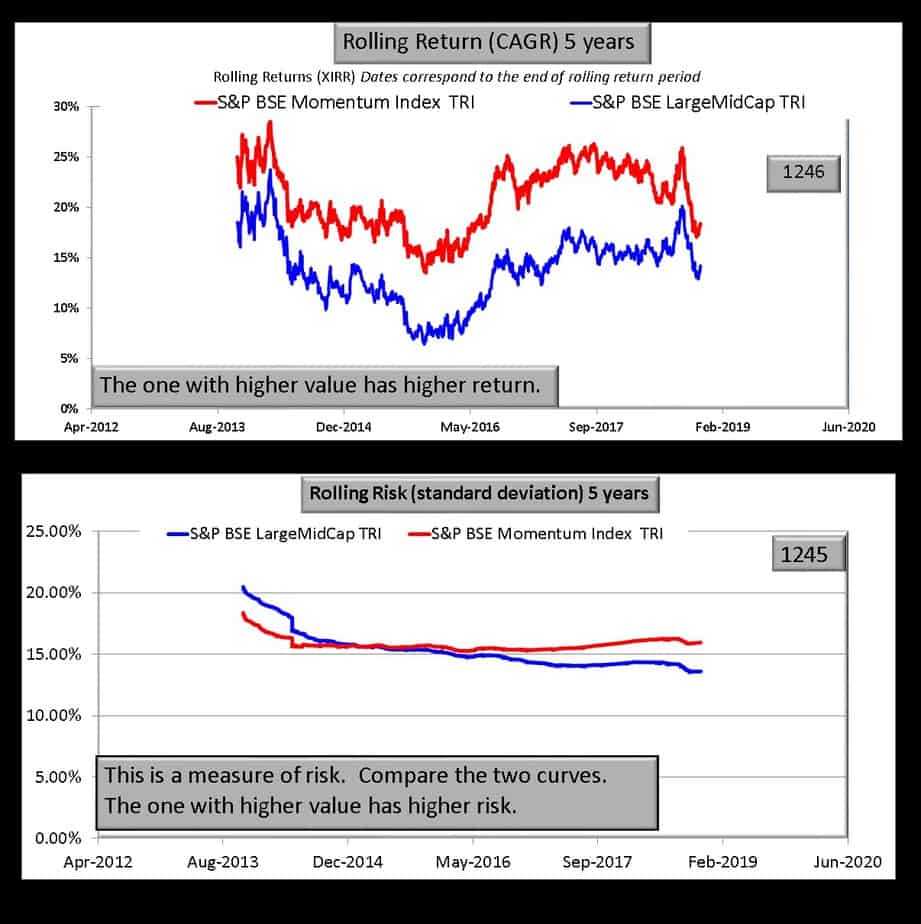
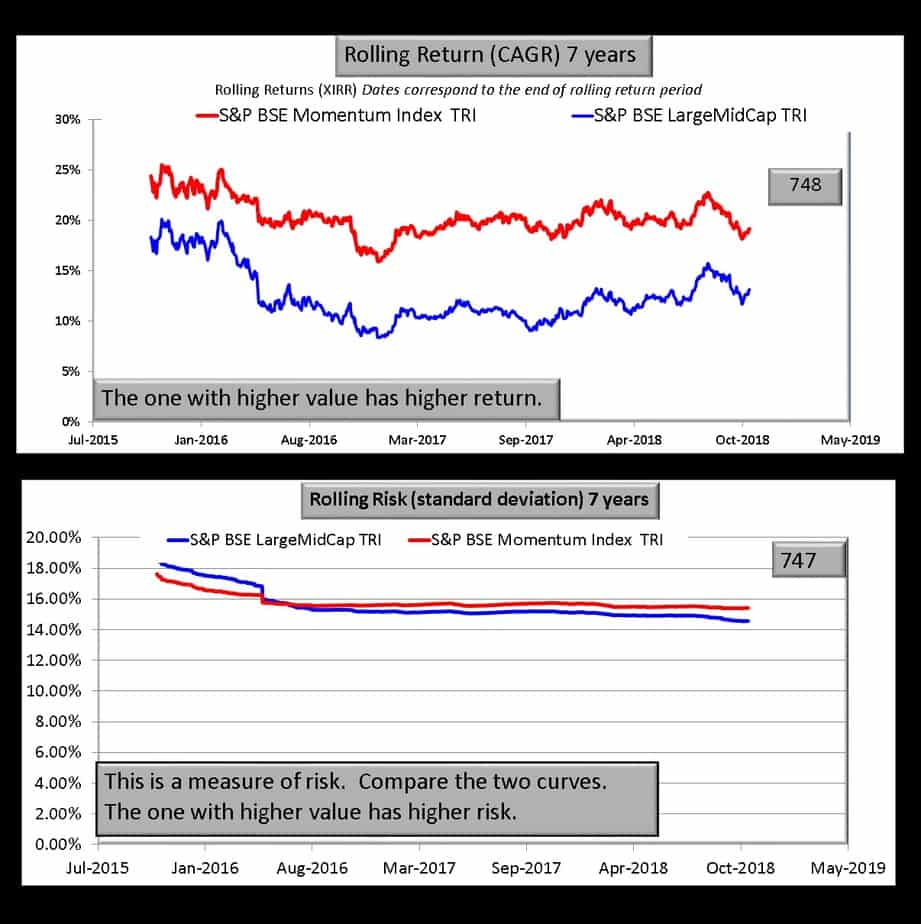
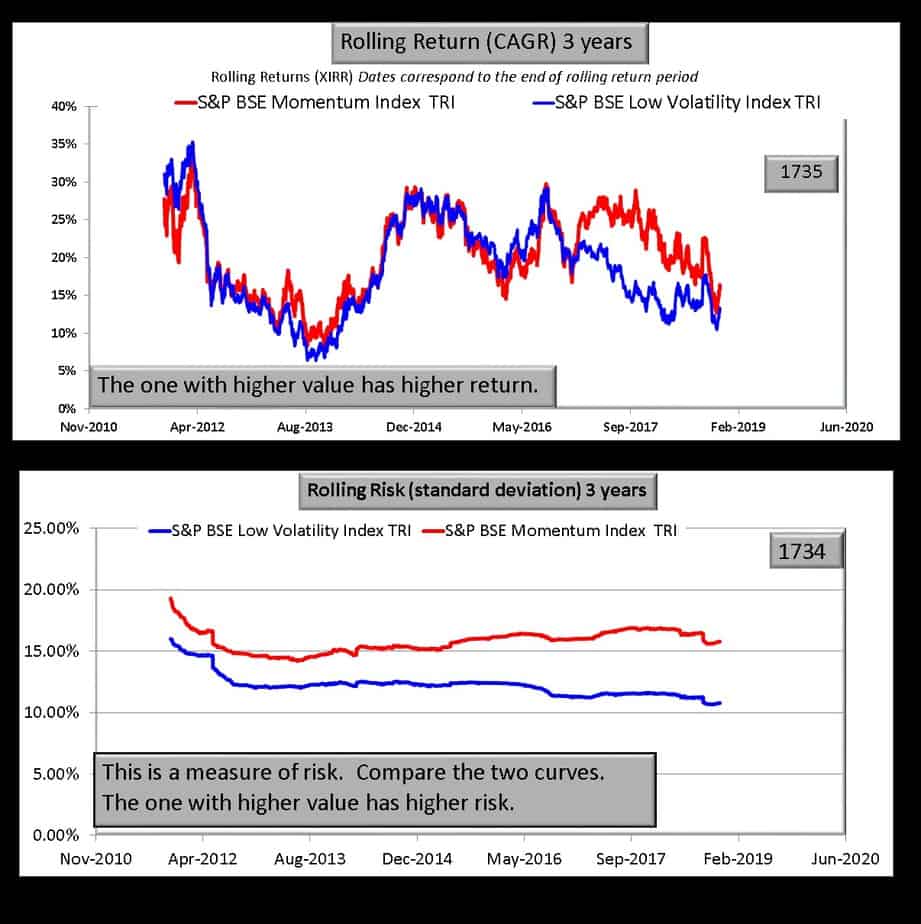
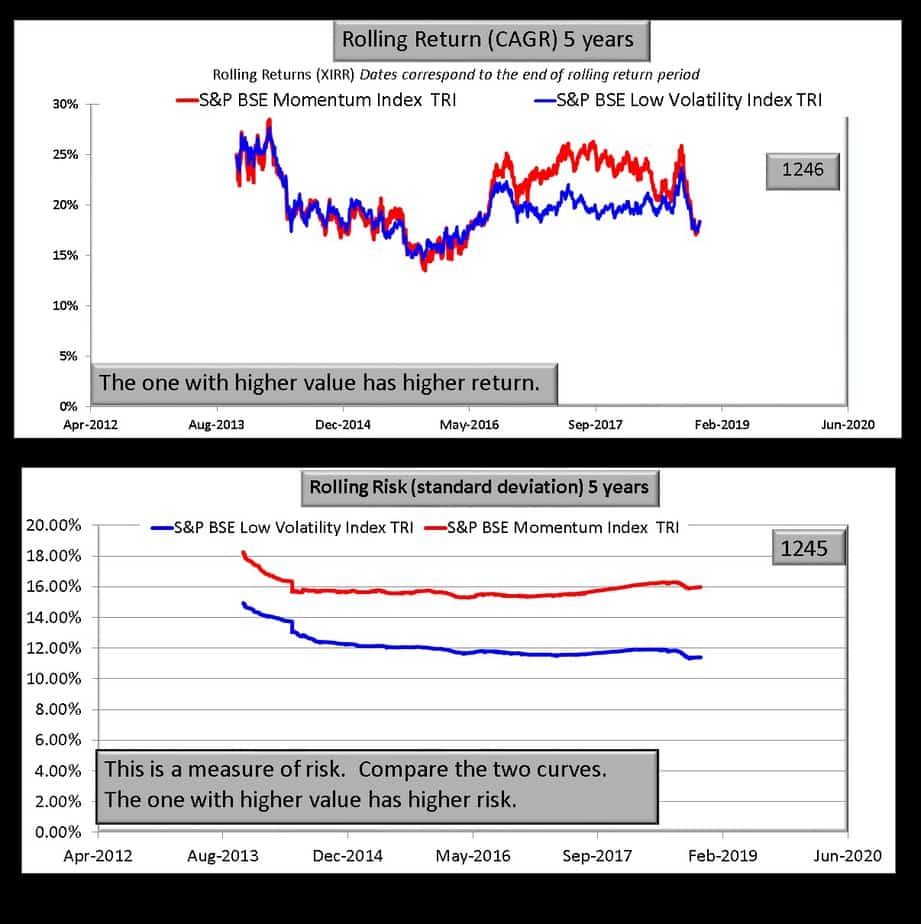
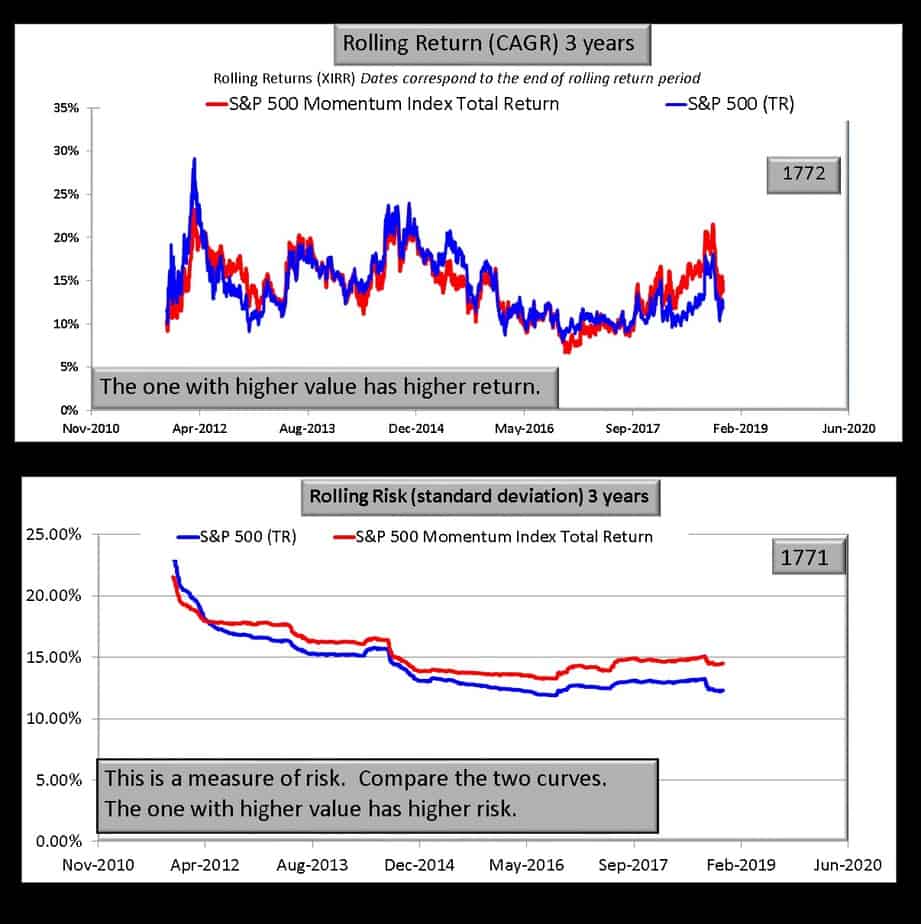
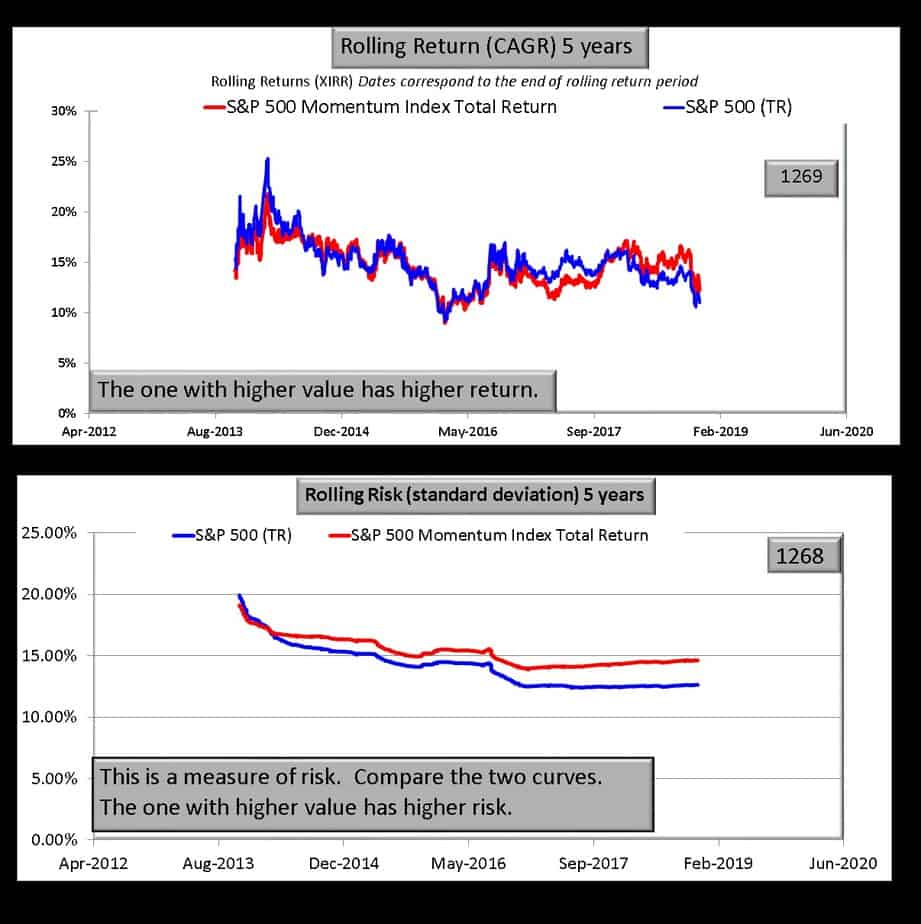
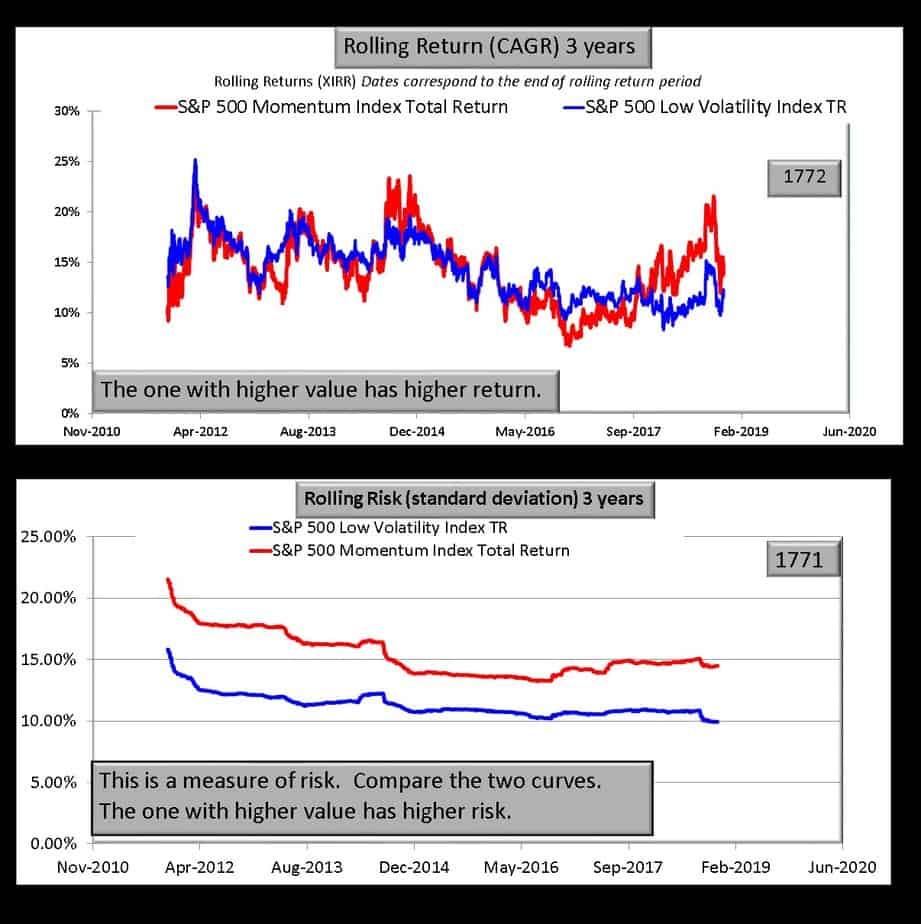
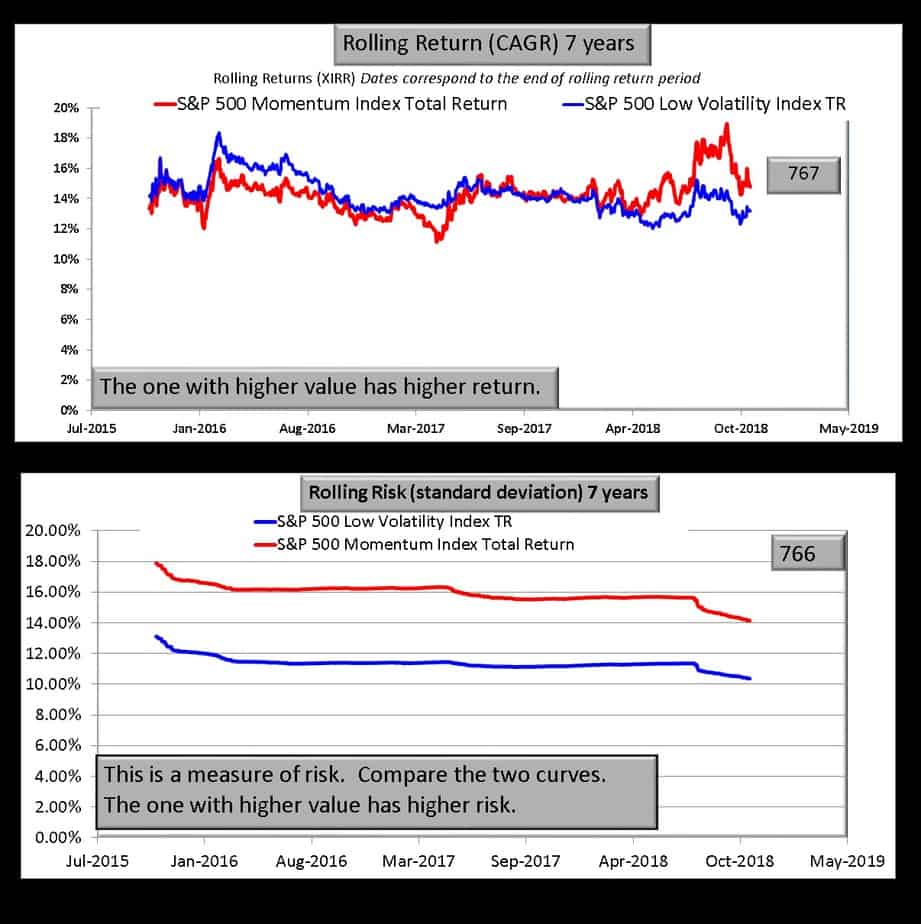
In all the graphs below, the top panel has the rolling returns. The no of return data points in each curve (red or blue) is denoted in the top right box (1735 below). The bottom panel is a measuring or rolling risk (standard deviation) Please spend some time on each graph to understand what they show.
Five years
Seven years
Observations:
The BSE momentum index clearly outperforms its parent index BSE Large midcap. What I find amusing is that in terms of volatility, there is not much difference between the two. Only over 7 years do we see the momentum index have a bit more volatility. So the answer to the question, does momentum investing in India work? is a big YES! Technically, the momentum investing method used by the BSE works in India.
A real-life example of an individual portfolio following momentum can be found in Prashanth Krish’s blog (@Prashanth_Krish on twitter) portfolioyoga. This is benchmarked with the Nifty smallcap 100 and the stocks are selected on a similar strategy as outlined above. This strategy is not without disadvantages but will work for those who understand what they are getting themselves into.
BSE momentum index vs BSE Sensex
Seven years
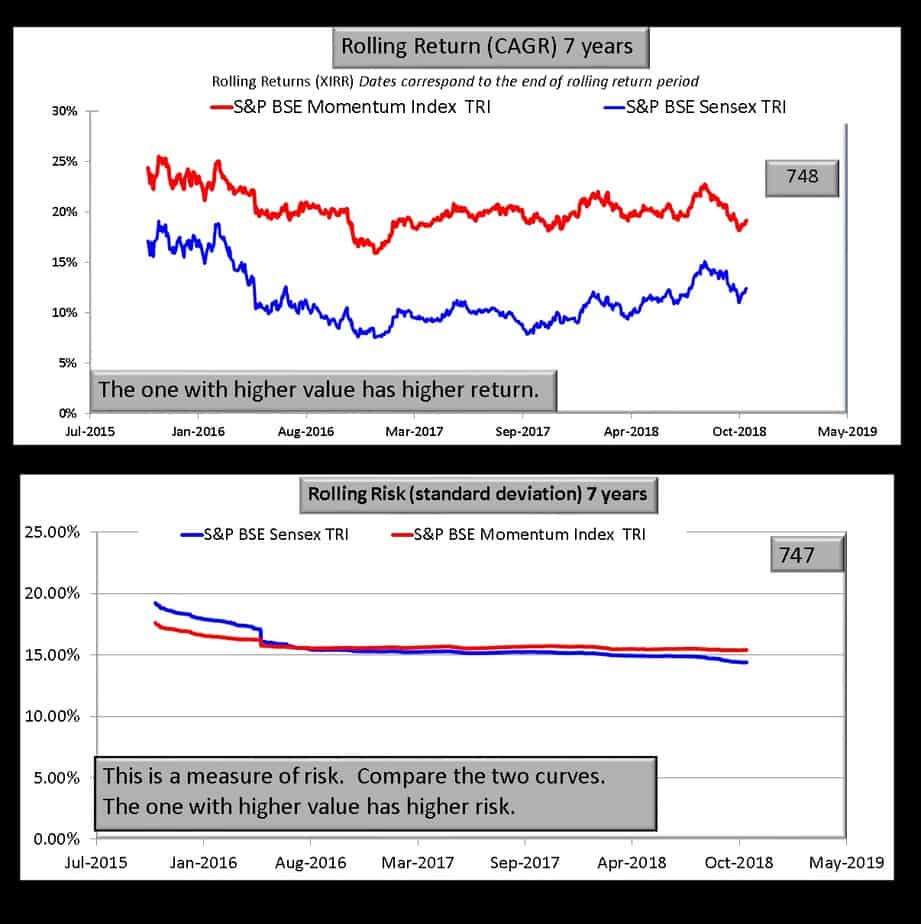
Observations:
The BSE momentum index has similar volatility wrt the Sensex but with much higher reward.
BSE momentum index vs BSE Low Volatility Index
Three years
Five years
Seven years
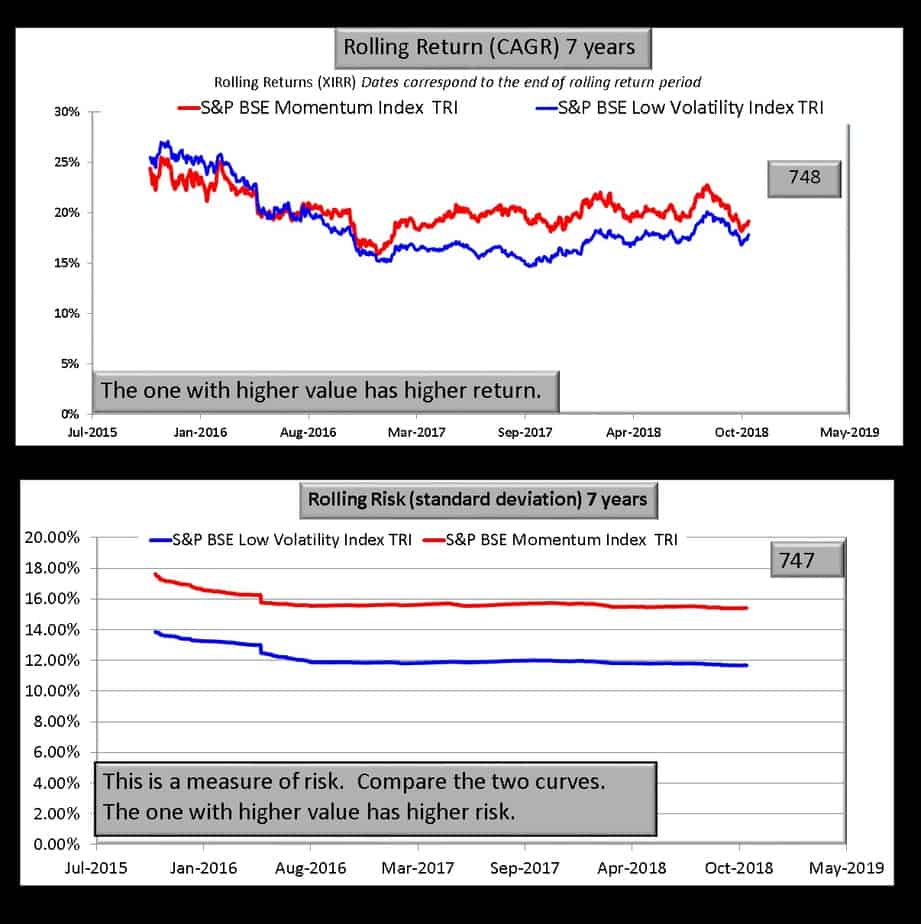
Observations:
The momentum index outperforms the volatility index “sometimes” but always has a higher risk. Therefore, in my opinion, this gives the low volatility method an edge
Momentum Investing in the USA
S & P 500 momentum index comprises of 100 stocks from the S&P 500 with the highest risk-adjusted momentum score computed as described above. We will compare this index with the S&P 500 and the S&P 500 Low volatility index (100 least volatile stocks in the S&P 500)
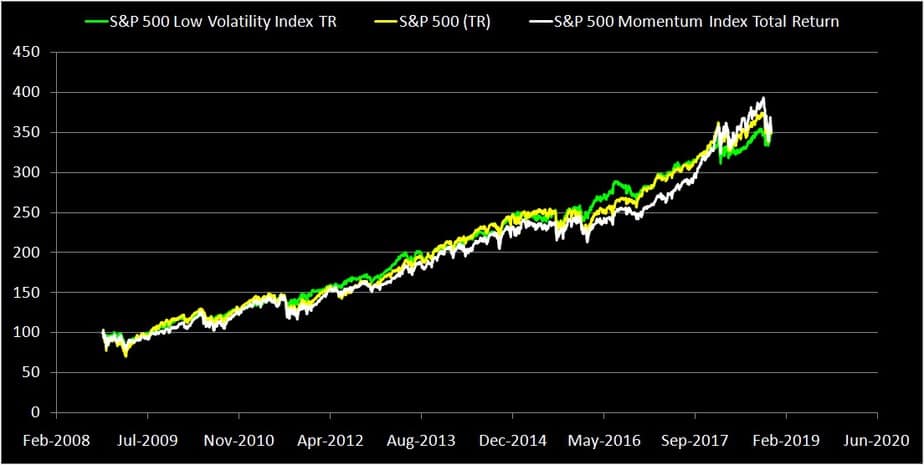
S&P 500 momentum index vs S&P 500
Three years
Five years
Seven years
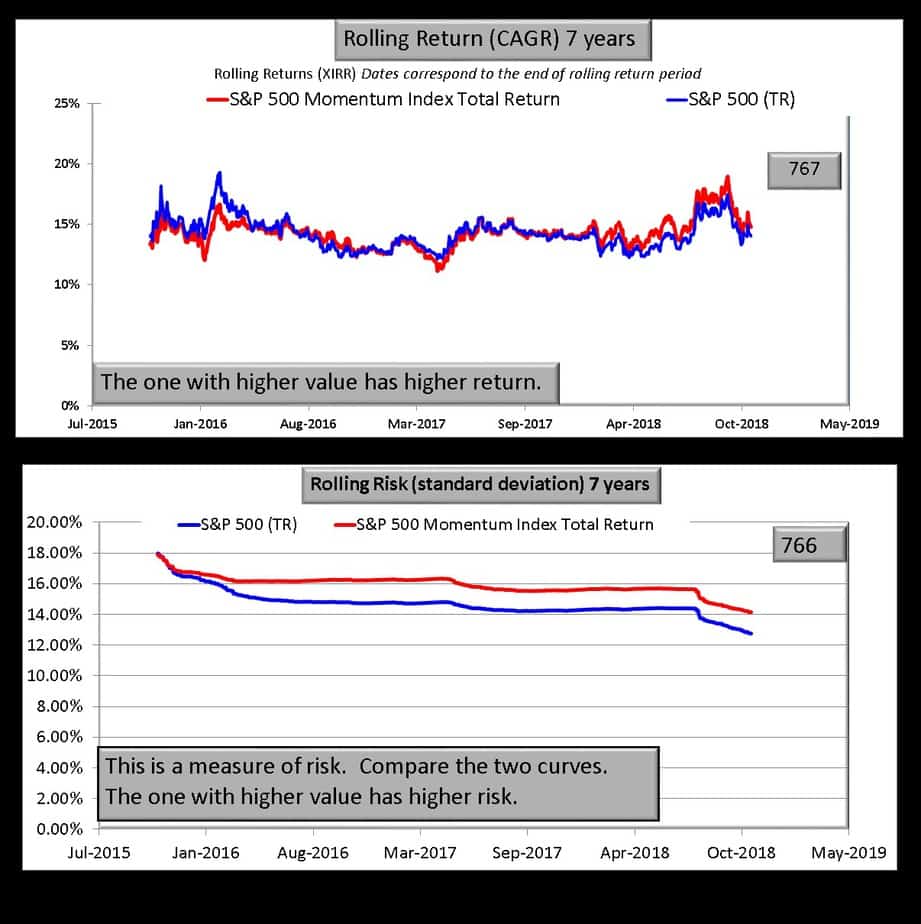
Observations:
There is no compelling reason to choose S&P 500 momentum as it not rewarding compared to S&P 500 and is a bit more volatile.
S&P 500 momentum index vs S& P 500 low volatility index
Three years
Five years

Seven years
Observations:
Again the S&P 500 momentum index (or to be specific the momentum investing method used by the S&P) does not seem to work in the USA. The low volatility index has much less volatility (although that too is not rewarding when compared to S& P 500. See Low volatility stock investing: Does it work? Higher returns at lower risk? )
S&P BSE Momentum Index and Low Volatility Index Constituents (Nov 2018)
S&P BSE Momentum Index | S&P BSE Low Volatility Index |
| Adani Ports and Special Economic Zone | Asian Paints Ltd |
| Asian Paints Ltd | Bajaj Auto Ltd |
| Axis Bank Ltd | Bosch Ltd |
| Bajaj Auto Ltd | Britannia Industries Ltd. |
| Bharti Airtel Ltd | Colgate-Palmolive India Ltd |
| Coal India Ltd | Dabur India Ltd |
| HDFC Bank Ltd | HDFC Bank Ltd |
| Hero MotoCorp Ltd | Hero MotoCorp Ltd |
| Hindustan Unilever Ltd | Hindustan Unilever Ltd |
| Housing Development Finance Corp | Housing Development Finance Corp |
| ICICI Bank Ltd | IndusInd Bank Ltd |
| IndusInd Bank Ltd | Infosys Ltd |
| Infosys Ltd | ITC Ltd |
| ITC Ltd | Kotak Mahindra Bank Ltd |
| Kotak Mahindra Bank Ltd | Larsen & Toubro Ltd |
| Larsen & Toubro Ltd | Mahindra & Mahindra Ltd |
| Mahindra & Mahindra Ltd | Marico Ltd |
| Maruti Suzuki India Ltd | Maruti Suzuki India Ltd |
| NTPC Ltd | MRF Ltd |
| Oil & Natural Gas Corp Ltd | Nestle India Ltd |
| Power Grid Corp of India Ltd | NTPC Ltd |
| Reliance Industries Ltd | Oracle Financial Services Software Ltd |
| State Bank of India | Pidilite Industries Ltd |
| Sun Pharmaceutical Industries Ltd | Power Grid Corp of India Ltd |
| Tata Consultancy Services Ltd | Rajesh Exports Ltd |
| Tata Motors Ltd | RBL Bank Ltd |
| Tata Motors Ltd DVR | Tata Consultancy Services Ltd |
| Tata Steel Ltd | UltraTech Cement Ltd |
| Vedanta Ltd | Wipro Ltd |
| Wipro Ltd | Zee Entertainment Enterprises Ltd |
| Yes Bank Ltd |
The overlapping stocks are shown in red. Currently, 17 stocks in the low volatility index are part of the momentum index. So that more than 50% overlap!
Summary
In conclusion, both smart-beta or alternate beta* strategies – momentum and low volatility – seem to work better for India (developing markets as we saw in the low volatility post linked just above?) and not for the USA (developed market?). In future posts, we will dig deeper into identifying momentum stocks with low volatility. * alternative beta refers to risks not covered in the original Capital Asset Pricing Model (CAPM)
Investors interested in momentum investing can the links and book mentioned above and track the stocks in the BSE momentum index or the BSE low volatility index and invest in a manner similar to the test Stock Portfolio Update November 2018 (Lazy Investing)