Last Updated on August 18, 2025 at 10:31 am
Tata Quant Fund aims to “consistently achieve better returns than the index” and “avoid negative absolute returns” with an ” internally developed machine learning-based model to make investment decisions”. In this review, we ask if artificial intelligence (AI) & machine learning (ML) necessary to beat the index/market?
What is Tata Quant Fund? It is an open-ended equity scheme that aims to generate medium to long-term capital appreciation by investing in equity and equity-related instruments selected based on a quantitative model (Quant Model).
What is a quant-based mutual fund? A fund that uses a quantitative model (math-based, rule-based with or without machine learning) to select its portfolio (stocks, bonds etc) instead of individual security selection.
🔥Secure your future with our Robo-advisory tool trusted by over 3,500 investors and advisors. From effortless retirement planning to funding your children’s biggest dreams, turn your financial goals into reality. 🔥
Subscribe for money management solutions via email! (Link takes you to our email sign-up form) Join 32,000+ readers in our community.
👉 New Tool Alert! NaviPlan: A Privacy-Focused Multi-asset Tracker and Goal Planner 👈
What is the model used by Tata Quant Fund? The fund will combine factor-based investing and machine learning. It will use multiple factors such as alpha, value, quality along with machine learning algorithms that will adapt these factors to changes in market conditions.
What is the benchmark of Tata Quant Fund? S&P BSE 200 TRI indicative of the stock selection universe.
What is factor-based investing? Also known as strategic investing or smart-beta investing, it is a technique to combine active-stock selection and passive investing. This is one type of rule-based investing. For example, alpha-based investing would choose stocks that have generated alpha over the past year from a given index like Nifty 100. Multi-factor investing combines multiple-factors like alpha, quality, value etc.
How are quant-based funds classified? For the purpose of this review, we shall classify them into two: rule-based quant funds and AI-based quant funds. Rule-based funds stick to a particular set of rules, while AI-based funds
Resources to learn more about factor-based investing
- NIFTY100 Alpha 30 Index Review: How good a “factor” is alpha?
- How new stock investors can quickly start investing using NIFTY Multi-Factor Indices
- Are Nifty Smart Beta (strategic) Indices better than the Nifty Next 50?
- How good are the top 10 stocks of NIFTY Quality Low-Volatility 30 Index?
- Watch my talk on momentum and low volatility stock investing in India
- Low volatility stock investing: Does it work? Higher returns at lower risk?
- Momentum Stock Investing in India: Does it work?
How will the Tata Quant Fund use artificial intelligence (AI) & machine learning? Starting from a rule-based model based on multiple factors like alpha, quality, value, the fund will use computational power to study ongoing and emerging economic and market conditions to modify the rules of the initial model for portfolio construction.
Will Tata Quant Fund have no human interference? It has a fund manager who can take active judgement calls on the portfolio.
Has Tata Quant Fund’s strategy worked in the past? The fund house has not presented any evidence in the scheme document or presentation or brochure that it can.
Can AI /ML beat the market? There may be other quant-based funds (either rule-based or AI/ML-based) that have provided such a backtest or have even actually performed well in the recent past).
We shall not explore this here and therefore shall not discuss this question any further. After all, there is a growing voice that claims, no matter what method is used one cannot beat the market. We shall not get into this argument here.
Why are mutual fund launching more and more thematic funds these days? Because SEBI regulations prevent them from launching new large cap, mid cap etc funds if they already have one! There is no restriction on the number of thematic funds per AMC. Hence this AUM generation exercise with fancy hocus-pocus.
Does the scheme document of Tata Quant Fund mention AI and ML? This is the only reference: The quant model-based factor strategy is expected to provide combined benefits of active and rule-based systematic investments by minimizing the influence of human emotions and biases in decisions, increasing discipline and leverage computation power of machines for operational efficiency
Is artificial intelligence (AI) & machine learning (ML) necessary to beat the index/market?
The purpose of an active mutual fund is to try and beat the market on a risk-adjusted basis. We shall not discuss whether this is possible or not here. Instead, let us ask is such fancy mumbo jumbo as AI and ML necessary to beat the market when we already have multi-factor indices operated by the NSE (see links above).
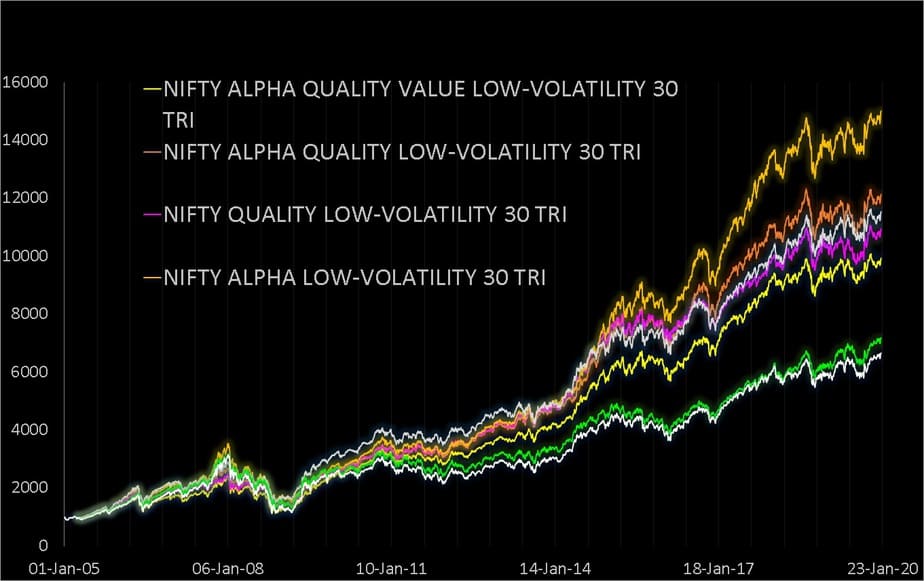
The since inception growth of four multi-factor indices is shown below along with NIfty 50 and NIfty 200.
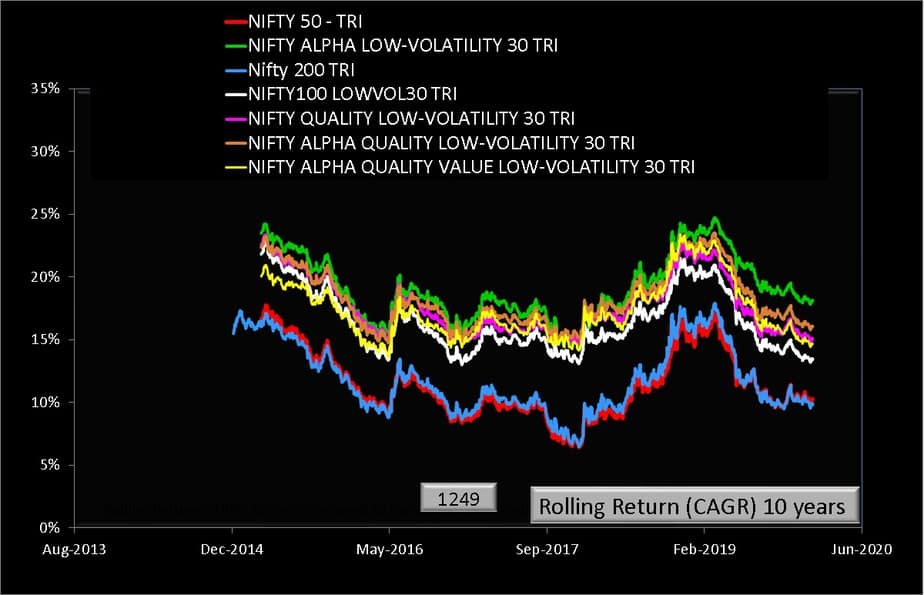
The ten-year rolling returns or every possible ten-year returns in the past are shown below.
The five-year rolling returns are shown below.
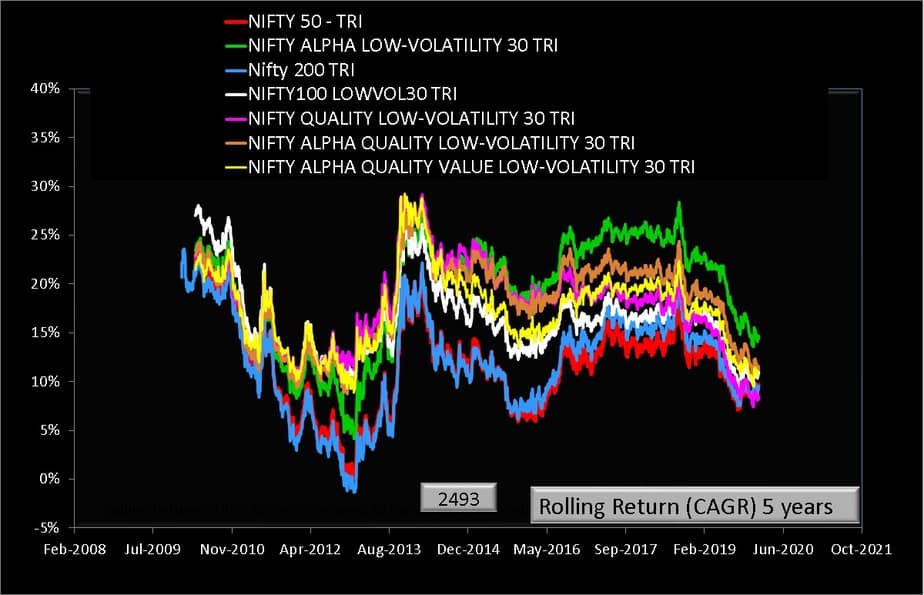
While one cannot say if factor-investing will work in future but for the limited history available in India, it has comfortably done so. Based on this evidence, one could have simply created a low-cost multi-factor index fund (there are a few single-factor ETFs available, but tread carefully with these) instead of this fancy, expensive actively managed fund. DSP that has it own quant fund is also guilty of this.
Tata Quant Fund: Should we invest?
No. It is much ado about nothing. A simple rule-based factor strategy has worked in the past. There is no need for AI or ML and the associated extra expenses. While analysts will follow it keenly, investors can happily avoid it.