Last Updated on December 29, 2021 at 4:59 pm
NSE has launched a new strategy index (aka factor-based index, aka smart beta index), the NIFTY100 Alpha 30 Index from June 28 2019. The NIFTY100 Alpha 30 index consists of 30 companies from Nifty 100 with the highest Jensen’s alpha using one-year trailing price. In this review, we study how good a “factor” (explained below) is alpha by comparing it with other indices like low volatility, momentum and liquidity. Let us start with the basics.
What is a strategy index or a factor-based index? Usual indices like Nifty, Sensex, Nifty Next 50 etc choose stocks and assign portfolio weights by their free-float market capitalization alone (free-float refers to the number of shares freely tradeable). In a factor-based index, we use an active stock-picking strategy like value investing, momentum investing etc. to select stocks and assign portfolio weights.
For example, in the Nifty 100, the stock with the highest free-float market cap would have the maximum exposure in the index and in descending order thereon. If you take an index like Nifty 100 Low Volatility 30 index, the stock with the lowest daily volatility in the last year has the highest weight.
Regular readers may be aware that I am a fan of low volatility investing and have written extensively about it. See for example: Watch my talk on momentum and low volatility stock investing in India and is the reason I create monthly stocks screeners based on low volatility and momentum. I also use low volatility to pick stocks as detailed in this video.
🔥Secure your future with our Robo-advisory tool trusted by over 3,500 investors and advisors. From effortless retirement planning to funding your children’s biggest dreams, turn your financial goals into reality. 🔥
Subscribe for money management solutions via email! (Link takes you to our email sign-up form) Join 32,000+ readers in our community.
👉 New Tool Alert! NaviPlan: A Privacy-Focused Multi-asset Tracker and Goal Planner 👈
What is alpha? This is the measure of the excess return of a stock compared to both risk-free return (say FD return) and the market (eg. Nifty 100 here) after accounting for how volatile the stock is relative to the market. Higher the alpha, better is return produced for the risk taken.
Whenever investors hear the word “alpha”, they get excited. They assume it means a higher return than the “market”. This is wrong. It is important to understand that Alpha of a fund/stock is NOT excess return above market! (This link also describes with a simple example how alpha is calculated)
NSE has two alpha based indices. NIFTY Alpha 50 take stocks with the highest alpha from the Nifty 300 and weights them as per their alpha (nothing else). The kid on the block, NIFTY100 Alpha 30 Index differs in two ways. (1) It restricts itself to the top 100 stocks in the NSE (so only the so-called “large caps”) and (2) the stocks weights are a combination of market cap and alpha. We shall see below if this makes a difference.
There are several factor-based indices. Some of them are:
- Momentum: Includes stocks that have shown the higher price increase in the last 12 months with low volatility (aka quality momentum, see my talk). Weighting is based on quality momentum score.
- low Volatility: Stocks with lowest daily price change in the last 365 days are part of this index.
- Alpha: Stocks with highest Alpha in the last year are part of the index.
- Value: Pick stocks based on High ROCE, High Dividend, Yield, Low P/E, Low P/B
- Quality Stock with High ROE, Low Debt, Equity ratio, Average Change in PAT
Check out past articles on strategy indices
Are Nifty Smart Beta (strategic) Indices better than the Nifty Next 50?
Picking Stocks With Low Volatility: A simple, but effective strategy?
Nifty High Beta 50: an unsmart beta strategy
NIFTY100 Alpha 30 Index: Top Ten Stocks (May 2019)
According to the latest factsheet, these are the top ten stocks of NIFTY100 Alpha 30 Index. The numbers represent the weight percentage.
- Bajaj Finance Ltd. 8.96
- Tata Consultancy Services Ltd. 8.51
- Reliance Industries Ltd. 7.58
- Divi’s Laboratories Ltd. 7.45
- Infosys Ltd. 7.15
- Axis Bank Ltd. 6.21
- Hindustan Unilever Ltd. 6.06
- Tech Mahindra Ltd. 5.01
- Havells India Ltd. 3.30
- Pidilite Industries Ltd. 3.06
Shown below is a snapshot from the factsheet. Notice how volatile the index is with huge drawdowns (fall from all-time highs). Like they say, if you want alpha, you got to put up with the beta (higher risk).
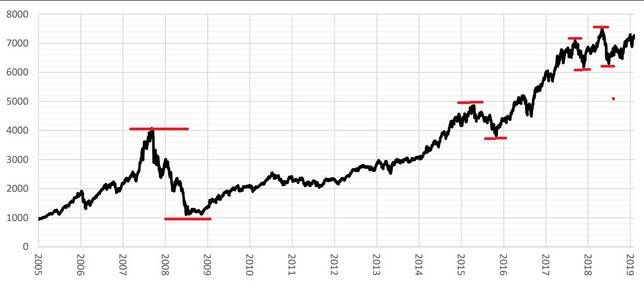
NIFTY100 Alpha 30 TRI vs Nifty 100 TRI vs NIFTY Alpha 50
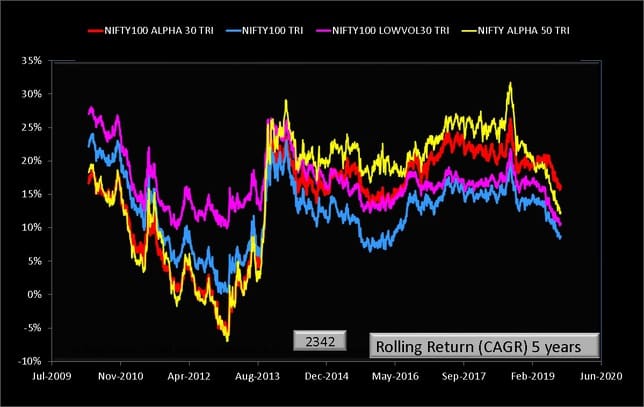
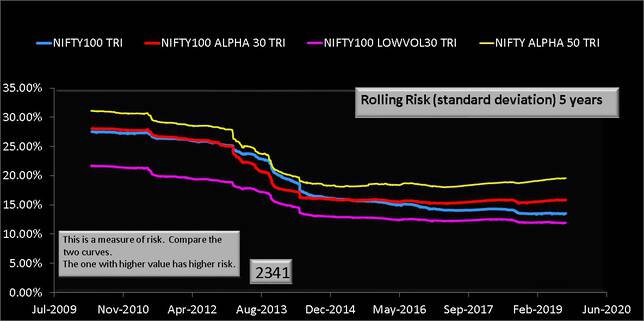
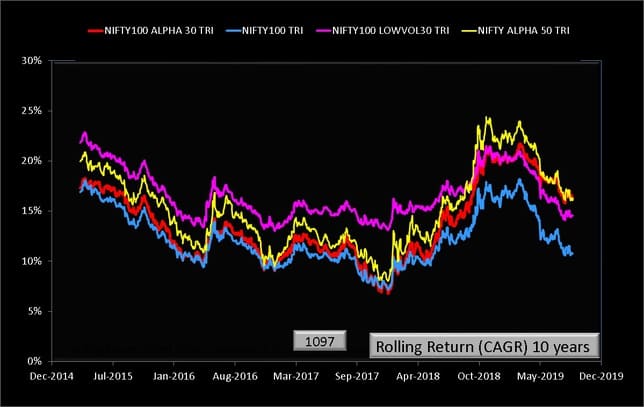
Let us study every possible five and ten-year returns of these indices and also look at risk over five years.
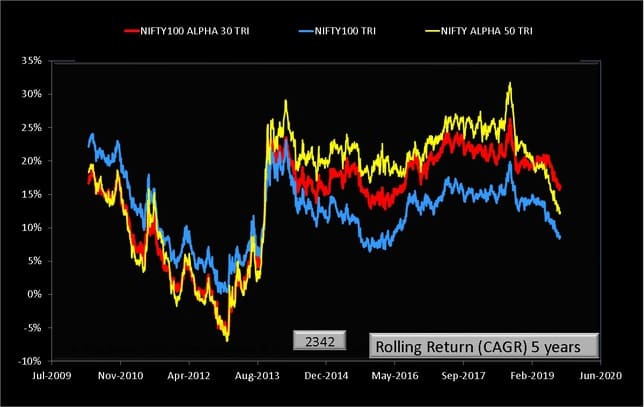
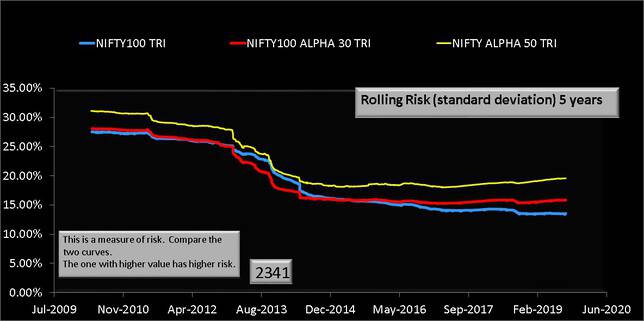
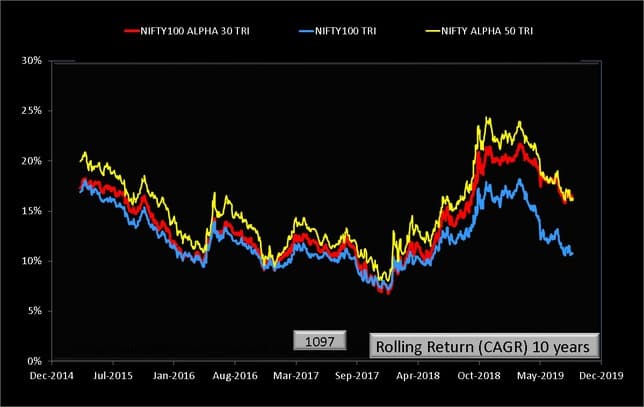
NIFTY100 Alpha 30 Index vs Nifty 100 Low Volatility 30
Now let us get to my favourite: the low volatility 30 index. Notice how the spread in returns is a lot less for the pink line and how much more consistent it is!
NIFTY100 Alpha 30 Index vs BSE Momentum
Finally, let us compare “alpha” with “momentum”. There is not enough momentum history though for ten years.
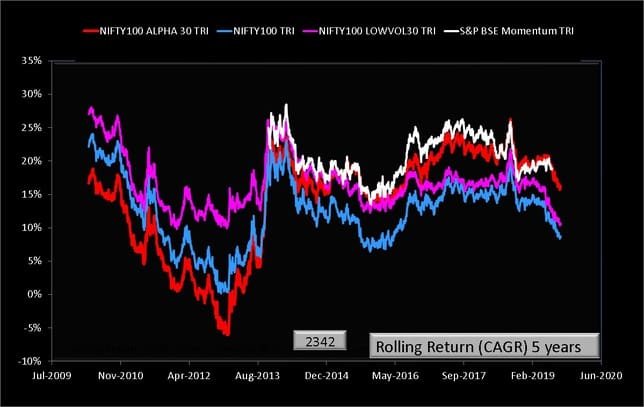
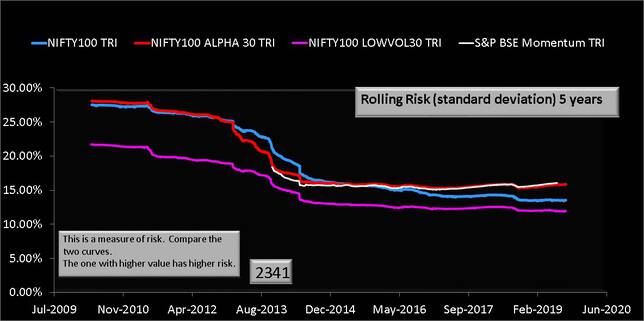
Momentum (for the period studied) is just as volatile with a bit more reward than “alpha”. However considering its return can fall down to the low volatility index, the latter still wins for the guaranteed lower risk it provides.
How good is “alpha” as an investment factor?
In summary, alpha has outperformed Nifty 100, but momentum is a bit better at the same risk level. Alpha is also better than “value” (shall show graphs in the video version). However low volatility is consistent in its outperformance with guaranteed lower risk than Nifty 100. So it is a no-brainer that it is the best factor-based investment strategy in Indian equity as on date. The new index from NSE, NIFTY100 Alpha 30 Index has a bit lower risk than Nifty Alpha 50 but not higher reward.