Last Updated on April 14, 2026 at 11:44 am
Axis Long Term Equity Fund was the darling of first-time mutual fund tax savers a couple of years ago. Has its performance slipped? Is this because of its large AUM? Can existing investors continue? Can new investors consider this for tax saving under section 80C? Let us find out by checking how consistent the fund has performed.
Axis Long Term Equity Fund is an open-ended equity-linked Savings Scheme (ELSS) where each unit you purchase cannot be sold on or before the completion of three years. This is a mandatory requirement for reporting such investments under section 80C. ELSS mutual funds are governed by the finance ministry and not SEBI! See: Five Interesting Facts about ELSS Mutual Funds
Launched in Dec 2009 as Axis Equity Tax Saver Fund, the fund was renamed as Axis Long Term Equity Fund in mid-2011 (a bold change as it is not immediately apparent that it is an ELSS fund). The fund has remained a large cap fund that can invest in select mid cap stock with a mix of growth and value investing strategy. Axis MF has aggressively marketed the fund especially via its banking channel making it the ELSS fund with the most AUM.
The fund could manage only 4.9 Cr a month after inception (Jan 2010). A year later, 66.8 Cr. In Jan 2012, 145.7 Cr, Jan 2013 – 446.5 Cr (start of the big push). Jan 2014 849.9 Cr (notice these big leaps!). Jan 2015 3,869.92 Crore (What?!). Jan 2016 6,885.54 Crore, Jan 2017 11143.89 Crore, Jan 2018 16516.68 Crore, Jan 2019 17089.75, Jul 2019 18952.6 Crores. Source: AMC Factsheets
🔥Secure your future with our Robo-advisory tool trusted by over 3,500 investors and advisors. From effortless retirement planning to funding your children’s biggest dreams, turn your financial goals into reality. 🔥
Subscribe for money management solutions via email! (Link takes you to our email sign-up form) Join 32,000+ readers in our community.
👉 New Tool Alert! NaviPlan: A Privacy-Focused Multi-asset Tracker and Goal Planner 👈
Fund manager Jinesh Gopani has been managing the fund since April 2011. Although the pace of AUM growth has significantly slowed down, 7548% increase in AUM over just five years is simply too much AUM too soon. I have mentioned many times before that it is not AUM that is a problem for fund management, but sudden spike in AUM. Let us find out if this has hurt existing Axis Long Term Equity Fund investors.
Before we begin, according to Axis Mutual Fund,
A 3-year lock-in ensures that the money stays invested in equities and does not get perturbed by market ups and downs. Add to it, the fund manager can take much-informed decision and look through the interim volatility.
This is complete nonsense, with no evidence to back it up and simply not possible in an opened-ended ELSS fund three years after inception. See: The Myth About ELSS Fund Lock-in
Axis Long Term Equity Fund vs benchmarks and peers
The fund is benchmarked against BSE 200, but I prefer to check against Nifty LargeMidcap 250 which is 50% Nifty 100 and 50% Nifty Midcap 150. I have also included ABSL Tax Relief and DSP Tax Saver Funds. Both these funds are currently part of My Handpicked Mutual Funds July 2019 (PlumbLine)
Let us look at the rolling returns over five years. The fund is still quite young, so longer durations do not make much sense. First notice the green, red and yellow lines. These are Nifty 200, Nifty 100, BSE 200 indices. Notice their returns are not different.
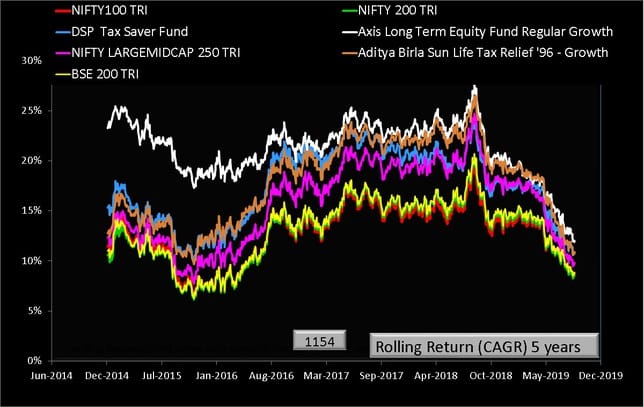
Amusingly the fund hit the 10,000 Crore AUM milestone around Aug 2016. Did the rate at which the AUM grew during the above period make it difficult for the fund manager to maintain outperformance? I am inclined to think so. In any case, investors who entered on the back of this performance would be disappointed.
The while line is above the pink line for all the 1154 five-year durations studied but the outperformance has dropped because the fund managers freedom was restricted due to a bulging AUM.
Now, look at the blue and brown lines. The quantum of outperformance (wrt the pink line) of both ABSL Tax Relief and DSP Tax Saver has been steady over the period considered. I would rather buy a fund (if I cannot exhaust 80C via EPF, VPF, PPF or NPS and needed tax-saving benefits from a mutual fund) that display steady outperformance.
A “low AUM” also helps during down-market periods. The fund would still be nimble enough to lower losses for investors. In all fairness, Axis Long Term Equity Fund is still a “good fund”. Using the Aug 2019 Equity Mutual Fund Performance Screener, we find that the Axis fund beat Nifty largemidcap 250 index 570/885 periods, while the ABSL fund managed 647/885 and the DSP fund 697/885. Still decent by any standard.
It appears to be a case of too much expectation from the Axis fund investors and too much pressure on the fund management. At least until the next “bull market” the AUM growth would not be significant allowing some breathing space for the fund manager and existing investors. They can continue investing as long as the fund is able to beat BSE 200 (and as long as they need 80C benefits).
Just hope that your income would increase a lot* before the next bull run and you would have no more need for this or any other ELS fund. * If salaried, your EPF or NPS would then take care of 80C.
For new investors, I would recommend less popular steady performers like ABSL Tax Relief and DSP Taxsaver or an ELSS fund from an AMC that has no ties to a mainstream bank!