Last Updated on January 4, 2021 at 6:58 am
Many years ago, I found, in an exchange of comments in a blog, a curious statement: ELSS funds have a lock-in period (of 3 years). Hence, the fund manager can operate without redemption pressure, resulting in better returns. No evidence was provided to prove or disprove this statement and I thought no further about it.
A few days ago* , a video was posted in FB group, Asan Ideas of Wealth.
(*) This was in Jan 2015. I have updated this post with current data.
It was a clip from a Tamil TV program on finance. A financial adviser before suggesting funds to a caller, made the same statement as above (at ~ 8 mins):
🔥Secure your future with our Robo-advisory tool trusted by over 3,500 investors and advisors. From effortless retirement planning to funding your children’s biggest dreams, turn your financial goals into reality. 🔥
Subscribe for money management solutions via email! (Link takes you to our email sign-up form) Join 32,000+ readers in our community.
👉 New Tool Alert! NaviPlan: A Privacy-Focused Multi-asset Tracker and Goal Planner 👈
‘In an ELSS fund, the fund manager can take ‘long-term’ calls without fear of redemption’. He went on to state (in English), because of the lock-in, “All the tax-saver funds have given the best of returns”.
Therefore, he goes on to advise that a ELSS fund should be part of a folio, even if 80C benefits are not required!
That is too strong a statement and too weird an advice for me to leave alone. Besides, I have found such statements made in other places on the web from time to time.
First some history of ELSS funds, courtesy of IFA Deepak Khemani:
Under the provisions of Section 80CCB, investment in units of a notified equity linked savings scheme was eligible for deduction from the total income up to an amount of Rs.10,000 in a previous year. This deduction was allowable for investments made during the period from 1st April 1990 to 31st March 1992.
The first of these schemes was launched in 1991 by UTI followed by other Pvt Sector MFs.
This was then merged into Section 88 which still had a sub-limit of 10000 for ELSS.
ELSS funds
Large cap, Large-mid cap andMid-small cap funds
Update Jan 2016
I have now compared ELSS (which are typically diversified with a large cap tilt with Equity multi-cap and equity-oriented balanced funds)
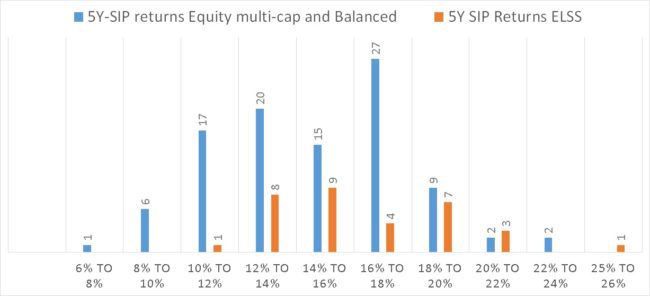
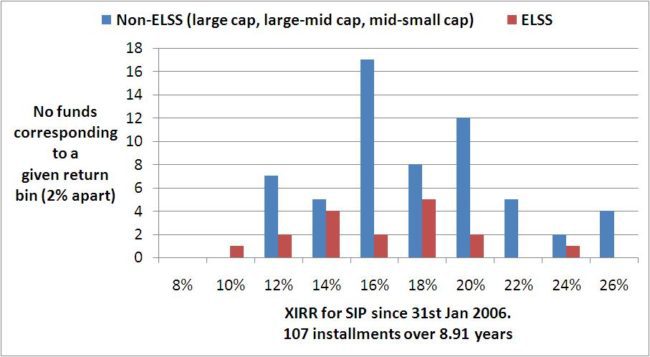
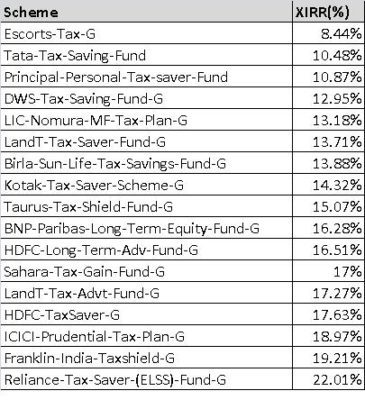
There is no evidence from the distribution (incl the new graph) and actual XIRR returns for the period considered that ELSS funds are better than other equity fund categories. The dispersion in returns in both ELSS and non-ELSS funds is equally large. There is also no evidence that spread in returns for ELSS funds is lower than other categories (even though the number of ELSS funds studied is much smaller!)
Thankfully, most of the funds at the lower end are index funds or belong to dud fund houses. Most of the active funds (ELSS or not) have done well. This again proves what I wrote earlier: Fund Selection is NOT important
Mutual Fund investing is hardly rocket science, however investors attitude towards long-term investing apparently is rocket science! Those who can recognise common sense when they see it, will realize that investor discipline to keep investing and stay invested is far, far, far more important than fund selection. So stop asking others for what funds they hold! Also, please do not use this data to extrapolate that mid-small cap funds always do better than other categories. The mid-small cap category is not old enough for such statements.
Back to the current issue:
The IFA in the above video claimed that inflow to ELSS funds are higher than outflows due to the lock-in and this allows the fund manager to take ‘long-term calls’. While this is likely to be true, it has no impact on performance or rather, it does not make ELSS funds superior.
For the first 3Y since inception, the ELSS fund is a closed-ended fund. There is no outflow. As time passes, investors can take out their money and outflows gradually increase. Either the outflows are not small enough, for ‘superior performance’ or they simply do not matter.
So the kind of generalizations made in the program and in other places are absurd and baseless.
Human beings thrive on extrapolation. They see a couple of instances (be it human behaviour, stock of fund movement or what not) and without any second thought extrapolate it as the norm. They then go on to advise this finding as the ‘best’ option to others!
Moral of the story: Invest in ELSS funds for the tax break that they offer (as long as they offer it!) but do not expect superior performance. Understand the investment strategy of the ELSS fund and ensure there is no other fund with a similar strategy in your folio. Not all ELSS funds are the ‘same’ in terms of where they invest.
A diversified folio is the ticket to superior risk-adjusted performance. Not lock-in.