Last Updated on December 29, 2021 at 6:06 pm
We have often pointed out that the fate of our mutual fund SIPs is decided by “timing luck” and not because of patience or discipline or rupee cost averaging. We have also presented the solution to this problem: Do not expect returns from mutual fund SIPs! Do this instead! However, this stance confuses new readers of our site. Here is a question recently received on email: “Thank you for the eye-opening articles that one cannot be sure of high returns from equity mutual funds over the long term. Then why should we invest in them when there is no guarantee of returns?”
First of all, we must appreciate that there are no guarantees of return in any investment. We can invest in a five year FD deposit in a safe bank. The return is well known, but inflation is not; taxation rules are not. After five years, we might be paying more tax than anticipated, or more of our money would lose value due to higher inflation. See, for example, Inflation has reduced Rs. one lakh to just Rs. 6000 in 40 years!
Only the risk is guaranteed! There are uncertainties in every decision we make in life, whether joining a college, getting married, or investing in equity or fixed income. If that is the case, how do we live? How do you get by?
We survive by appreciating the difference between risk and reasonable risk. If we do this long enough, we can move from surviving to thriving. Why are stock investments or equity mutual fund investments recommend? To beat inflation over the long term. To ensure our money (our purchasing power with it) does not lose value.
🔥Secure your future with our Robo-advisory tool trusted by over 3,500 investors and advisors. From effortless retirement planning to funding your children’s biggest dreams, turn your financial goals into reality. 🔥
Subscribe for money management solutions via email! (Link takes you to our email sign-up form) Join 32,000+ readers in our community.
👉 New Tool Alert! NaviPlan: A Privacy-Focused Multi-asset Tracker and Goal Planner 👈
We have established several times that returns from equity (lump sum or SIP) are cyclic. See: The stock market always moves up in the long term, but returns move up and down! What about their ability to beat inflation?
Let us first consider data for the USA. Using Prof. Robert Schiller’s PE datasheet, we can compute rolling SIP returns for the S&P 500 Total Returns Real Index. That is, the index adjusted for both dividends and consumer price inflation.
Shown below are 1279 15-year S&P 500 Real TR Rolling SIP Returns. They are computed with the Mutual Fund SIP and Lump Sum Rolling Returns Calculators.
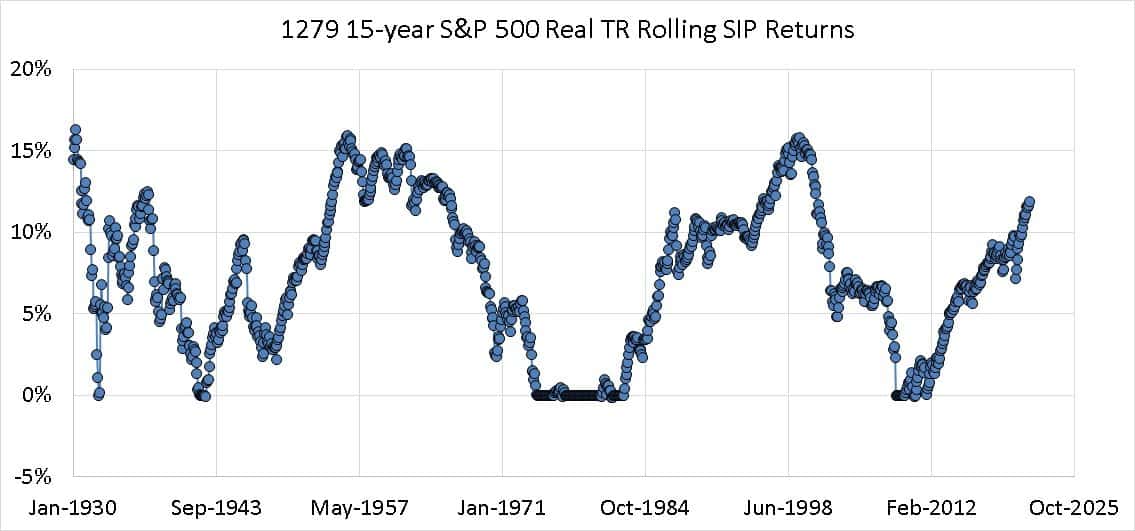
Only 16% of the real returns are 0% or less. That is, 84% of the real returns are positive. If we insist the real return should be more than 4% (assuming 2% would be lost to tax and real daily inflation is 2% higher than the consumer price inflation), 67% of the above returns qualify.
The chances of success (defined in inflation-beating return) are about 20% better than a coin toss. If we include some basic portfolio management steps like asset allocation and annual rebalancing, the risk can be reduced further. If we include systematic goal-based de-risking, the risk can be reduced even more – backtests done before and after retirement is part of the goal-based portfolio management course.
So even with such wildly oscillating returns, the risk is quite reasonable provided we have a system in place for managing the risk. I would take this chance any day, provided there is enough time to manage this risk.
The situation for India is quite tricky. The history is short and tumultuous. The Harshad Mehta scam defines the long term returns of the Sensex even today! See: Sensex return is 16% plus over last 41 years, but half of that came from just three good years! We have had high-interest, tax-free fixed income options for at least 25 years of those 41 years. The market depth has increased over the years resulting in lower stock market volatility. So our benchmark of a “good equity return” has been continuously changing (decreasing!) over the 25-30 years. See: Ten-year Nifty SIP returns have decreased by almost 50%
If we set the prevailing PPF rate as the benchmark for a 15Y SIP in the Sensex, then this is what we get. The data is up to March 2021. It would be better to consider 15-year PPF returns instead of just the prevailing rate. This study will be presented in the next few days.
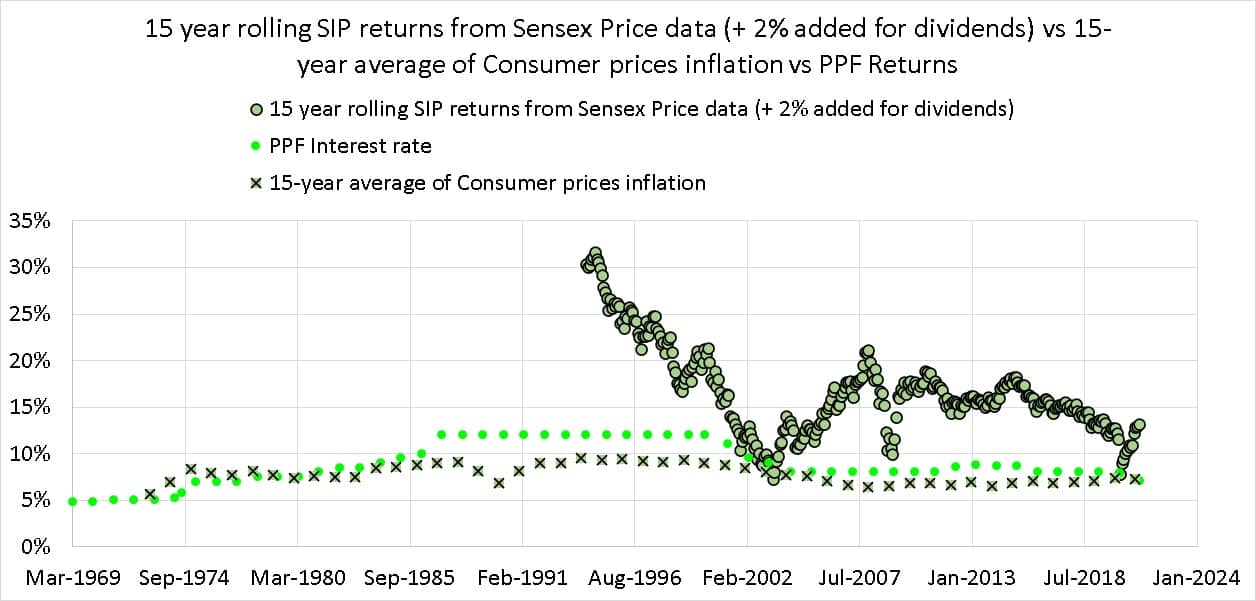
The 15-year Sensex return has almost always beat the prevailing PPF rate. However, the equity return has been falling and fluctuating. This is more than acceptable odds, but only when systematic risk management is in place.
In summary, the chance of equity beating inflation over the long term is quite reasonable. Therefore, the risk of investing in stocks or equity mutual funds is a reasonable, manageable risk when there is enough time to do so.
Risk management is crucial to reduce the impact of an unknown, variable equity return. If you like to learn how to do this systematically, this seminar may be useful: Basics of portfolio construction: A guide for beginners.