Last Updated on November 10, 2024 at 7:27 pm
Nearly three years ago, I was introduced to an interesting idea in goal-based investing by Chenthil Iyer, Horus financials.
You invest a monthly sum of X in a single portfolio for all financial goals. The portfolio is allowed to grow and when the time for each goal arrives, the necessary sum is withdrawn. The final value of the portfolio should be equal to the retirement corpus.
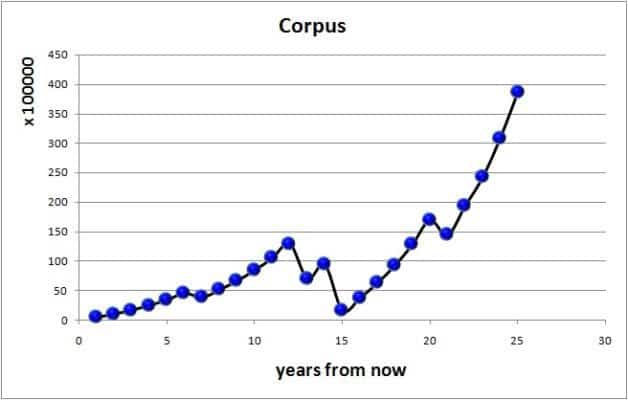
Ideally, the corpus will evolve with time like this
🔥Secure your future with our Robo-advisory tool trusted by over 3,500 investors and advisors. From effortless retirement planning to funding your children’s biggest dreams, turn your financial goals into reality. 🔥
Subscribe for money management solutions via email! (Link takes you to our email sign-up form) Join 32,000+ readers in our community.
👉 New Tool Alert! NaviPlan: A Privacy-Focused Multi-asset Tracker and Goal Planner 👈
The dips in value correspond to redemptions made for different financial goals (except retirement).
So the aim is to find the monthly investment X for a given inflation, return and duration for each goal.
I first published a calculator based on this idea in Aug. 31st 2012: Optimize Your Goal Investment Amount
This was followed up with two variants in the Four part series on Goal Based Investing
- Overwhelmed By How Much You Need To Invest For Your Financial Goals? Here Is A Way Out!
- How Achievable Are Your Financial Goals?
All the while I have never been comfortable about this strategy and do not practice it for my goals.
On paper the strategy looks quite impressive for more than one reason:
1) Simplicity. One portfolio. Less number of funds. Less time managing it.
2) The investment amount X in the unified portfolio approach will be significantly lower than the total investment amount if the goals had been treated independently (see why below) . So this makes people sit up, take notice, get motivated and adapt it.
However, it is important to consider the issues associated with such a portfolio.
Some people tend to treat long-term (10Y+) and short-term goals with this approach. This means that a 5 year goal and a 15-year goal will have the same asset allocation.
This is obviously incorrect. So I think the unified portfolio should only be used for long-term goals.
Which brings us to the question:
Are all long-term financial goals the same?
Can you use the same asset allocation for a 10-year goal and 25-year goal? Do they both have the same risk profile? That is in terms of what they mean to you.
I would like to answer this in two ways: (1) with some math and (2) how I personally view it .
Let us start with slides that I use for the investor workshops.
This is the average Sensex CAGr of every 5, 7, 10, 15-year durations between 1979 to 2013. The corresponding standard deviation is also plotted.
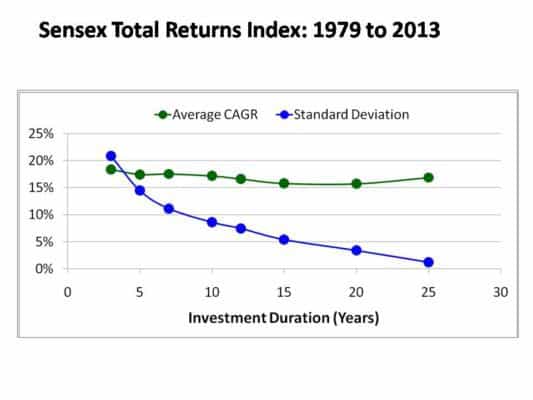
The standard deviation is a measure of how much actual returns will deviation from the average. That is, it is the error in the average.
For 5 years, the return is ~ 17% +/- 14%(std dev.) A huge spread in returns.
From 14% for 5 years, the spread drops to about 9% for 10Y, 5% for 15Y and 4% for 20Y.
The same information can also be presented in this way:
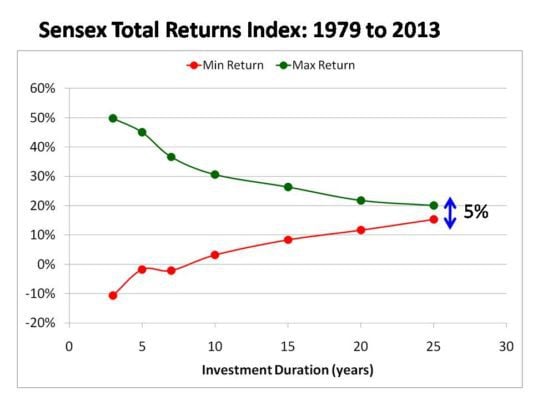
Do not make the conclusion that the difference between the maximum and minimum returns will drop to zero with time. It will not. Remember our markets are still too young.
The swing in returns possible for a 10Y goal is considerably different from that a 15Y goal and a 20Y goal.
So it makes no sense (at least to me) to group them together and use the unified portfolio.
So my answer is: not all long-term goals are the same
This is why I prefer to manage them individually under separate portfolios. I may start off with a 60% equity allocation but with time, this will change (decrease) for goals like my son’s education and not retirement. In fact, I now use 100% equity for his marriage (not a top priority to me and I am not investing enough for it. Can’t rather.).
Individual portfolios allow me to track the goals better, take a different and hopefully appropriate amount of risk.
As noted above, the investment required for a unified portfolio is much smaller than for individual portfolios. The reason for that is the unified portfolio takes into account future cash flows.
For example, if my retirement is 25 years away and my son’s college education is 15 years away, I can invest more for retirement after 15 years.
The unified portfolio factors that in now itself. Is this not a smart thing to do?
Not really. We are assuming the future will turn out like it does on an Excel sheet.
I have enough experience to not take that kind of a risk. It is folly to assume future cash inflows can be used the way we want. Life may have other plans for us.
If you do not have enough to invest to for each goal separately, it is okay to use the unified portfolio approach. However, be sure to invest more in future (if and) when you are able to do so.
Also de-risking the corpus (that is reducing equity exposure) a few years before the goal is crucial. This is easier to do with individual folios. You can also start with a single portfolio and branch out before each goal. So many ways to play it.
Is it not hard to manage individual folios? Not if you are a patient investor who takes informed decisions. There are so many folio trackers today that it is not hard at all.
Will not be too many mutual funds? One or two equity funds per goal is not that big a deal.
I write this post as a note of caution.
I recently listened to Dr. Uma Shashikant discuss this method with a group of advisors. Inspired by this, I reworked the above sheets and used it for the Chennai and Hyderabad investor meets.
This is a note of caution for all participants that there are disadvantages associated with this method.
While I do not recommend it, it can serve as a motivation to start investing for goals.
The unified portfolio is now part of the freefincal robo advisor tool.