Last Updated on June 25, 2025 at 10:12 am
A reader says, “I am attempting to start an experiment within my family. The plan is to create an inheritance pot each generation tries to hand over to the next generation. If they can add to the kitty, then great, but that is not an expectation. It is good enough if they can sustain and allow it to compound independently. In an extreme need scenario, it is theirs to liquidate and consume. I need your feedback on this plan”.
My situation: I am 46 and hopefully will take an early retirement this year. I have 2 kids aged 11 and 4 years. Based on my calculations, I can achieve financial freedom (including some buffer) and hopefully spare a small corpus for this inheritance experiment. I wish to keep a one-time corpus of Rs. 25 L for each kid.
I have already taken advice from a Fee-Only Advisor for my retirement planning. For this current experiment, I need someone with a lot more experience to look at it, hence reaching out to only you and Ashal Bhai.
Since there is no end goal/ date, I am not planning to apply goal-based management learnings of systematically increasing the debt ratio. I will teach my children to systematically increase the debt ratio in case they need the money and have time on hand.
🔥Secure your future with our Robo-advisory tool trusted by over 3,500 investors and advisors. From effortless retirement planning to funding your children’s biggest dreams, turn your financial goals into reality. 🔥
Subscribe for money management solutions via email! (Link takes you to our email sign-up form) Join 32,000+ readers in our community.
👉 New Tool Alert! NaviPlan: A Privacy-Focused Multi-asset Tracker and Goal Planner 👈
I need input on whether to rebalance over this long period, given that currently, there is no end goal date in sight. Or should one start rebalancing only a few years before one needs to withdraw?
Q1. Since the time horizon is very long, do I need to rebalance regularly? I understand not rebalancing means taking on a much higher risk. Sharing below 2 workings of difference if one does not rebalance:
Without annual asset allocation and rebalancing:
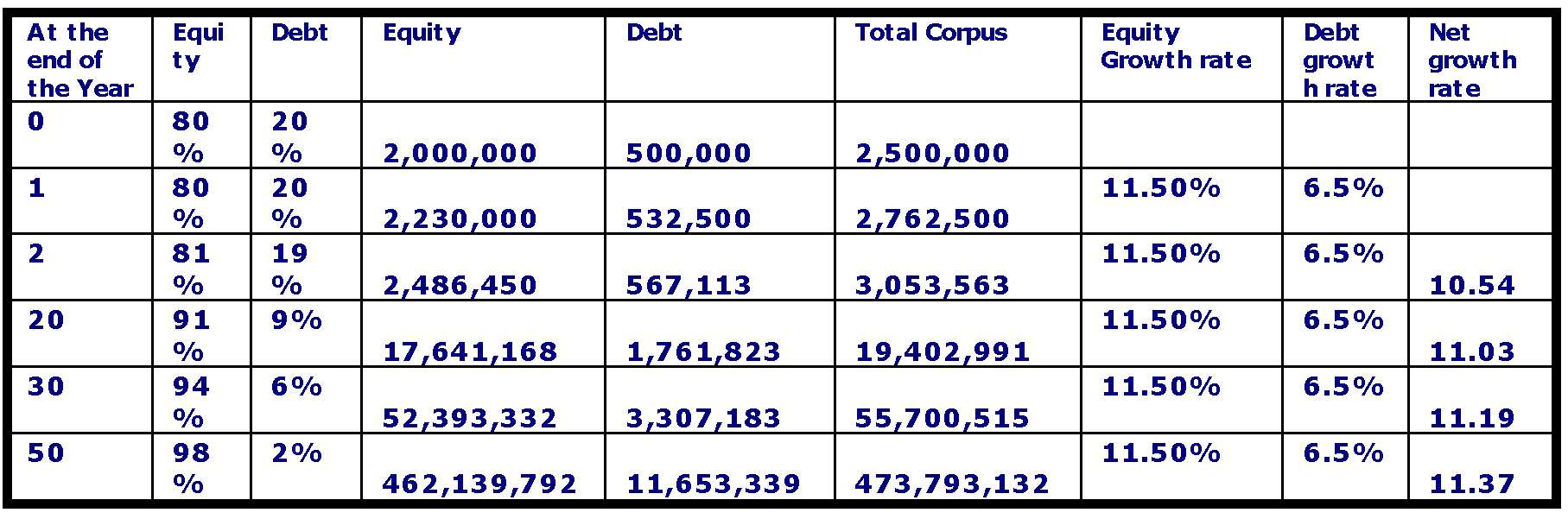
Illustration without annual asset allocation and rebalancingWith annual rebalancing to maintain an Eq: debt ratio of 80:20
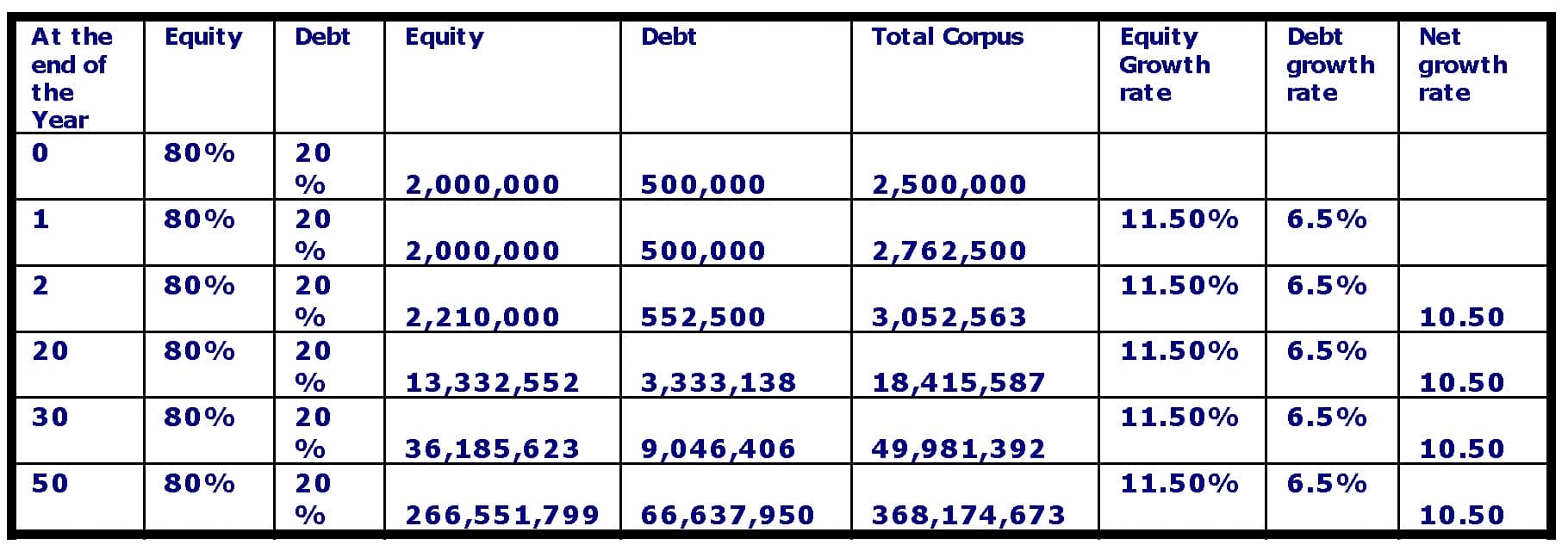
Difference between Table 1 and 2:
- Over 30 years, approach 1 is 11% higher than approach 2
- Over 50 years, approach 1 is 29% higher than approach 2
Response: These are illustrations with nice fixed equity returns and debt returns. The reality is far removed from this. Even with real past returns, backtests on Indian data should not be taken seriously as they are too short.
Most of us “believe” that Indian equity will give good returns. If you press for a guarantee, most people will not commit, but deep down, they assume it is a guarantee.
What is the purpose of rebalancing? To reduce the volatility in my corpus as I approach a well-defined target. To reduce the volatility in portfolio returns and keep it close to what I expect. Before someone starts an investment journey, there is no way to know whether rebalancing will result in a higher corpus. Still, it is guaranteed to result in a lower return volatility. See: What are the benefits of portfolio rebalancing?
Therefore, most people who invest with a specific goal must rebalance their portfolios! See: Forget tax and exit loads. This is why your portfolio should be rebalanced each year.
That said, your circumstances are different. You do not have a specific goal because it does not have a well-defined target corpus. It is open-ended. You don’t expect to redeem from it. You wish your children to redeem only in dire emergencies. And you are comfortable with an 80% equity exposure (although we strongly suggest you abandon any return expectations!). See: Do not expect returns from mutual fund SIPs! Do this instead!
So you can afford not to rebalance. But be warned that a sustained bear market can put a big dent in your plans. The only difference here is there is no specific goal, so you can afford to “wait” for the market to “eventually” get out of water.
Q2. Any comments on the following assets that I plan to invest in:
| Each Child | |
| UTI Nifty 50 Index | 10 L |
| UTI Nifty Next 50 Index | 4 L |
| Parag Parikh Multi Asset Fund | 6 L |
| ICICI Gilt Fund | 3 L |
| Nivesh Lakshya Fund | 2 L |
| Total | 25 L |
I realize that today, for this small corpus, 5 funds appear an overkill. However, looking at a horizon of 30 – 50 years, I thought I should spread out slightly. Your comments will help. Probably for you, today’s Nifty Next 50 may appear as unnecessary diversification.
Response: I don’t see anything overtly wrong here. The only catch is that the Nifty Next 50 nifty can be frustrating to hold. Maybe that will happen to Nifty 50 as well. Active fund performances can be cyclic at best and heading southward at worst. So regular reviews are necessary.
A minimal maintenance portfolio with only index funds (debt and fixed income) would suit your needs. Your kids can continue to hold these funds without worrying about performance.