In this article, Ganesh, a central government employee, decodes the unified pension scheme and discusses when it makes sense to opt for it.
Per the UPS Gazette notification, an individual corpus will be built for each employee, consisting of 20% of Basic + DA (10% by employee and 10% by government/employer). A separate contribution of 8.5% of Basic + DA will be made by the employer/government to a pooled corpus.
PFRDA will define a benchmark corpus value based on the default allocation of the individual corpus. Upon superannuation, the benchmark value from the individual corpus will be transferred to the pooled corpus. If additional corpus remains in the individual account, that will be returned to the employee. If the corpus is lower than the benchmark corpus, the employee can contribute the remaining amount or accept a lower pension.
After superannuation, PFRDA will pay 50% of the Basic+DA (average value of last 12 months of pay) per month from the pooled corpus until the death of the employee. The payout from the pooled corpus will also be inflation-indexed, which is incorporated due to the changes in DA (Dearness Relief for pensioners). Upon death of the employee, PFRDA will pay 30% of Basic+DA to the legally wedded spouse. PFRDA will also provide a lump sum gratuity at the time of superannuation.
UPS vs OPS
The terms of pension in UPS are similar to OPS (except the lumpsum at the beginning, and the reduced pension to family). However, employees in UPS are actually taking a 10% pay cut w.r.t employess under OPS. This is due to the fact that the 10% contribution made by the employee is transferred to the Pooled corpus upon superannuation.
🔥Secure your future with our Robo-advisory tool trusted by over 3,500 investors and advisors. From effortless retirement planning to funding your children’s biggest dreams, turn your financial goals into reality. 🔥
Subscribe for money management solutions via email! (Link takes you to our email sign-up form) Join 32,000+ readers in our community.
👉 New Tool Alert! NaviPlan: A Privacy-Focused Multi-asset Tracker and Goal Planner 👈
For example, if an employee were unmarried/divorced/widow/widower at the time of retirement, and they die before they recoup the entire individual corpus through pension, the remaining balance in the pooled corpus will be used to pay the other pensioners.
UPS vs NPS
In the NPS, the current contribution to the individual corpus is 24% of Basic+DA for Central government employees (10% from employee + 14% from government). With respect to employees under OPS, the government pays an additional 14% as salary, under the condition that this money will be available to you only after reaching the age of 60 (with an appropriate level of compounding). Upon superannuation, the employee can withdraw 60% of the Individual corpus tax-free and will have to invest the remaining 40% in an annuity plan. There is no guaranteed pension after superannuation as in UPS (or OPS).
One of the questions about the NPS is: will the final corpus be enough for sustenance after retirement? While this is a valid question, the UPS does not answer this question either! The UPS only gives a fixed amount every month; if one’s expenses are higher than 50% of Basic+DA at retirement, they will have to pull in money from their other investments (for which retirement planning is an essential prerequisite). Therefore, choosing to move to UPS or staying in NPS is NOT a retirement question! the The relevant question is: Is the proposed 10%(+14%) pay cut worth the returns after superannuation?
One way to answer this question is to ask how long a corpus “X” can provide inflation-indexed payments of 50% Basic+DA per month? Let’s consider the example given in the Gazette notification: an individual having a Basic Pay of Rs. 45,000/- and an Individual Corpus of Rs. 50,00,000/- retires on March 31, 2025, and opts for the Unified Pension Scheme (UPS). The current DA allowance is 53%. To determine how long the corpus of Rs. 50 Lakhs will provide inflation-indexed payments, we will use the following “algorithm”:
1. Upon superannuation, the annual payment for the first year of retirement is withdrawn from the Individual corpus.
2. The remaining corpus is invested in a risk-free/safe account that grows untouched until the next year. We will assume this to be 8% – approximately what is available for Senior citizens now through fixed deposits and post office saving schemes.
3. Inflation-indexing is incorporated in the subsequent annual payout (at the average rate of 5% – see Is the Unified Pension Scheme sustainable?), and Steps 1 and 2 are repeated until the corpus becomes negative.
The table below shows the details of this calculation:
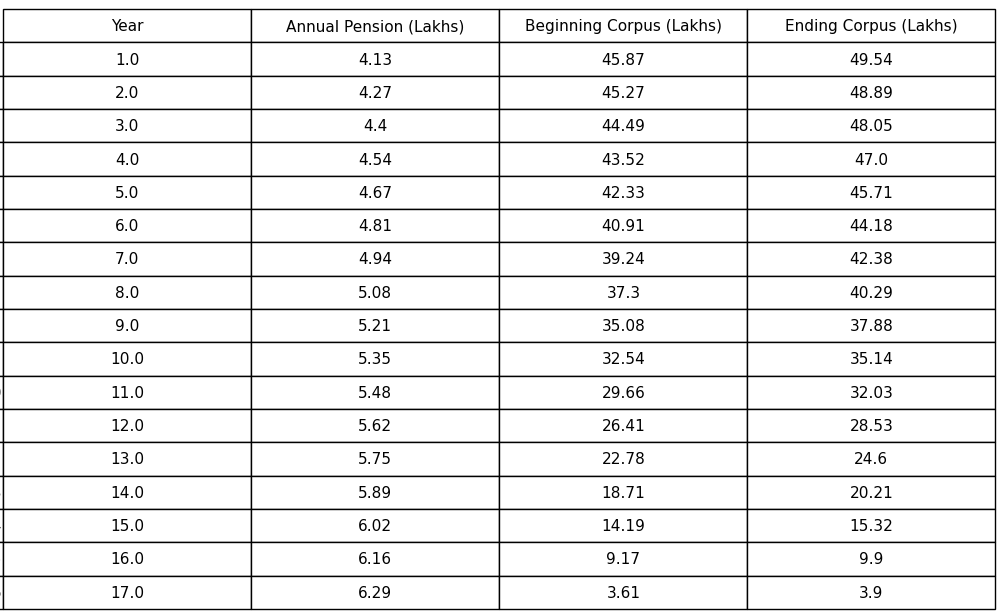
As we can see, the corpus of Rs. 50 Lakhs will give this individual an inflation-indexed pension for 17 years. If we assume that the current age of the individual is 60, then the corpus will run out by the time they reach age 78. Therefore, in all likelihood, the built-up corpus will probably not last for the lifetime of the individual and/or spouse. As a result, the individual will benefit by enrolling in the UPS.
Using the above calculation as an estimate, how much corpus do we need to accumulate if we want it to last for at least 40 years after retirement? To determine this value for any individual (different salary and corpus), we will normalize the Individual corpus as a multiple of the last drawn Basic+DA pay. For example, in the above case
M = 5000000/(45000*1.53) = 72.6
The value M determines how long the corpus will give 50% of the last Basic+DA pay without any inflation-indexation to an individual. In the above scenario, the corpus will give Rs. (45000*1.53*0.5) for 145 months, or 12 years and 1 month from the date of superannuation. The figure below shows the number of years the corpus will last for M, varying from 60 to 300.
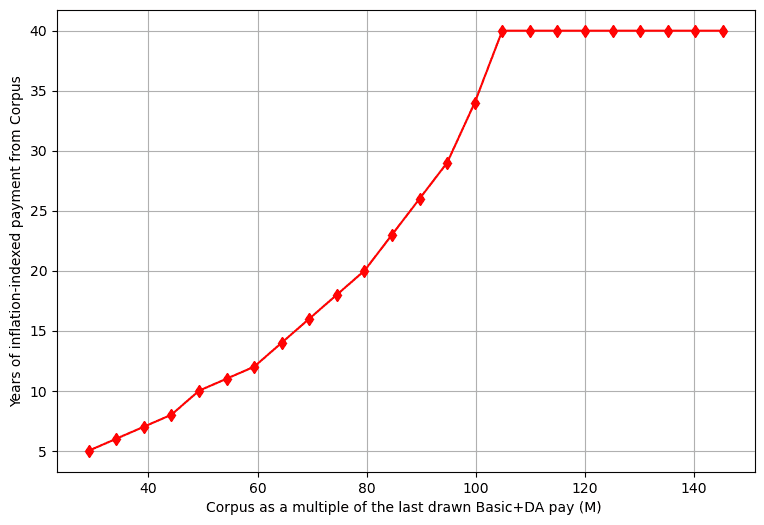
As we can see from this figure, if the individual corpus is 105 times the last drawn paycheck (Basic + DA), then the corpus will last for 40 years. Note that the calculation is stopped when the corpus lasts for 40 years, as we think this is a good enough estimate. If one accumulates a corpus beyond this value, then the NPS will match, or most likely, be better than the UPS.
In doing this calculation, we have assumed that the net difference between the growth of the corpus and the inflation adjustment is 3%. If the difference between these two values is 1%, the number of years the individual corpus will last is shown in the figure below.
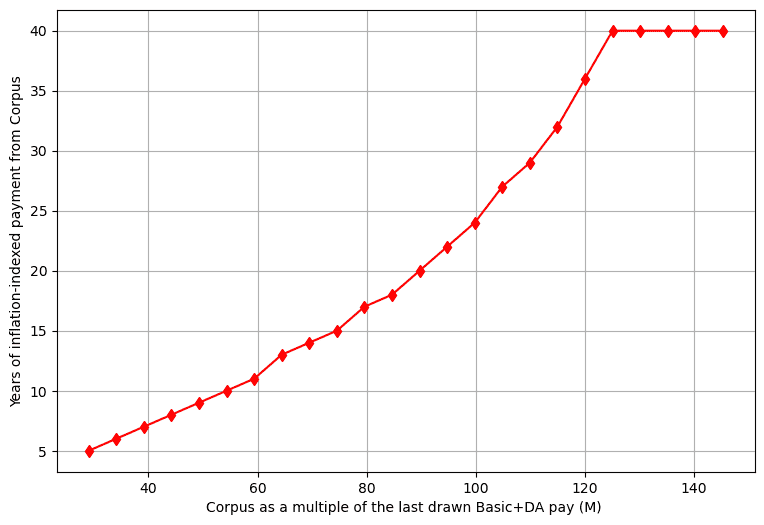
The corpus required now needs to be roughly 20% larger than the earlier estimated corpus (the multiplier becomes 125 instead of 105). While the exact value of the required corpus is difficult to determine, we have performed this calculation with very conservative estimates based on available data. Therefore, we can conclude that if one accumulates a corpus which is at least 100 times the last drawn salary (Basic+DA), then the NPS will more or less be equally viable as an option when compared to UPS.
We now have an estimate of the required corpus. Is it possible to build such a corpus during one’s employment? This question has already been answered in an earlier post
Revised UPS vs NPS Calculator after Jan 2025 Gazette Notification
The calculation remains more or less the same. We will provide an estimate of the corpus assuming the following parameters
1. Yearly Base Salary Increment : 3%
2. Annual Dearness Inflation: 5%
3. XIRR of NPS corpus: 8%
4. Years of Employment: 25 years
The corpus will be 98 times the last drawn pay for the above-chosen parameters for any starting base salary. Assuming an employee works for 30 years (instead of 25), the corpus will be 130 times the last drawn pay. As mentioned earlier, we have chosen a conservative estimate for the salary increment and the corpus’s growth rate. Therefore, we can conclude that the corpus built-in NPS should be able to provide the same benefits as the UPS. If one carries out proper financial planning and builds a good income stream after retirement, staying in NPS might be more prudent in controlling the individual corpus.
Some remarks regarding the above analysis:
1. The UPS is also market-linked, so we have assumed that there is no difference in the NPS and UPS corpus (except for the additional 4% contribution for Central government employees). If the market-returns are very poor, then the government will have to increase their contributions to UPS (currently defined as 18.5%). If this contribution has to increase every year, then the UPS becomes an OPS-lite scheme, and the OPS scheme has already been shown to be financially unviable. If one retires under such scenarios, they will also have to worry about the then-government not honouring their pension payments. See: UPS vs NPS: Which should I choose for retirement?
2. In the OPS, the pension payments are also revised when a new pay commission is implemented. The gazette notification does not clarify whether this is applicable for UPS. The calculations will have to be modified if this is indeed the case. Further, the nuance of 40% of the NPS corpus being linked to an annuity plan hasn’t been used in the comparison.
3. The NPS was introduced in 2004, and it has been only 15 years since the schemes were set up. See: After 13 years of investing in the NPS, my return is 8.78%. Therefore, there is not enough data to predict the performance of NPS as of today. As a corollary, one can also say that the introduction of the UPS is probably not a referendum on the NPS (in fact, anybody who joined in NPS and retires before 2029 will not have the minimum 25 years reuired for full payout in UPS). In other words, we don’t think that UPS has been introduced because NPS is a bad scheme for retirement.