Last Updated on October 2, 2023 at 10:38 am
In this article, we look at how LIC’s immediate annuity plan Jeevan Akshay’s annuity rates have over the last 20 years. This study was triggered while preparing a retirement planning illustration based on laddered annuities.
Annuity rates tend to follow interest rates and inflation movements over the long term*. The first version of Jeevan Akshay (Product UIN 512N089V01) was launched in Feb 1988 and was available until June 2000. Annuity rates for this product could not be found online but one can imagine that they would have been extraordinarily high. According to this report, those in the mid-50s would have got 10%-plus.
* The repo rate is an overnight rate while annuity rates represent long term rates. Generally, a lower policy rate slowly permeates to the longer duration end of the rate spectrum. However, a one-to-one correspondence between the REPO rate movement and annuity rate movement will not be seen.
The REPO rate was 13.5% (!) in Sep 2000 and dropped dramatically down to 9% a year later and 8% another year later!. LIC removed the above plan and launched another variant with only 8% rates for 50-somethings (see data below). Also see: RBI Repo Rate History
🔥Secure your future with our Robo-advisory tool trusted by over 3,500 investors and advisors. From effortless retirement planning to funding your children’s biggest dreams, turn your financial goals into reality. 🔥
Subscribe for money management solutions via email! (Link takes you to our email sign-up form) Join 32,000+ readers in our community.
👉 New Tool Alert! NaviPlan: A Privacy-Focused Multi-asset Tracker and Goal Planner 👈
If anything the single important takeaway from this data is, that as the rate of borrowing goes down with our economy gradually becoming stronger, annuity rates would fall down. Therefore it is crucial while planning for something like this – How to beat inflation after retirement along with guaranteed pension – to keep annuity expectations low and revise them yearly before retirement.
The following policies were considered. This is not an exhaustive list and there are some gaps in between.
- Jeevan Akshay I, Product UIN 512N204V01, Launched 14-Dec-01, Withdrawn 16-Oct-03.
- Jeevan Akshay II, Product UIN 512N221V01, Launched 1 Oct 2003, Withdrawn 20 Dec 2004.
- Jeevan Akshay III, Product UIN 512N227V01, Launched 13 Dec 2004, Withdrawn 17 Mar 2006
- Jeevan Akshay IV, Product UIN 512N234V01, Launched 7 March 2006, Withdrawn 20 Sep 2006
- Jeevan Akshay V, Product UIN 512N234V02, Launched 10 Aug 2006, Withdrawn 10 Sep 2007
- Jeevan Akshay VI (old), Product UIN 512N234V03, Launched 7 Aug 2007, Withdrawn 15 May 2012
- Jeevan Akshay VI (new), Product UIN 512N234V04, Launched 15 May 2012, Withdrawn FY 2016-17
- Jeevan Akshay VI (newer!) Product UIN 512N234V06, Launched Dec 2017, Withdrawn Aug 2019
- Jeevan Akshay VII (old), Product 512N337V01, Launched 25th Aug 2020, Withdrawn 1st Feb 2022
- Jeevan Akshay VII (new), Product 512N337V02, Launched1st Feb 2020.
Finding the annuity rates for the 8th policy was hard so we decided to find out for ourselves using LIC’s online calculator: What are the annuity rates of LIC Jeevan Akshay VII from Feb 2022?
Historical LIC Jeevan Akshay annuity rates
Roman numerals represent the version number of Jeevan Akshay. Select data is also presented in the tables below. We shall consider the annual payout option for “annuity for life” only.
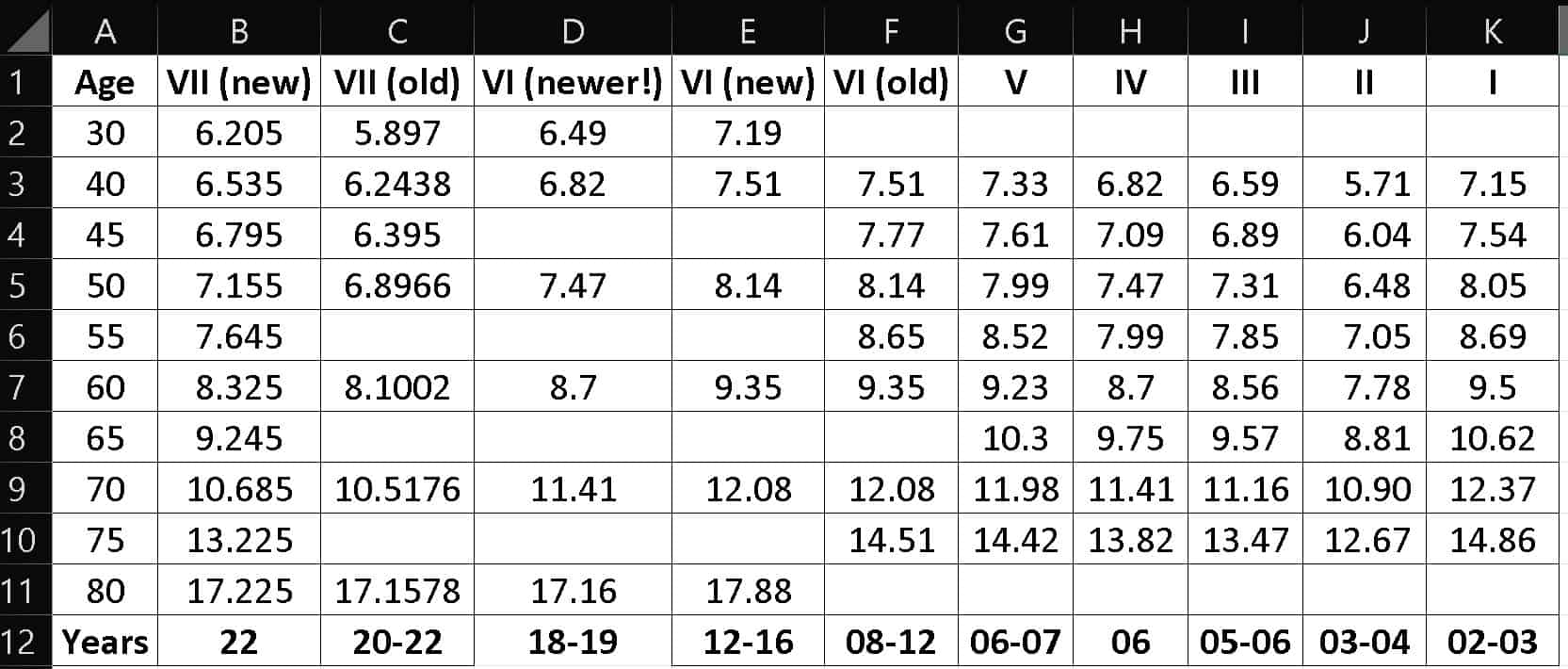
Notice the big drop in rates from Jeevak Akshay I to II. They correspond to a fall in REPO rate from about 8.5% to 7% The small increase from Jeevan Akshay III, IV and V also represent an increase in interest rates. The decrease in annuity rates from VI (newer!) to VII (old) also corresponds to a fall in the REPO rate. The annuity has marginally increased from 2020 to 2022 possibly due to an increase in inflation. Now RBI has followed suit with a higher repo rate!
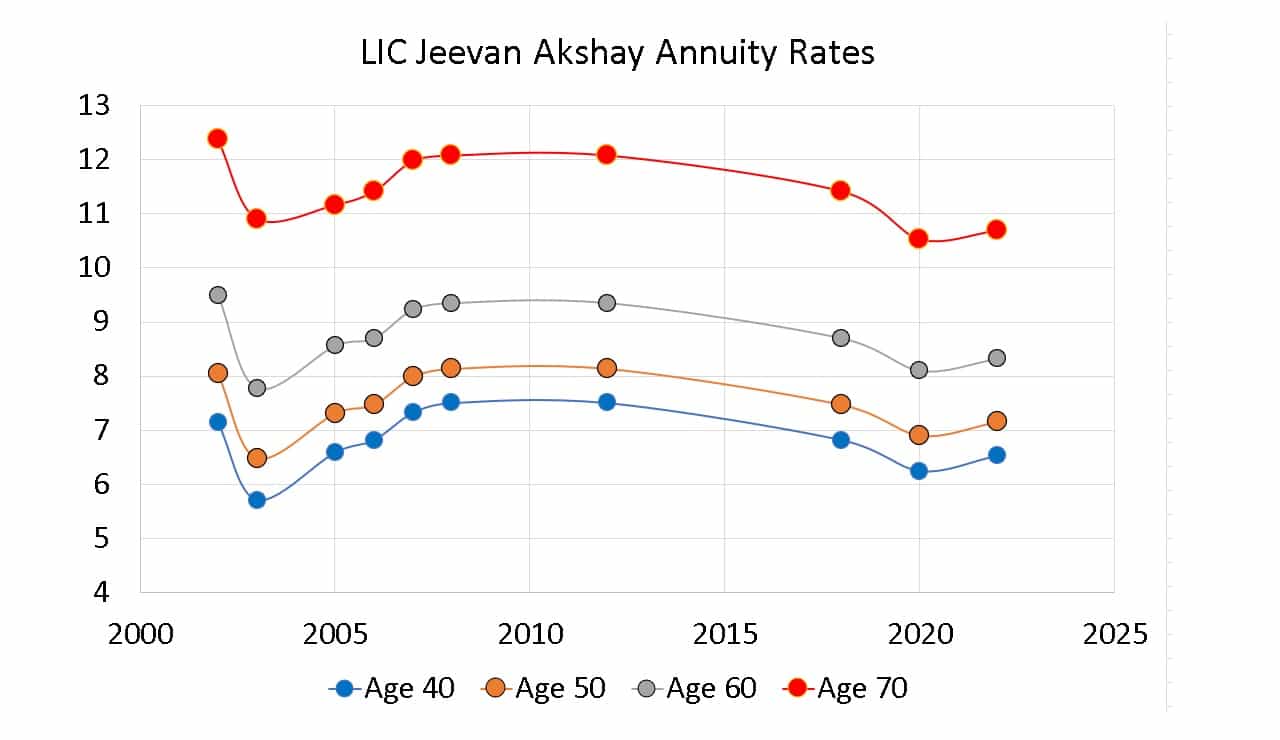
The rates have dropped the most for senior citizens. Over the last 20 years, the change in rate (point to point) is -14% for 70-year olds, -12% for 60-years, -11% for 50-year olds and -9% for 40-year olds.
Historical Jeevan Akshay Annuity Rates (for life) for 40-year olds
| Years | Age 40 |
| 2002 | 7.2 |
| 2003 | 5.7 |
| 2005 | 6.6 |
| 2006 | 6.8 |
| 2007 | 7.3 |
| 2008 | 7.5 |
| 2012 | 7.5 |
| 2018 | 6.8 |
| 2020 | 6.2 |
| 2022 | 6.5 |
Historical Jeevan Akshay Annuity Rates (for life) for 50-year olds
| Years | Age 50 |
| 2002 | 8.1 |
| 2003 | 6.5 |
| 2005 | 7.3 |
| 2006 | 7.5 |
| 2007 | 8.0 |
| 2008 | 8.1 |
| 2012 | 8.1 |
| 2018 | 7.5 |
| 2020 | 6.9 |
| 2022 | 7.2 |
Historical Jeevan Akshay Annuity Rates (for life) for 60-year olds
| Years | Age 60 |
| 2002 | 9.5 |
| 2003 | 7.8 |
| 2005 | 8.6 |
| 2006 | 8.7 |
| 2007 | 9.2 |
| 2008 | 9.4 |
| 2012 | 9.4 |
| 2018 | 8.7 |
| 2020 | 8.1 |
| 2022 | 8.3 |
Historical Jeevan Akshay Annuity Rates (for life) for 70-year olds
| Years | Age 70 |
| 2002 | 12.4 |
| 2003 | 10.9 |
| 2005 | 11.2 |
| 2006 | 11.4 |
| 2007 | 12.0 |
| 2008 | 12.1 |
| 2012 | 12.1 |
| 2018 | 11.4 |
| 2020 | 10.5 |
| 2022 | 10.7 |
With LIC changing the annuity rates often, future retirees should expect current rates to head south. Private insurers tend to offer a higher rate but this is more due to a smaller market share. Also in terms of buyer trust, it is hard to look past LIC.