Last Updated on January 22, 2025 at 6:48 pm
I was invited as a guest on the Paisa Vaisa Podcast hosted by Anupam Gupta, a CA and equity research consultant. The podcast was co-hosted by CFP Anees Rao. In the first part, we had defined what exactly is financial freedom, why it is for everyone and why we need to replace conventional notions of retirement and pension with financial freedom. In the second part, we get into specifics about how to create a financial freedom plan
To help listeners of the podcast, I have added some screenshots of the Freefincal Robo Advisory Software Template. They can use this to create their own financial freedom plan. Step 1: listen to the first and second parts of the Paisa Vaisa Podcast episodes: Ep. 139: Financial Freedom – Part 2 Step 2: make a list of your most basic expenses that will continue lifelong – these are what Anupam referred to as “food & fuel” expenses in the podcast. Step 3: Using the inflation thumb rule – the 8-9 rule – discussed, project your inflation into the future, up to when you will retire. This is only a rough estimate to warm you up.
Step 4: If you are married or have a partner, make them sit with you when you do the following calculation. It will only take about 15 minutes. Step 5: Get the robo advisory tool from the above link . Then it is a simple matter of following the instructions in the sheet to arrive at your financial freedom plan. Here are the steps.
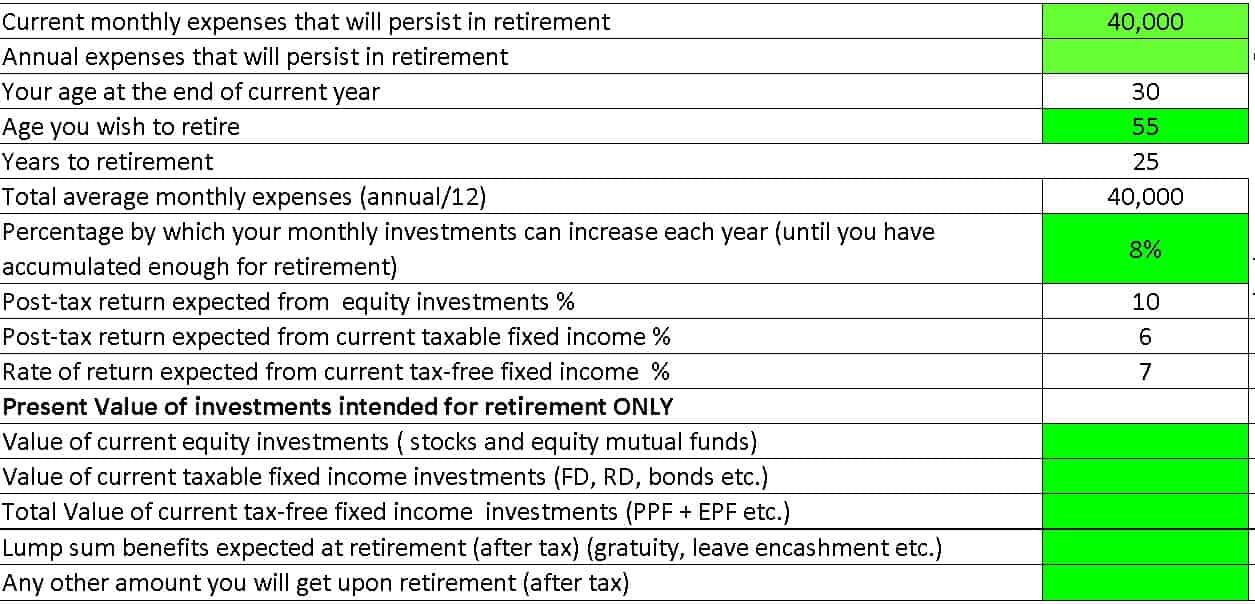
The numbers and assumptions used below are different from what was used in the podcast. So the results will be different. We shall assume that a financial freedom plan is being created for a 30-year-old with a 28-year-old spouse. If the spouse is working, the total income can be added together. For now, we will not do that. So for this couple, the current expenses that will persist in retirement are about Rs. 40,000 a month. You can add or subtract as you desire in the template.
🔥Secure your future with our Robo-advisory tool trusted by over 3,500 investors and advisors. From effortless retirement planning to funding your children’s biggest dreams, turn your financial goals into reality. 🔥
Subscribe for money management solutions via email! (Link takes you to our email sign-up form) Join 32,000+ readers in our community.
👉 New Tool Alert! NaviPlan: A Privacy-Focused Multi-asset Tracker and Goal Planner 👈
The breadwinner wants to retire at age 55. The template assumes an inflation of 8% and will create a financial freedom plan for the younger spouse until they turn 90. These assumptions cannot be changed in the free version of the robo advisory template. You can add your current investments into the sheet. If you receive a monthly income from other sources (eg rent), you can add these also into the sheet and it will adjust the retirement corpus require. The sheet will assume a fixed post-tax return of 10% from equity (cannot change in free version) and 6-7% return from fixed income.
When planning for financial freedom, the key question is, “how is the corpus required to be financially free?”. This actually means, “how long will my retirement corpus last?’ This, in turn, means, given a corpus X at the time of retirement, we invest it in a variety of instruments – some safe, some volatile – draw out an income ourselves each month (will increase due to inflation) and after some years, due to increased withdrawals, the X will drop to zero.
So while creating the financial freedom plan, we need to calculate the corpus required for an assumed return and inflation, that will last up to a certain age – in this case when the younger spouse turns 90. This number will be astoundingly large and even unachievable at first. But given enough time and with the right kind of investments, we can get pretty close. I would suggest that you take some time to read these two articles: Why is the retirement corpus I need so large?! and Do not be scared by what you need to accumulate for retirement!
So take a deep breath, relax and have a look first at the total corpus required.
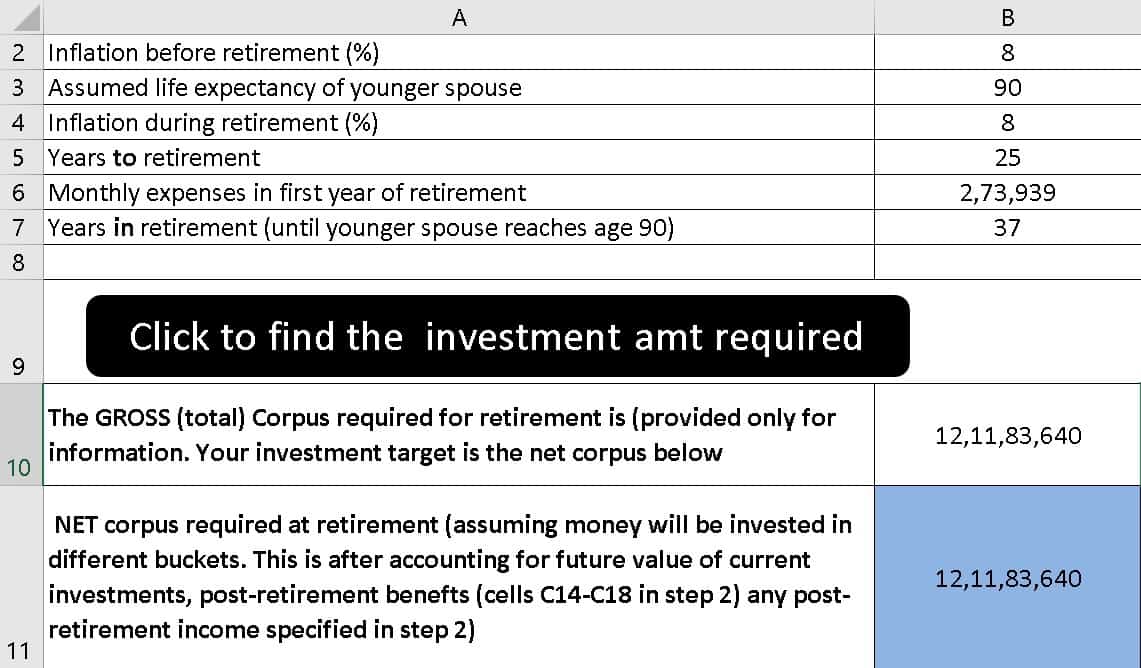
Yeah, that is 12 Crores. One guy looked at that said, it is not 12 crores, it is 12 crores after 25 years. That is the right attitude! The inflation assumed is still 8% after retirement. Many people think this is too much, but considering we will get sudden increase in expenses due to the medical bills (primarily) after retirement, I think it is a safe assumption.
So this is the investment schedule. The assumption here is that the person can increase investment by at least 8% a year due to salary hikes, promotions, bonuses etc. Notice that the total initial investment is 138% of the current monthly expenses that will persist in retirement.If that is not manageable, go for at least 70-% 100% of expenses. What can I say, life is tough!
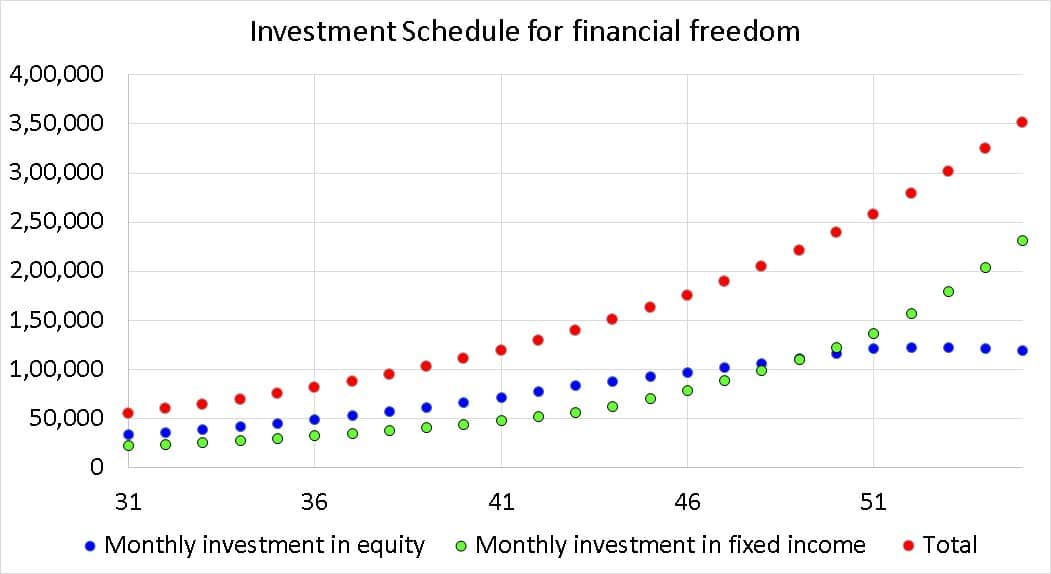
The monthly investment necesarry in fixed income includes EPF or NPs contribution. The asset allocation or the percentage exposure to equity and to fixed income is shown below. It is important to recognise that the required investment is so large because we factor in the decrease in equity exposure.

Also post-retirement, we assume that the corpus is invested into a mix of four buckets: the income bucket, the low-risk bucket, medium risk bucket and high risk bucket. You can see more details at Key features of the freefincal robo advisory software template
Don’t forget to listen to the Paisa Vaisa Podcast episodes: Ep. 138: Financial Freedom – Part 1 and Ep. 139: Financial Freedom – Part 2
I know it is a lot of money, but just a make a start, today. Things will get better after a while.