Last Updated on December 29, 2021 at 5:23 pm
Direct plans in which no commissions are removed daily from the NAV along with expenses (prior to publication) were introduced on 1st Jan 2013. This is how a seven-year SIP and a seven-year lump sum in the direct plan and regular plan of the same mutual fund have fared from 1st Jan 2013 to Feb 28th 2020. Please share this article with investors who are still holding regular plans.
It must be made clear to the reader that the primary reason to shift from regular plans to direct plans is to avoid conflict of interest. For the DIY investor, the lower cost over the long term is a no-brainer.
Distributors have been trying all sorts of tricks to prevent investors from redeeming from regulars plans. Some claim that since the direct plan is higher it will result in lower no of units purchased. This myth has been busted before (so will this data): Direct Mutual Fund NAV is higher so Investors will get fewer units: Is this bad?
🔥Secure your future with our Robo-advisory tool trusted by over 3,500 investors and advisors. From effortless retirement planning to funding your children’s biggest dreams, turn your financial goals into reality. 🔥
Subscribe for money management solutions via email! (Link takes you to our email sign-up form) Join 32,000+ readers in our community.
👉 New Tool Alert! NaviPlan: A Privacy-Focused Multi-asset Tracker and Goal Planner 👈
Another misinformation used to prevent exit is, “SEBI has said direct plans are only for knowledgeable investors”. This is similar to how insurance agents and employees try to dissuade policy surrenders. I am fairly sure freefincal readers will have such colourful stories to share. Please do in the comments section below.
Investors harassed by distributors should complain to SEBI via their SCORES portal. Note: investors need not inform their distributors before switching out. AMC staff would say this to stop you, but this is wrong.
Those who want assistance may pay a flat fee (not a fee linked to amount invested)) to a SEBI Registered fee-only Investment Advisor. Note a fee-only financial planning is a holistic service including goal-planning, tax-planning, insurance (life/health) and estate planning (will creation, trust creation etc). So please do not compare “fees” of a fee-only with a distributor. It makes even lesser sense to compare the fees of a fee-only planner and a fee-based (fees + commissions).
This report is for those still investing in regular plans. They can pull out some money from regular funds before March 31st (up to one lakh capital gains overall is tax-free for equity, equity mutual funds). Another shift can be made be in April 2020.
For this study, we shall consider 106 large cap, large and midcap, multicap, midcap and smallcap funds in existence on or before 1st Jan 2013. Return (XIRR) from a Rs. 1000 monthly SIP from 1st Jan 2013 is considered.
The difference in XIRR of a SIP started on 1st Jan 2013 in a direct plan and regular plan is shown below. The horizontal axis is only a serial number. Note that the XIRR has not been arranged in ascending or descending order.
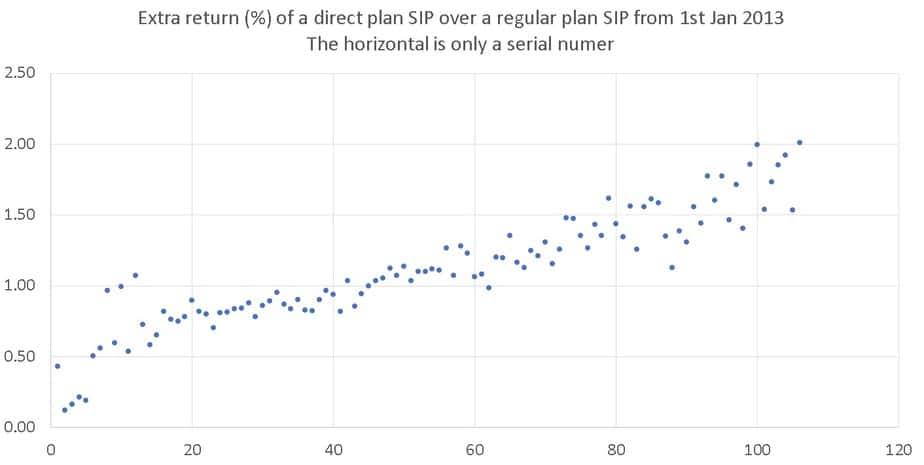
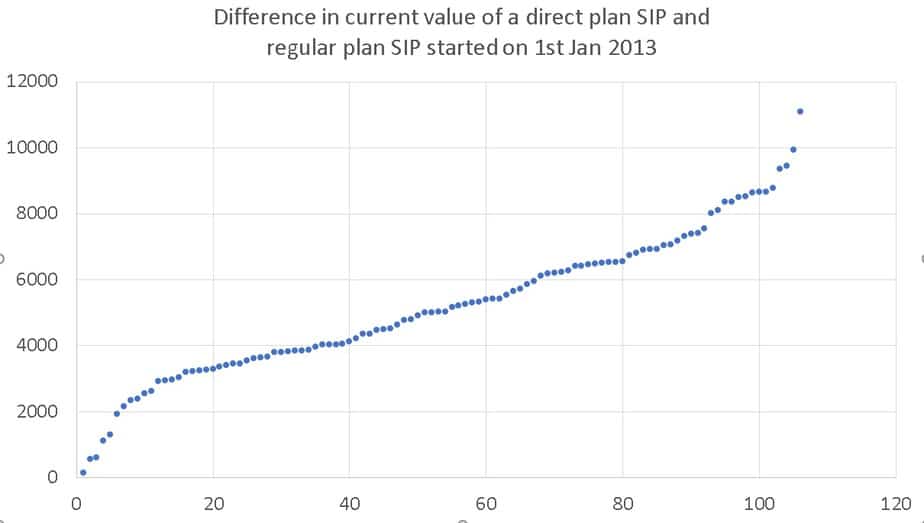
The difference in value as on Feb 29th 2020 ranges from 138 to 11,000 for a monthly Rs. 1000 investment. If the AMCs had not tinkered with direct plan expense ratios frequently, the difference could have been significantly more!
See for example: 48% increase in expense ratio of Birla Reg Savings Fund! Time for SEBI to act?
The highest difference in XIRR (top 25)
| Fund Name | XIRR Difference % |
| Essel Large Cap Equity Fund | 1.56 |
| Principal Emerging Bluechip Fund | 1.26 |
| PGIM India Large Cap Fund | 1.56 |
| Sahara Power & Natural Resources Fund | 1.61 |
| IDFC Core Equity Fund | 1.58 |
| Edelweiss Mid Cap Fund | 1.35 |
| Mirae Asset Emerging Bluechip | 1.13 |
| Axis Bluechip Fund | 1.38 |
| Nippon India Small Cap Fund | 1.31 |
| Tata Large & Mid Cap Fund | 1.56 |
| Sahara Midcap Fund-Auto Payout | 1.44 |
| Indiabulls Blue Chip Fund | 1.78 |
| Kotak Small Cap Fund | 1.60 |
| BNP Paribas Multi Cap Fund | 1.77 |
| Axis Midcap Fund | 1.46 |
| BNP Paribas Mid Cap Fund | 1.71 |
| Canara Rob Emerg Equities Fund | 1.40 |
| Invesco India Largecap Fund | 1.86 |
| Sahara Growth Fund | 2.00 |
| Kotak Emerging Equity Fund | 1.54 |
| Invesco India Growth Opp Fund | 1.73 |
| Invesco India Multicap Fund | 1.85 |
| Sahara R.E.A.L Fund | 1.92 |
| SBI Small Cap Fund | 1.53 |
| Invesco India Midcap Fund | 2.01 |
The lowest difference in XIRR (bottom 25)
| Fund Name | XIRR Difference % |
| Quant Mid Cap Fund | 0.43 |
| Quant Small Cap Fund | 0.12 |
| HDFC Growth Opp Fund | 0.16 |
| Quant Active Fund | 0.21 |
| Quant Large & Mid Cap Fund | 0.19 |
| Taurus Starshare (Multi Cap) Fund | 0.50 |
| UTI Core Equity Fund | 0.56 |
| Edelweiss Large Cap Fund | 0.96 |
| Sahara Wealth Plus Fund-Fixed Pricing | 0.60 |
| Sundaram Large and Mid Cap Fund | 0.99 |
| UTI Equity Fund | 0.54 |
| SBI Magnum Multicap Fund | 1.07 |
| Nippon India Vision Fund | 0.72 |
| Taurus Discovery (Midcap) Fund | 0.58 |
| Sahara Star Value Fund | 0.65 |
| Taurus Largecap Equity Fund | 0.82 |
| HDFC Top 100 Fund | 0.76 |
| DSP Top 100 Equity Fund | 0.75 |
| Union Multi Cap Fund | 0.78 |
| Baroda Mid-cap Fund | 0.90 |
| LIC MF Multi Cap Fund | 0.82 |
| Baroda Large Cap Fund | 0.80 |
| SBI Large & Midcap Fund | 0.70 |
| L&T Equity Fund | 0.81 |
| Sundaram Small Cap Fund | 0.81 |
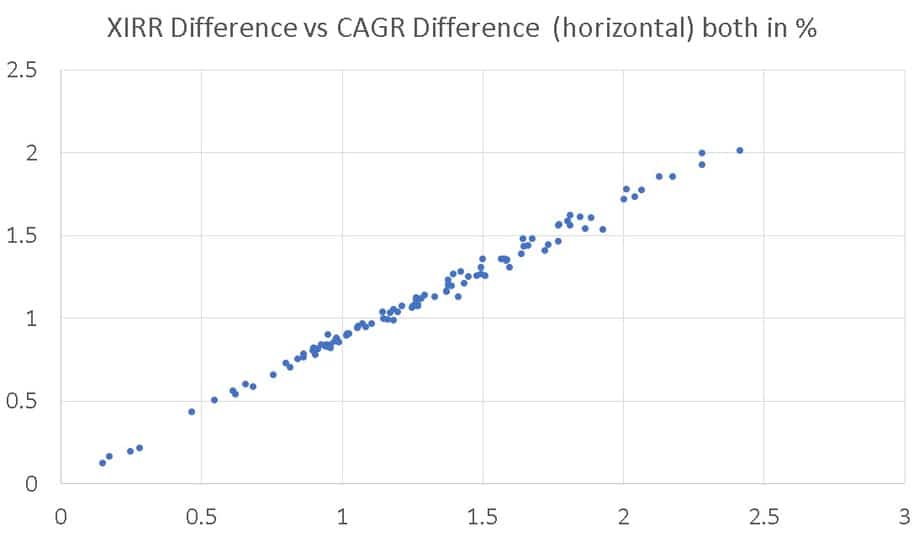
Returns for a lump sum invested on 1st Jan 2013 (CAGR) versus the SIP XIRR is plotted below. The near-linear trend is hardly surprising as commissions for the regular plan are removed each business day.
This article has merely quantified the obvious. Time to wake up, smell the coffee and redeem from regular funds.