Last Updated on December 29, 2021 at 5:21 pm
It is only after SEBI mandated that expense ratio changes must be intimated to investors did it become clear how often and how randomly the total expense ratio (TER) is varied by fund houses. With a 48% increase in TER of Aditya Birla Sun Life Regular Savings Fund. it is also time for SEBI to limit the quantum of such increases.
We had earlier reported one of the reasons for this change in direct plans and why SEBI should stop frequent mutual fund expense ratio changes. AMCs seem to make a fund inviting with a low TER and wait for enough AUM to accumulate and then jack up the TER. In this instance, the increase seems to be for a different reason.
SEBI Registered Investment Advisor, S R Srinivasan (who readers may recognise from How I achieved financial freedom and became an Investment Advisor!) altered me to this notification from Birla AMC
🔥Secure your future with our Robo-advisory tool trusted by over 3,500 investors and advisors. From effortless retirement planning to funding your children’s biggest dreams, turn your financial goals into reality. 🔥
Subscribe for money management solutions via email! (Link takes you to our email sign-up form) Join 32,000+ readers in our community.
👉 New Tool Alert! NaviPlan: A Privacy-Focused Multi-asset Tracker and Goal Planner 👈
All plans below are direct. The numbers 1.00% to 1.10% refers to a TER increase from 1% to 1.1% with effect from February 18, 2020
Aditya Birla Sun Life Banking and Financial Services Fund 1.00% to 1.10%
Aditya Birla Sun Life Equity Fund 0.80% to 0.86%
Aditya Birla Sun Life Manufacturing Equity Fund 1.44% to 1.73%
Aditya Birla Sun Life Regular Savings Fund 0.83% to 1.23%
Aditya Birla Sun Life MNC Fund 1.00% to 1.15%
Aditya Birla Sun Life Pure Value Fund 0.83% to 0.95%
That is a 48% increase in the TER of the Regular Savings Fund (this is a conservative hybrid fund, previously known as monthly income funds). This is an extract of the email sent to investors.
Dear Investor,
In compliance with provisions of SEBI Circular No. SEBI/HO/IMD/DF2/CIR/P/2018/18 dated February 05, 2018 on change and Disclosure of Total Expense Ratio (TER), please note that the base Total expense ratio of Aditya Birla Sun Life Regular Savings Fund (formerly known as Aditya Birla Sun Life MIP II – Wealth 25 Plan) – Direct will be revised from 0.83% to 1.23% effective 18-Feb-2020.
It is quite easy to assume from the language of the email that SEBI has approved the increase! If you look under Notice for Change in Expense Ratio of Mutual Fund Schemes at the Birla AMC page, there are four such TER change notifications just in Feb 2020!
It is impossible to know why a TER of a fund changes and it hard to even speculate. Shown below is the AUM of the fund (regular + direct) and TER of the direct plan (1st plot) and regular plan plotted separately. The TER is marked in the right axis.
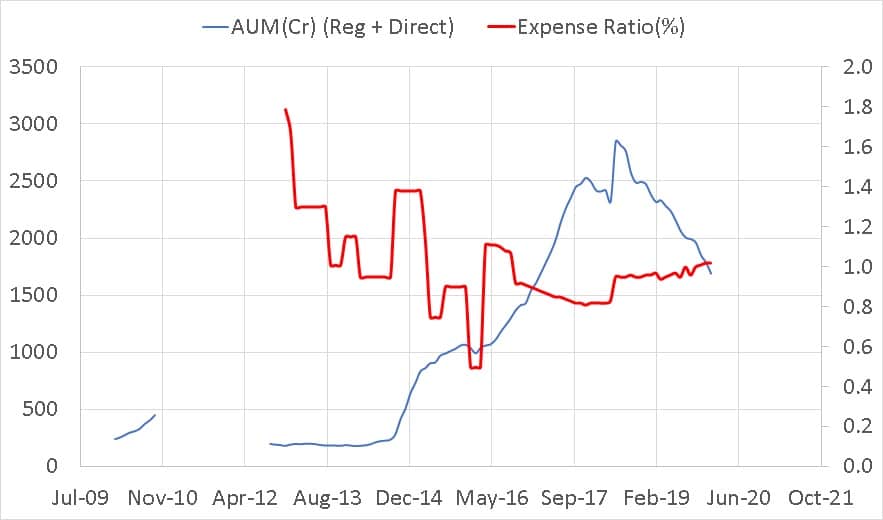
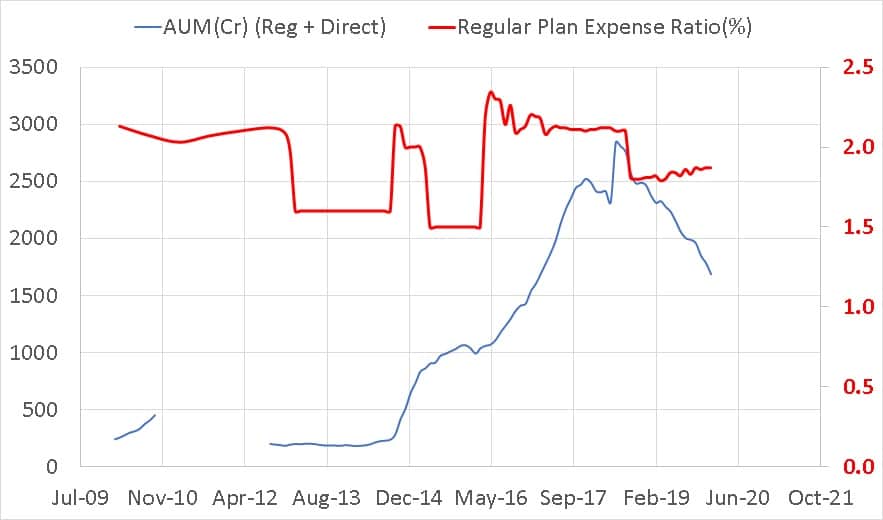
Notice how the direct plan TER has dropped significantly and now on the way up. This is a trend seen (see our report linked above) in other funds too. An invitation to invest in the direct plan.
Also, notice how both TERs went up with a sharp rise in AUM. The direct plan share of the AUM is only available in AMFI and that too updated only once a quarter. It was updated monthly up to Sep 2010!
Like all other funds, Aditya Birla Sun Life Regular Savings Fund too has a small share of AUM from the direct plan – about 13%. This has not changed much over the last three quarters.
However, from Jun 2019 to Deb 2020, the AUM (as seen above) has fallen significantly. This results in the natural question did the AMC jack up TER by 48% to compensate for 13% (approx) loss of direct AUM in the last three quarters of 2019?
This should approximately give them as much or more revenue from the direct plan as they got when the AUM peaked in June 2018.
The existing direct plan investors now will have to suffer ~ 0.5% return loss because of this TER increase. Is this because of the investors who chose to exit the scheme?
Only one thing is clear. It is high time SEBI steps in to curb (1) the no of times in a year TER can be changed, (2) the quantum of TER increases. In addition, a TER increase should be considered as a change in fundamental attribute and investors should be able to exit free of exit load.