A 28 year old reader wants to retire by 50. Can he do so?
Let us do the calculation using the freefincal robo advisory tool with the following assumptions (remaining assumptions stay the same):
- Monthly expenses Rs. 50,000;
- Post-tax return expected from equity investments % 10.00
- Post-tax return expected from current taxable fixed income % 5.00
- Rate of return expected from current tax-free fixed income % 6.00
- Life expectancy: 90 years
- Increase in monthly investment each year: 10%
- Inflation before retirement: 7% and after retirement 6%
The retirement corpus is Rs. 8.42 Crores, and the monthly investment required is Rs 48,520 increasing each year at the rate of 10%.
The recommended change in asset allocation and the corresponding change in overall portfolio return is shown below.
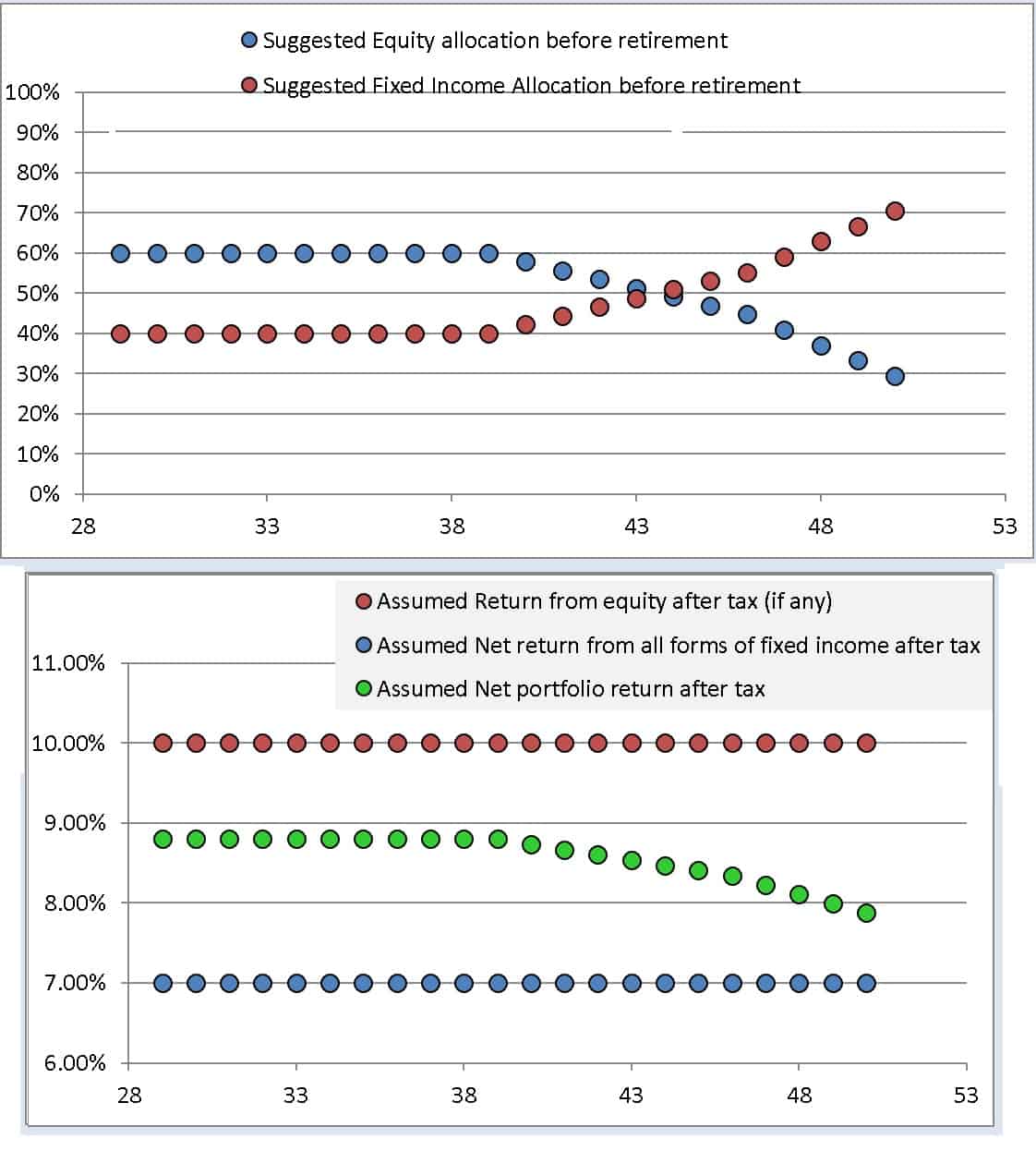
The equity allocation is gradually reduced from an initial 60% equity.
🔥Secure your future with our Robo-advisory tool trusted by over 3,500 investors and advisors. From effortless retirement planning to funding your children’s biggest dreams, turn your financial goals into reality. 🔥
Subscribe for money management solutions via email! (Link takes you to our email sign-up form) Join 32,000+ readers in our community.
👉 New Tool Alert! NaviPlan: A Privacy-Focused Multi-asset Tracker and Goal Planner 👈
Out of the total corpus of Rs. 8.42 crores, 5% is kept aside for emergencies. Out of the remaining corpus, 30% is set aside for equity, and the rest is fixed income distributed among four buckets.
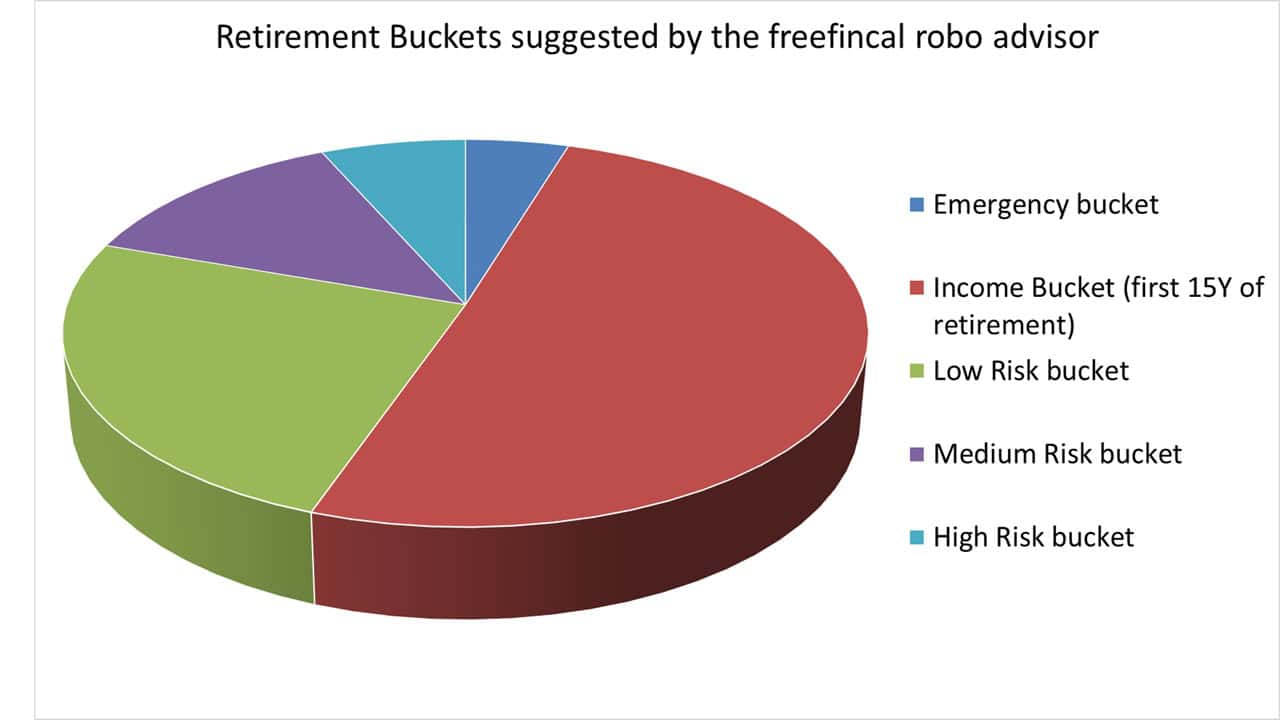
- An income bucket with 53% of the remaining corpus for guaranteed income for the first 15 years in retirement. During this time, investments will be made in the following three buckets.
- A low-Risk bucket with 26% of the remaining corpus for income from year 16 to year 25 in retirement. The low-risk bucket will have an asset allocation of 30% equity 70% debt during the investment period (years 1 to 15 of retirement).
- Corpus from a medium risk bucket with 14% of the remaining corpus will provide income from year 26 to 33 in retirement. This bucket shall have an asset allocation of 50% equity and 50% debt during the investment period (year 1 to year 25)
- Corpus from a high-risk bucket with 7% of the remaining corpus will provide income from years 34 to 40 in retirement. This bucket shall have an asset allocation of 70% equity and 30% debt during the investment period (year 1 to year 33)
- The buckets will be actively managed to reduce risk during this investment period via rebalancing and profit booking from one bucket to another. To understand how this works, try this: The Retirement Bucket Strategy Simulator.
- After 15 years, the low-risk bucket will be turned into 100% debt and provide income for about ten years. After that, the other buckets will also be progressively used.
We believe the reader is on track to retire by age 50 as long as he can stick to the investment schedule mentioned above.