Should you invest in the Nifty 500 Momentum 50 Index?

Published: September 15, 2024 at 6:00 am

Last Updated on September 15, 2024 at 9:33 am

There are currently two ongoing NFOs – Motilal Oswal Nifty 500 Momentum 50 Index Fund (and ETF) and Nippon India Nifty 500 Momentum 50 Index Fund. In this article, we analyse the risk and reward potential of the underlying index and what you need to know before considering a momentum index.

According to the index factsheet, The Nifty500 Momentum 50 Index aims to track the performance of the top 50 companies within the Nifty 500 selected based on their
Normalized Momentum Score. The Normalized Momentum Score for each company is determined based on its 6-month and 12-month price return, adjusted for volatility. Stock weights are based on a combination of the stock’s Normalized Momentum Score and its free-float market capitalization.

To compute the Normalized Momentum Score:

  • 12-month Momentum ratio = 12-month Price Return ÷ standard deviation (SD) and 6-month Momentum ratio = 6-month Price Return ÷ SD are computed.
  • Annualised standard deviation of lognormal daily returns of the stock for one year is used.
  • Z-Score for 12-month & 6-month momentum ratio is calculated. Z-score is the deviation from the mean momentum ratio divided by the standard deviation of momentum ratios.
  • Weighted Average Z Score = 50% * (12 month Momentum Z Score) + 50%
    * (6 month Momentum Z Score)
  • Normalized Momentum Score = (1+ Wgt. Average Z score) if Wgt. Average Z score
    >=0
  • Normalized Momentum Score = (1- Weighted Average Z score)^-1 if Wgt. Average Z
    score < 0
  • The top 50 stocks with the highest Normalized Momentum Score are selected
  • Each stock in the index is capped at the lower of 5% or five times the weight of the stock in the index based only on free-float market capitalization
  • Capping will be done semi-annually at the time of rebalancing
  • The weight of stocks may drift between two rebalancing periods due to movement in the stock prices

Considerations for investors

🔥Secure your future with our Robo-advisory tool trusted by over 3,500 investors and advisors. From effortless retirement planning to funding your children’s biggest dreams,  turn your financial goals into reality. 🔥

Subscribe for money management solutions via email! (Link takes you to our email sign-up form) Join 32,000+ readers in our community.

  • Is this definition arbitrary? Why choose only 6-month and 12-month windows? Why not 3-month or 9-month windows?
  • Why wait 6-months for a rebalance? Will there not be momentum shifts within that time? Recall the 2020 crash and recovery lasted only a month.
  • Even a casual inspection of the index methodology would tell us that the Nifty 500 Momentum 50 Index is expected to do well in a bull market. But what about bear markets when there is a lack of momentum?

Now, let’s look at the data. The rosy parts first. If you want to create plots like the ones below, you can join the freefincal investor circle to access exclusive tools.

Evolution of Nifty 500 Momentum 50 TRI vs Nifty 500 TRI since 1st April 2005 in log scale
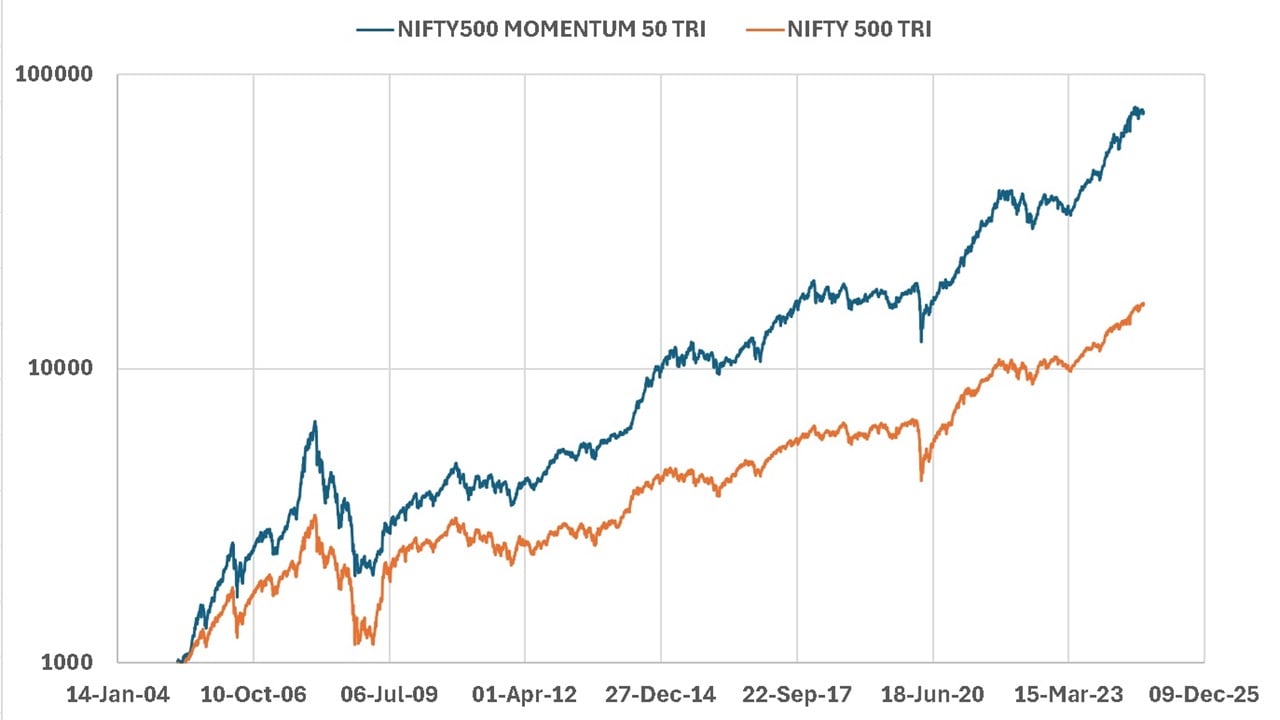
Evolution of Nifty 500 Momentum 50 TRI vs Nifty 500 TRI since 1st April 2005 in log scale

All since-inception graphs would look exciting like this. But we need to dig deeper (see below).

10-year rolling returns of Nifty 500 Momentum 50 TRI vs Nifty Smallcap 250 TRI vs Nifty Midcap150 TRI vs Nifty Multicap 50-25-25 TRI
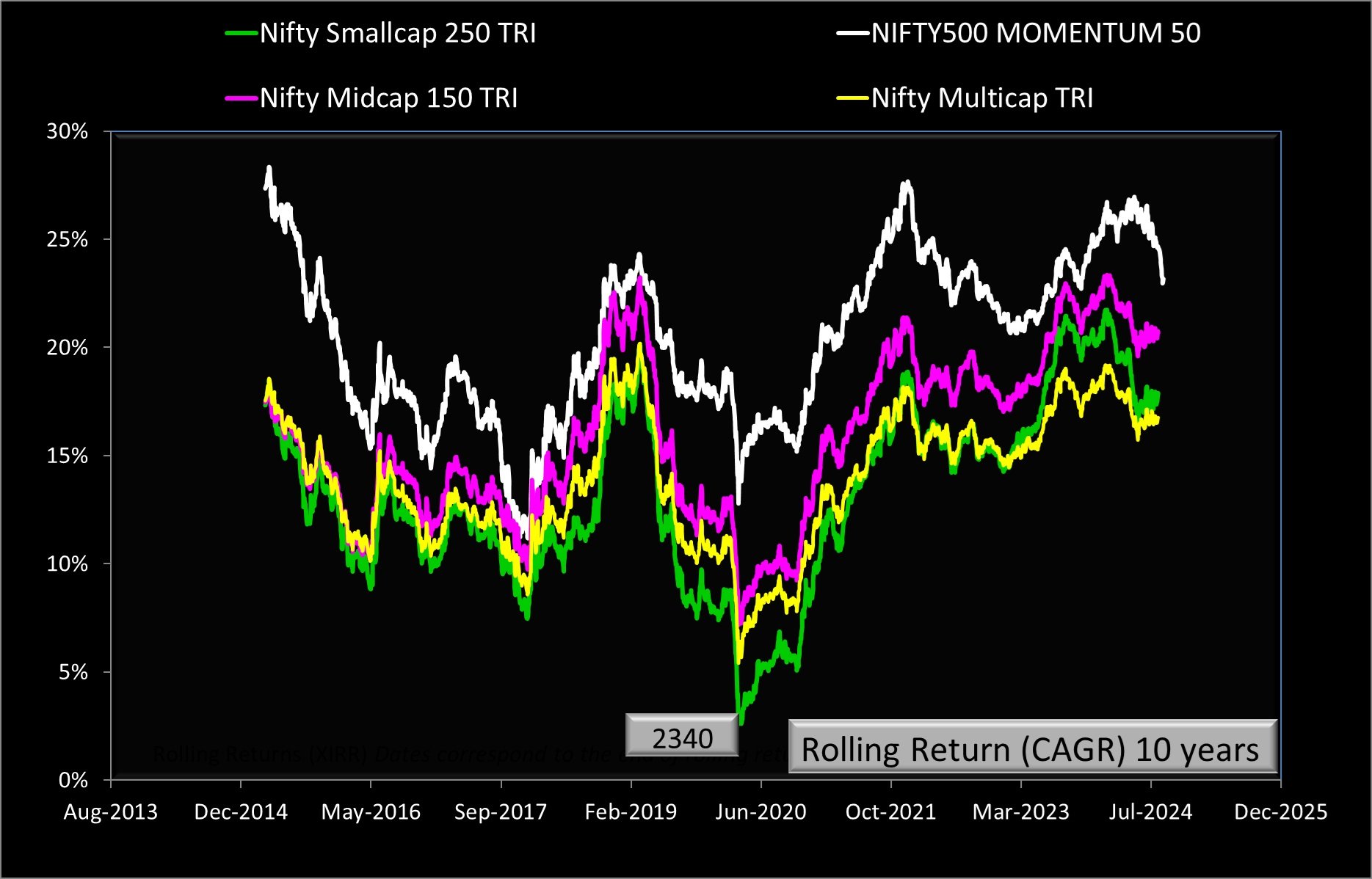
10-year rolling returns of Nifty 500 Momentum 50 TRI vs Nifty Smallcap 250 TRI vs Nifty Midcap150 TRI vs Nifty Multicap 50-25-25 TRI

That seems impressive. Before we get carried away, we need to look at the time window in the X-axis. It is less than ten years old. So, the history is way too short to have seen a variety of possibilities.

10-year rolling returns of Nifty 500 Momentum 50 TRI vs Nifty Next 50 TRI vs Nifty 50 TRI
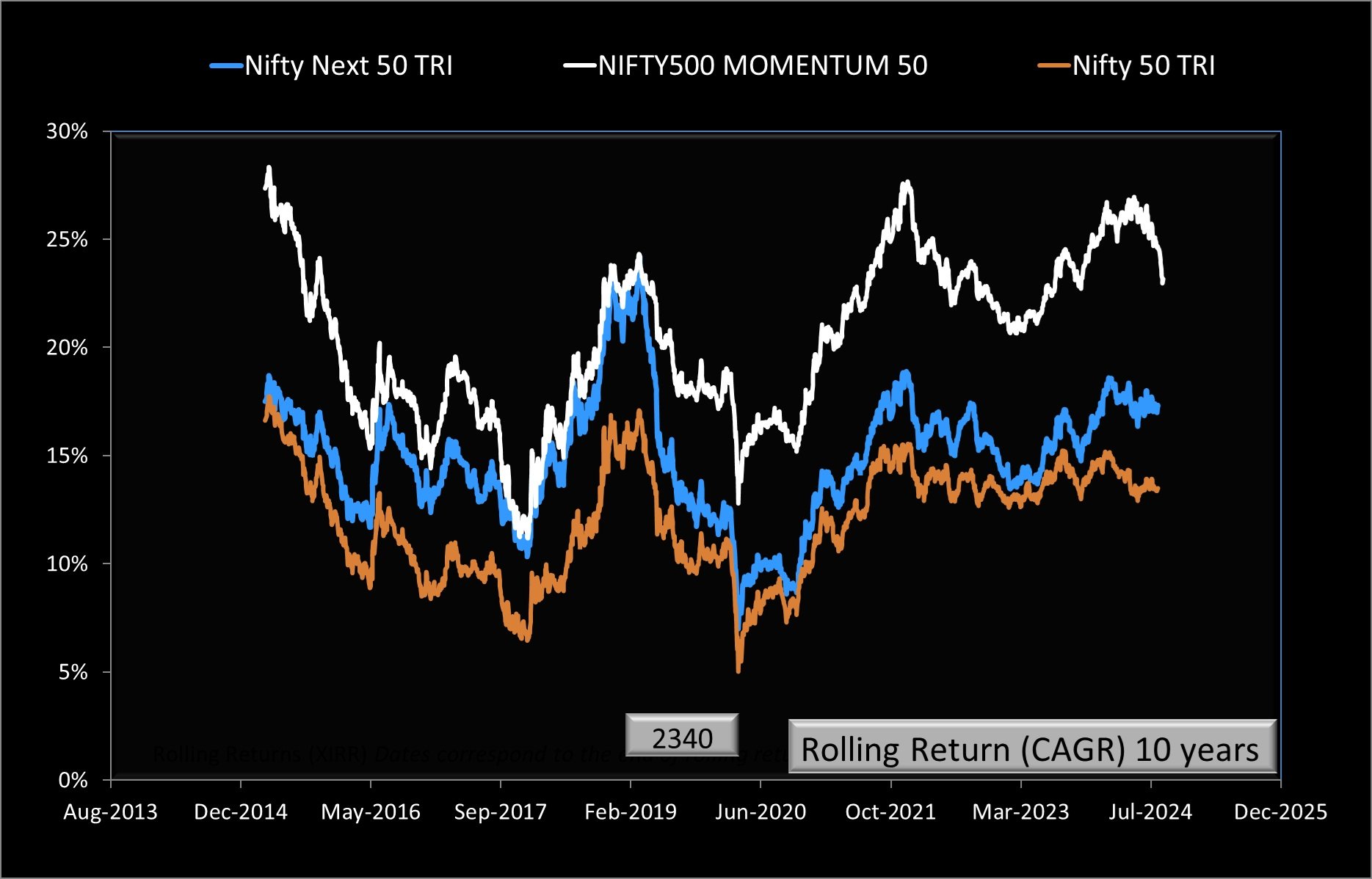
10-year rolling returns of Nifty 500 Momentum 50 TRI vs Nifty Next 50 TRI vs Nifty 50 TRI

Same caveat as above.

10-year rolling returns of Nifty 500 Momentum 50 TRI vs Nifty 500 TRI vs Nifty 50 TRI
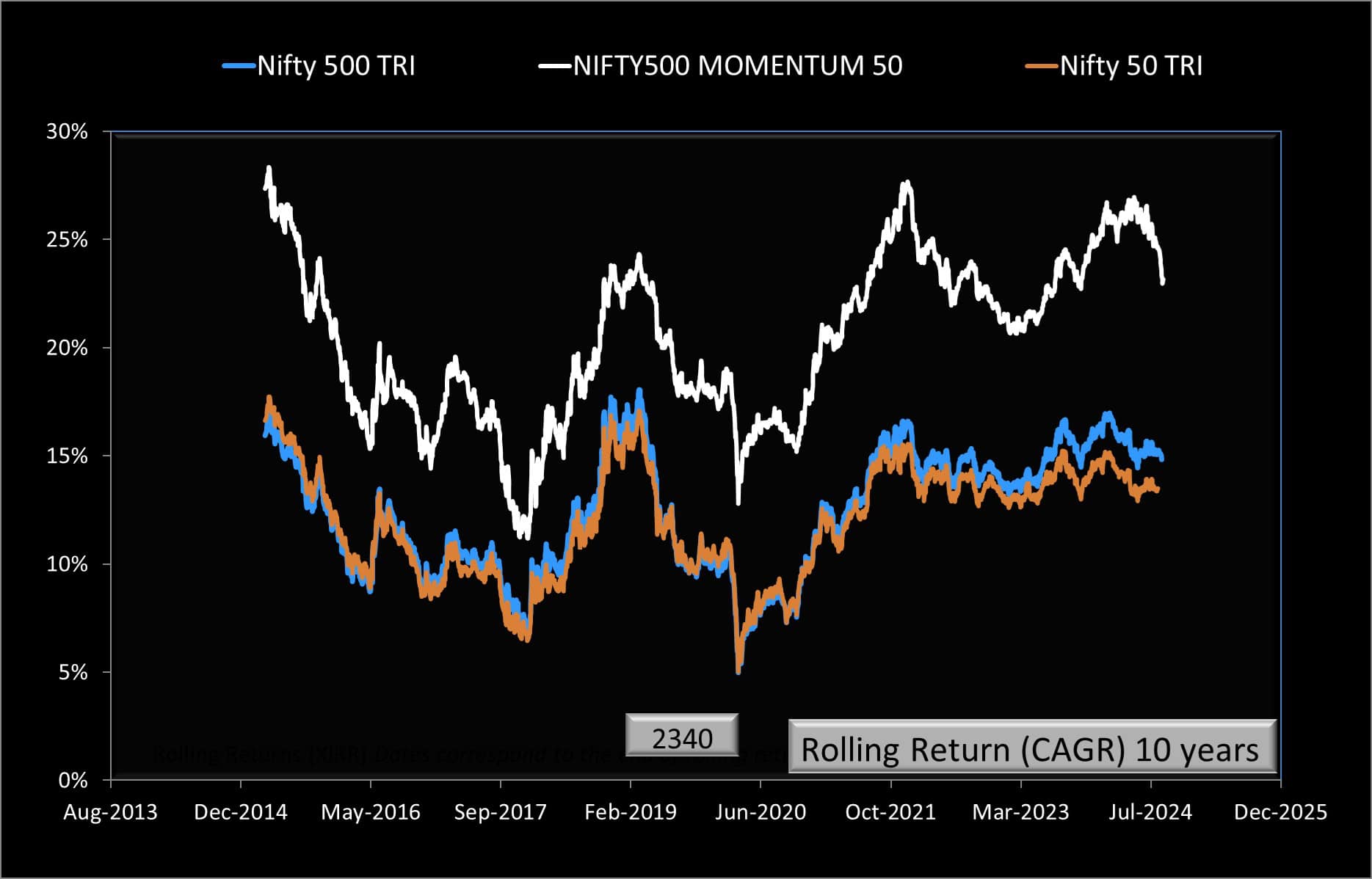
10-year rolling returns of Nifty 500 Momentum 50 TRI vs Nifty 500 TRI vs Nifty 50 TRI

Same caveat as above. This graph also illustrates why I keep saying you don’t get much “extra” by choosing Nifty 500 over Nifty 50.

Now, let us get to the nitty-gritty.

10-year rolling risk (standard deviation) of Nifty 500 Momentum 50 TRI vs Nifty 500 TRI vs Nifty Smallcap 250 TRI vs Nifty Midcap150 TRI vs Nifty Next 50 TRI
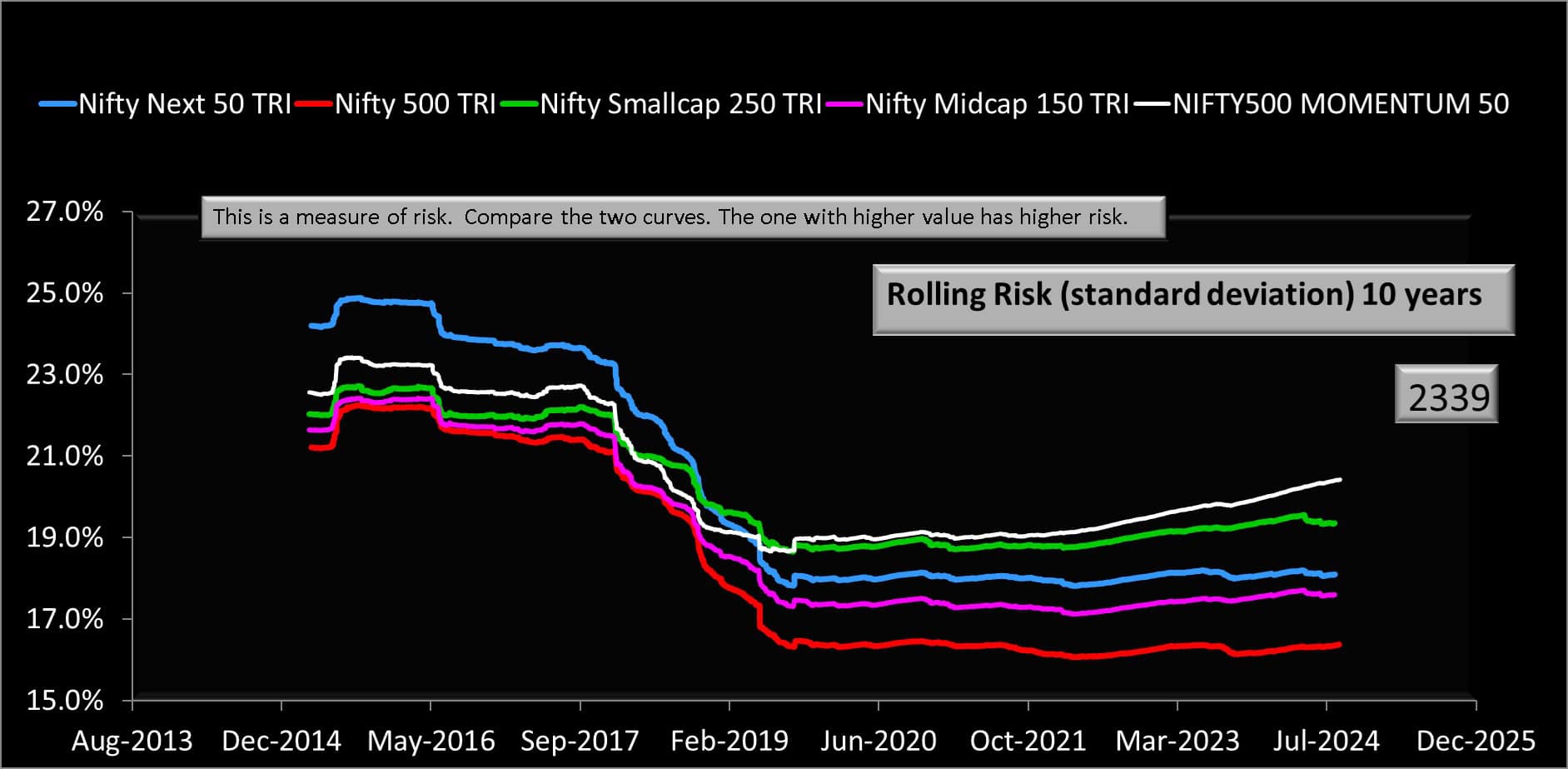
10-year rolling risk (standard deviation) of Nifty 500 Momentum 50 TRI vs Nifty 500 TRI vs Nifty Smallcap 250 TRI vs Nifty Midcap150 TRI vs Nifty Next 50 TRI

Notice that the Nifty 500 Momentum 50 has one of the largest standard deviations (volatility) among the indices compared to the small cap index, even higher than the small cap index. This is the price to pay for the higher return “over the long term”.

Show investors a ten-year rolling return graph like this, and they would claim they will stay invested for that long to reap benefits (if any). But talk is cheap. Investors must appreciate that the journey to such a potential higher return is riddled with risk.

5-year rolling returns of Nifty 500 Momentum 50 TRI vs Nifty 500 TRI vs Nifty 50 TRI
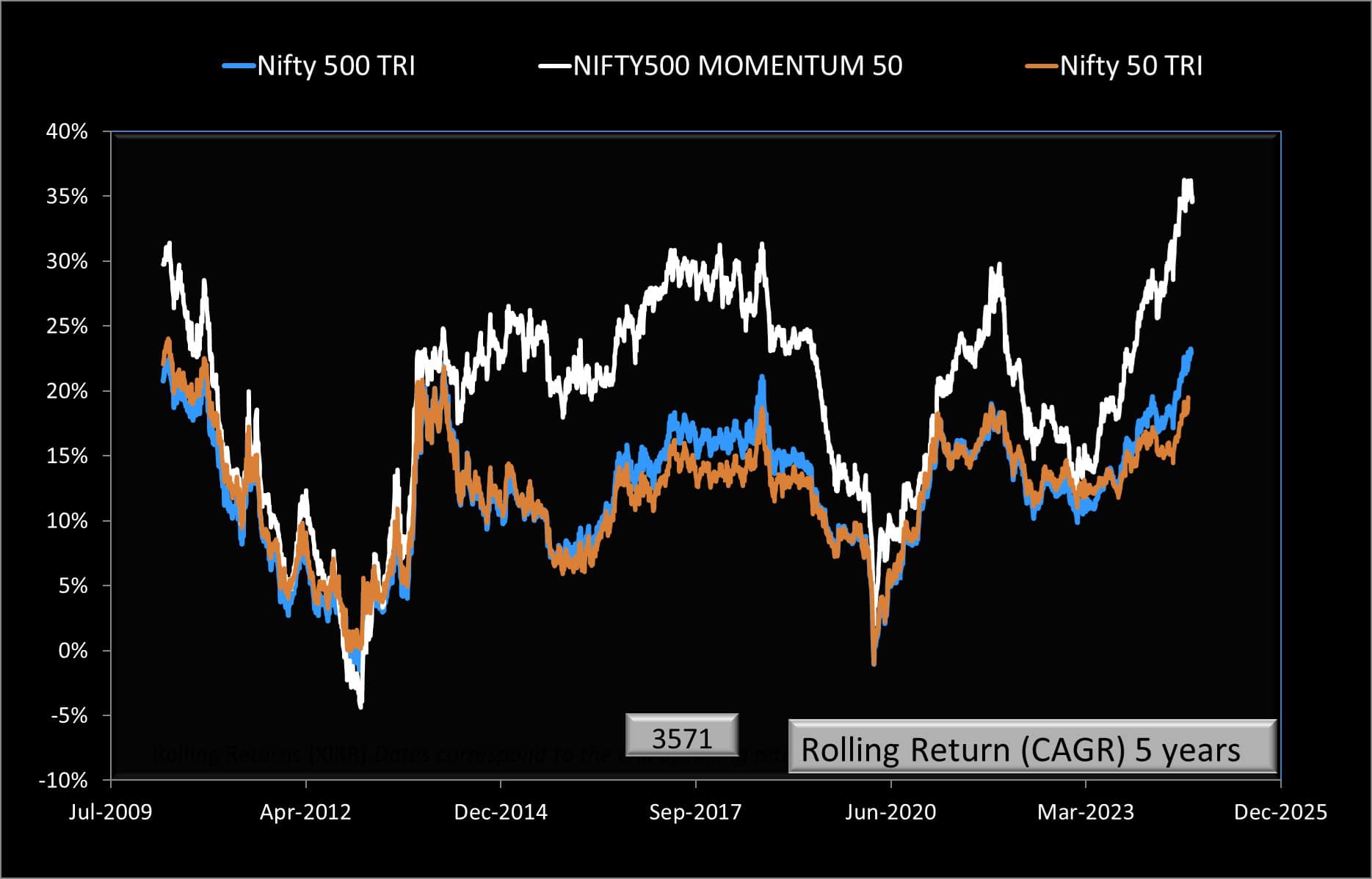
5-year rolling returns of Nifty 500 Momentum 50 TRI vs Nifty 500 TRI vs Nifty 50 TRI

Notice that five-year returns of the momentum index fall down to Nifty 50 levels from time to time, and when there is no market momentum, outperformance becomes hard. New mutual fund investors may find it hard to believe market momentum may vanish for long, but it is only a matter of time before it happens.

3-year rolling returns of Nifty 500 Momentum 50 TRI vs Nifty 500 TRI vs Nifty 50 TRI
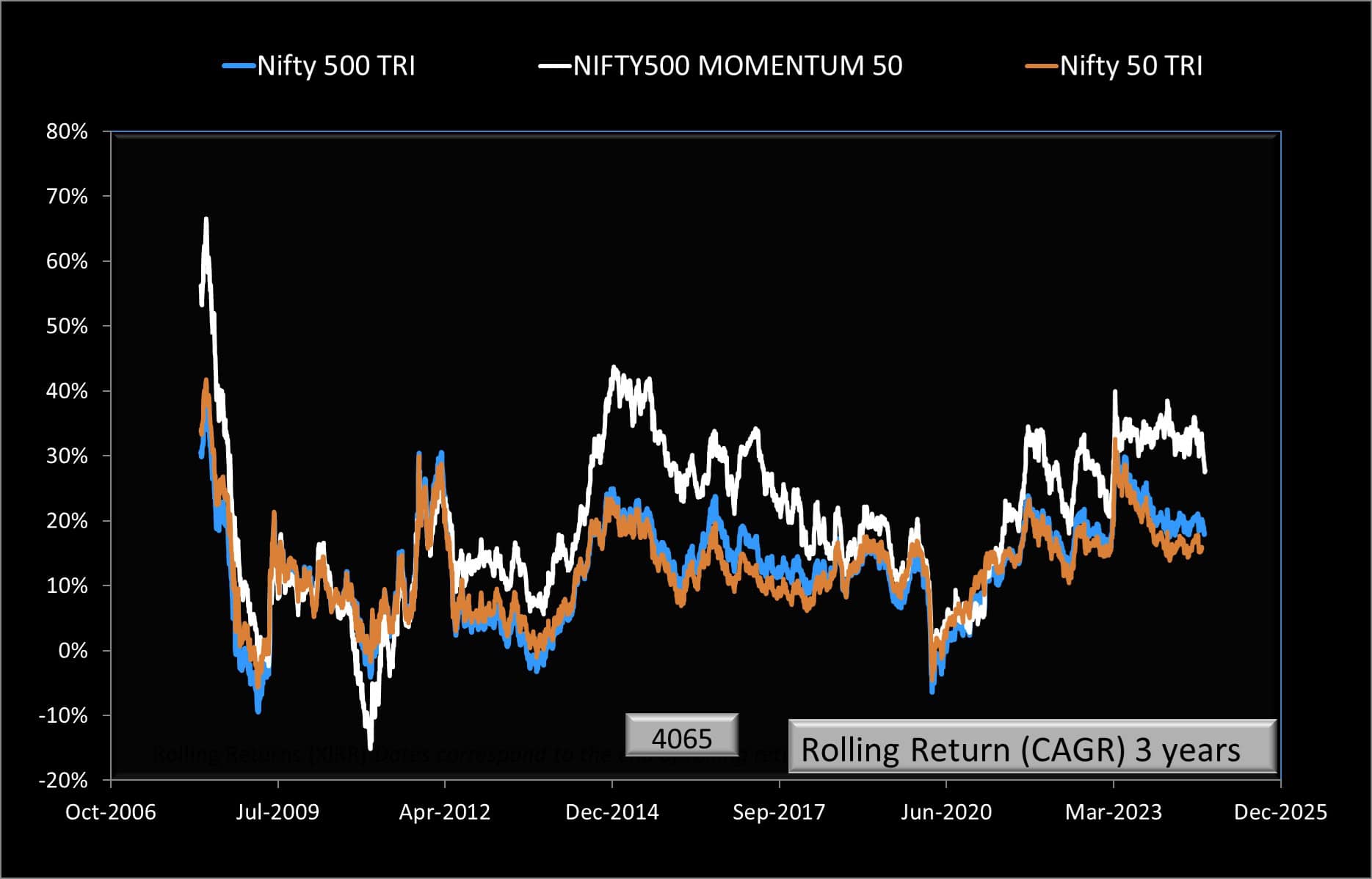
3-year rolling returns of Nifty 500 Momentum 50 TRI vs Nifty 500 TRI vs Nifty 50 TRI

The risk is more apparent when we consider three-year rolling returns. So, if you wish to hold the momentum fund for ten or more years, you must be prepared for years of underperformance. Most investors are incapable of this.

Motilal Oswal AMC’s presentation deck compares the momentum index’s drawdown with that of Nifty 50.
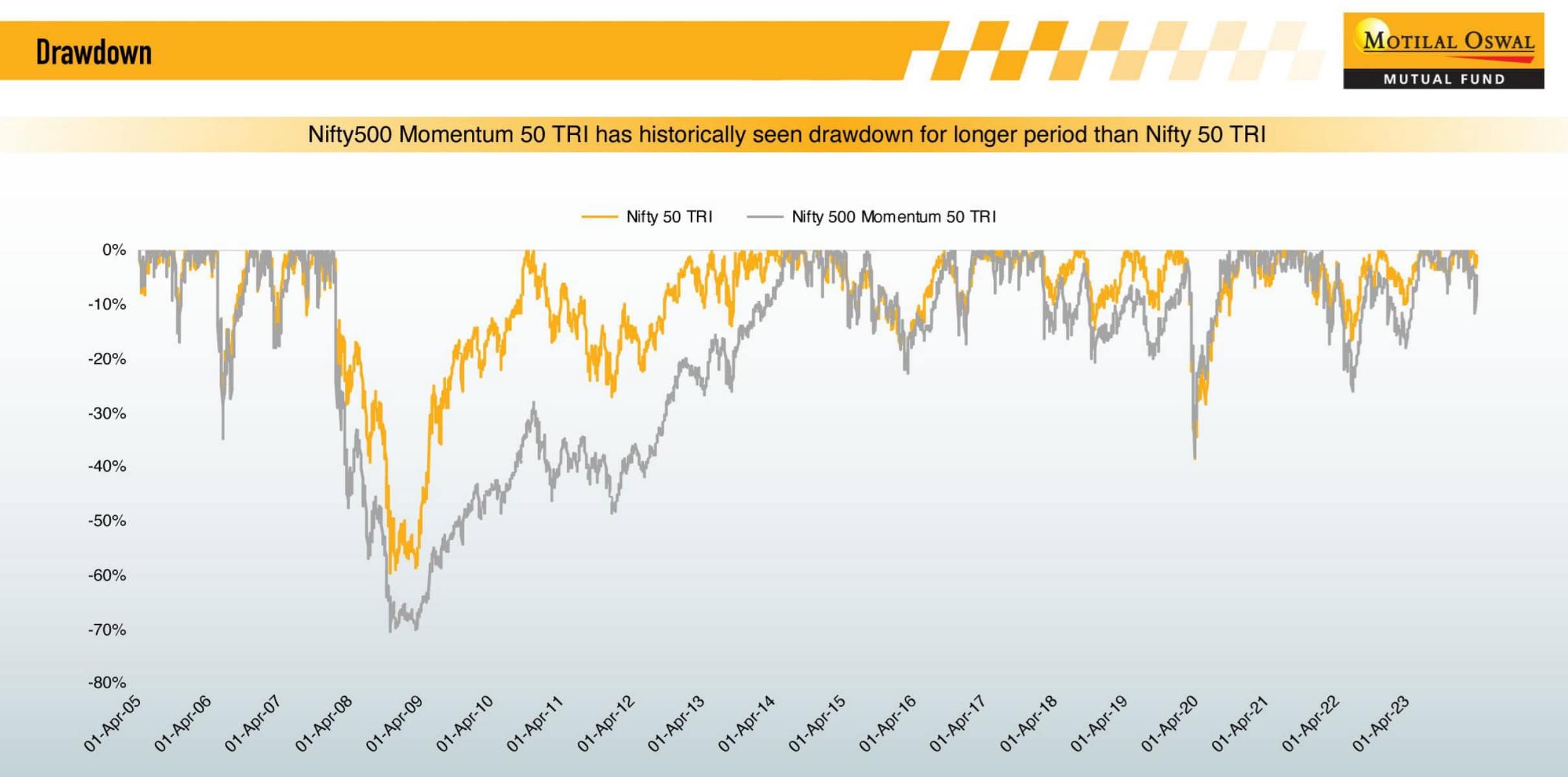
Drawdown of Nifty 500 Momentum 50 TRI vs Nifty 50 TRI from the presentation deck of Motilal Oswal AMC

It is clear that the momentum index falls more from a peak and tends to stay down longer. More instances of its volatile nature can be seen below.

Evolution of Nifty 500 Momentum 50 TRI vs Nifty 500 TRI from April 2005 to July 2009
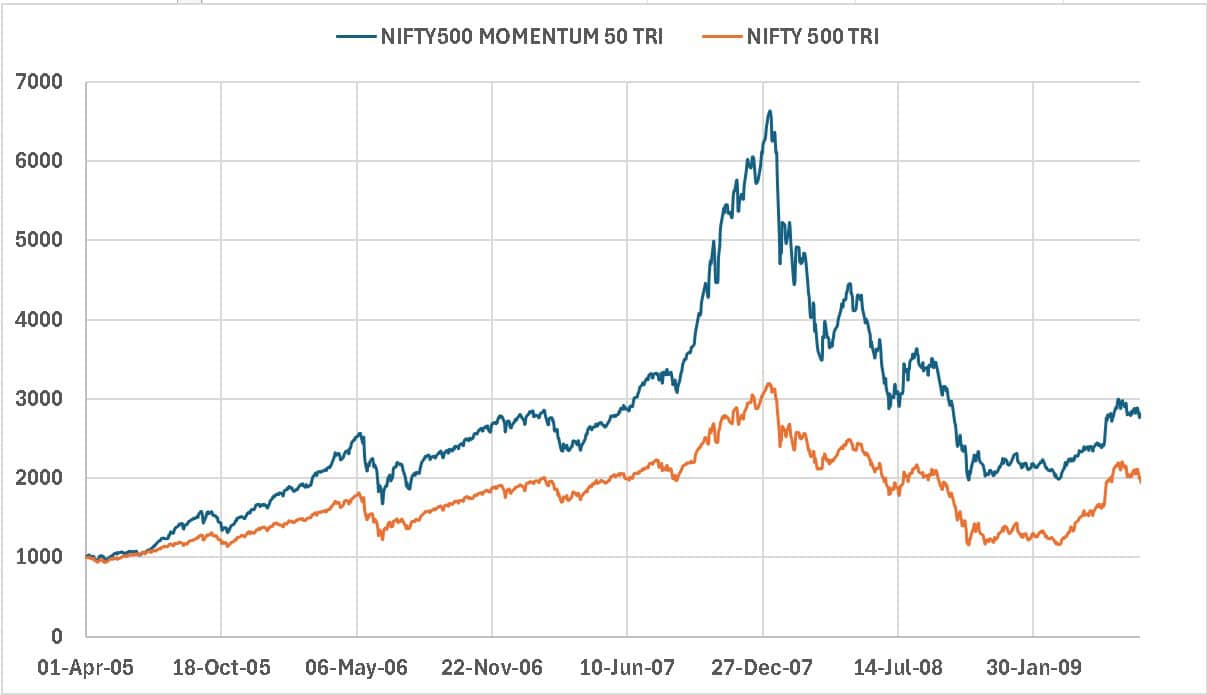
Evolution of Nifty 500 Momentum 50 TRI vs Nifty 500 TRI from April 2005 to July 2009

What goes up fast also comes down fast. Now, is that a smart way of investing?

Evolution of Nifty 500 Momentum 50 TRI vs Nifty 500 TRI from July 2009 to July 2023
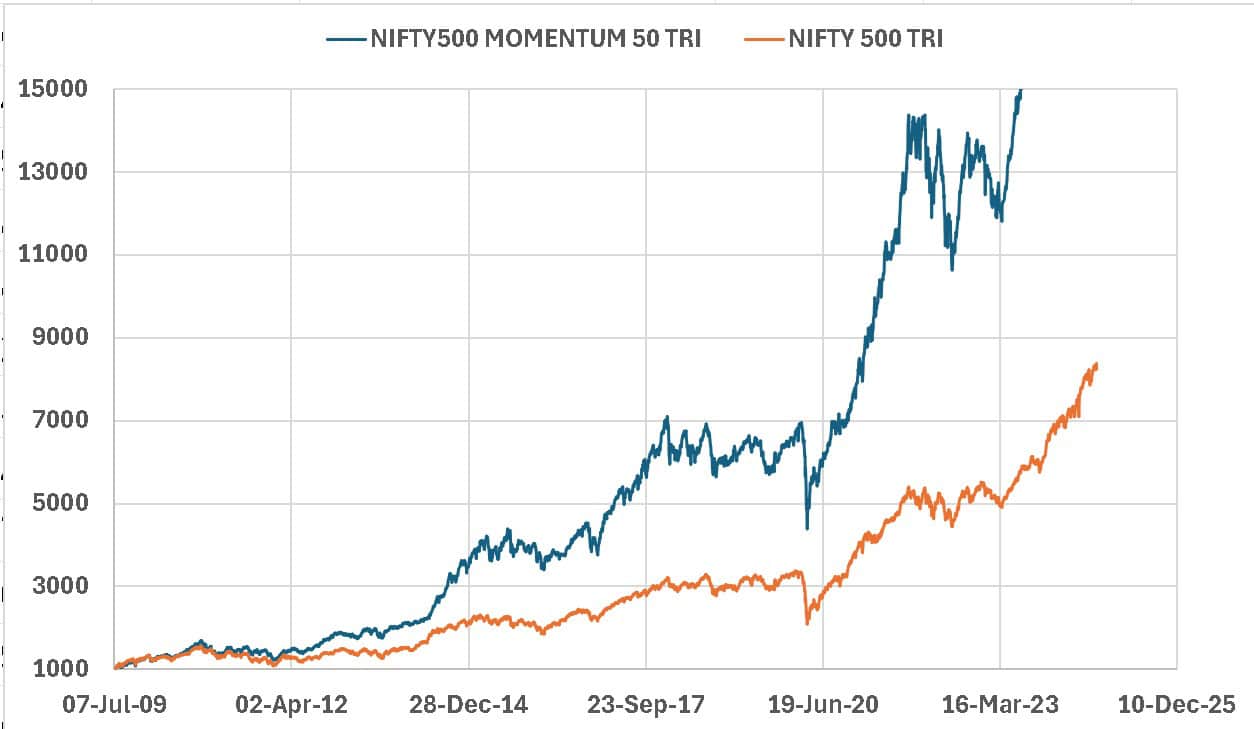
Evolution of Nifty 500 Momentum 50 TRI vs Nifty 500 TRI from July 2009 to July 2023

One of the reasons for its extreme volatility could be that the 50 chosen stocks from the Nifty 500 may have a good chunk of small cap or mid cap stocks. When the trend reverses, they fall as hard as they move up.

Should you invest in the Nifty 500 Momentum 50 Index?

It is too volatile (than a small cap index) to be the mainstay of a portfolio. At best, it can only be a sidekick included to satisfy the FOMO itch. But then again, mature investors would recognise that sidekicks only increase clutter and do not significantly impact wealth.

Our recommendation is to avoid momentum-based passive (or active) funds. If you “must” include it, add a small exposure. But then again, you can’t keep doing that each time there is a fancy NFO every few months.

Also see:

We are on Google News

Use this button to add freefincal.com as a preferred personal finance source on Google News.
Click to add freefincal as a preferred news source
You can also follow freefincal on Google News.
Click to follow freefincal on Google News

Explore 1,400+ videos on YouTube!

Click to subscribe to the freefincal YouTube Channel

Subscribe to get posts via email!

Join 32,000+ readers and get free money management solutions delivered to your inbox! (Link takes you to our email sign-up form)

Join our WhatsApp Channel

Click to follow freefincal on WhatsApp

Explore our products

🔥Join our community of 9000+ users! 🔥
  • Use our Robo-advisory Tool to create a complete financial plan! More than 3,500 investors and advisors use this! Use the discount code robo25 for 20% off. Plan your retirement (early, normal, before, and after), plus non-recurring financial goals (such as child education) and recurring financial goals (such as holidays and appliance purchases). The tool helps anyone aged 18 to 80 plan for retirement, plus six non-recurring and four recurring financial goals, with a detailed cash flow summary.
  • Our Flagship Course! Learn to manage your portfolio like a pro to achieve your goals regardless of market conditions! More than 3,500 investors and advisors are part of our exclusive community! Get clarity on how to plan for your goals and achieve the necessary corpus no matter the market conditions! Watch the first lecture for free! One-time payment! No recurring fees! Lifelong access to videos! Reduce fear, uncertainty and doubt while investing! Learn how to plan for your goals before and after retirement with confidence.
  • Join the freefincal investor circle! An exclusive space for investors, advisors, fintech employees and students to access financial planning and insurance tools, mutual fund and stock analysis tools, coding strategies and Excel macros for data extraction. 750+ members are now part of our investor circle.
  • Increase your income by getting people to pay for your skills! More than 900 salaried employees, entrepreneurs and financial advisors are part of our exclusive community! Learn how to get people to pay for your skills! Whether you are a professional or small business owner seeking more clients through online visibility, or a salaried individual looking for side or passive income, we will show you how to do it by showcasing your skills and building a community that trusts and pays you. (Watch the 1st lecture for free). One-time payment! No recurring fees! Lifelong access to videos!
  • We also publish monthly screeners for

Our Podcast: Let's Get Rich With Pattu

On Spotify: Let's Get RICH With PATTU! Every single Indian CAN grow their wealth! On Audible: Listen to the Let's Get Rich with Pattu Podcast
Poster for the Lets Get Rich with Pattu Podcast
Poster for the Let's Get Rich with Pattu Podcast
You can also watch podcast episodes on the OfSpin Media Friends YouTube Channel Listen to the Let's Get Rich With Pattu podcast on YouTube

Listen to the Let's Get Rich With Pattu podcast on YouTube.

Now watch Let's Get Rich With Pattu தமிழில் (in Tamil)!

About The Author

Dr M Pattabiraman giving a lecture

Dr M Pattabiraman giving a lecture

  • Dr M. Pattabiraman (PhD) is the founder, managing editor and primary author of freefincal. He is an associate professor at the Indian Institute of Technology, Madras.
  • He has over 14 years of experience publishing news analysis, research and financial product development. He has over 28 years of teaching and research experience. He is also a public speaker and keynote presenter.
  • He is a patron and co-founder of “Fee-only India,” an organisation promoting unbiased, commission-free, AUM-independent investment advice.
  • Connect with him via @pattufreefincal on X    LinkedIn   YouTube
  • Pattabiraman has co-authored three print books.
(1) You can be rich too with goal-based investing (Published by CNBC TV18) for DIY investors.

You can be rich too with goal based investing book cover

This book helps you ask the right questions and find the right answers. It also includes nine online calculators to create custom solutions.

(2) Gamechanger: Forget Startups, Join Corporate & Still Live the Rich Life You Want.

Gamechanger book cover

This book helps young earners get the basics right from the start! It will also help you travel to exotic places at a low cost! (3) Chinchu Gets a Superpower! for kids.

Both the boy and girl versions of Chinchu Gets a Superpower

Both the boy and girl versions of "Chinchu Gets a Superpower".

Most investor problems stem from a lack of poor decision-making. We made bad decisions and money mistakes when we started earning, and we spent years undoing them. Why should our children go through the same pain? What is this book about? As parents, what if we had to groom one ability in our children that matters not only for money management and investing but for every aspect of life? My answer: Sound decision-making. So, in this book, we meet Chinchu, who is about to turn 10. The story follows what he wants for his birthday and how his parents plan it, while also teaching him key ideas about decision-making and money management. What readers say!

Feedback from a young reader after reading Chinchu Gets a Superpower

Feedback from a young reader after reading Chinchu Gets a Superpower!

Must-read book even for adults! This is something that every parent should teach their kids right from a young age. The importance of money management and decision-making based on their wants and needs. Very nicely written in simple terms. - Arun.

About freefincal & its content policy

Freefincal is a News Media organisation dedicated to providing original analysis, reports, reviews and insights on mutual funds, stocks, investing, retirement and personal finance developments. We do so without conflict of interest and bias. Follow us on Google News. Freefincal serves more than three million readers a year (5 million page views) with articles based only on factual information and detailed analysis by its authors. All statements made will be verified with credible and knowledgeable sources before publication. Freefincal does not publish paid articles, promotions, PR, satire or opinions without data. All opinions will be inferences backed by verifiable, reproducible evidence/data. Contact Information: To get in touch, please use our contact form. (Sponsored posts or paid collaborations will not be entertained.)

Our publications

  • Your Ultimate Guide to Travel. This is an in-depth exploration of vacation planning, including how to find affordable flights, budget accommodations, and practical travel tips. It also examines the benefits of travelling slowly, both financially and psychologically, with links to relevant web pages and guidance at every step. Get the PDF for Rs 300 (instant download)

Travel Training Kit Cover

Connect with us on social media