If you open YouTube or Instagram today, the financial verdict is unanimous: Don’t buy a house. Rent it. The logic is seductive. Why pay an EMI of ₹60,000 for an apartment that rents for ₹25,000? The math says you should rent, invest the difference (the ₹35,000 surplus) in a mutual fund, and retire rich. Mathematically, the influencers are right. But there is a flaw in this logic: Humans don’t live in Excel sheets.
About the author: Ajay Pruthi is a fee-only SEBI-registered investment advisor. He can be contacted via his website plnr.in. Ajay is part of the freefincal list of fee-only advisors and fee-only India.
We live in communities and chaos. In the Indian context, a home is not just an asset class or a line item on a balance sheet. It is an emotional anchor. Here is the Missing Emotional Picture that the calculators ignore.
- The Nest Instinct: Autonomy & Logistics
The biggest hidden cost of renting is the Psychological Tax of living in someone else’s space.
- The 11-Month Sword: Every tenant lives with the low-level background anxiety of the 11-month agreement. The fear that the landlord might suddenly decide to sell the flat or move his son in, forcing you to pack up your entire life in 30 days.
- The Nail Constraint: Can you drill a hole to hang a painting? Can you paint the kid’s room pink? In a rented house, you are a guest. You adapt to the house; the house does not adapt to you.
- The Friction of Address Proof: In India, shifting houses isn’t just about moving boxes; it’s a bureaucratic nightmare. It means changing your Aadhaar, updating your bank KYC, finding new domestic help, and rerouting your Amazon deliveries. It is a logistical tax that renters pay repeatedly.
- The Loss of Social Roots (The Community Capital)
This is perhaps the most undervalued aspect of renting.
🔥Secure your future with our Robo-advisory tool trusted by over 3,500 investors and advisors. From effortless retirement planning to funding your children’s biggest dreams, turn your financial goals into reality. 🔥
Subscribe for money management solutions via email! (Link takes you to our email sign-up form) Join 32,000+ readers in our community.
👉 New Tool Alert! NaviPlan: A Privacy-Focused Multi-asset Tracker and Goal Planner 👈
- The Society Bond: When you live in a society for 3-4 years, you build an ecosystem. You have your evening walk group, your gym buddies, and the trusted vegetable vendor who knows your order. Your children have their gang downstairs.
- The Trauma of Uprooting: If a landlord asks you to vacate, you aren’t just moving furniture; you are severing these relationships. You can find a new flat, but you cannot instantly replace the neighbour who has a spare key to your house or the friends your parents made in the park. For elderly parents or growing children, this dislocation is deeply isolating.
- The Settled Label: Sociology & Marriage
In the West, renting at 40 is a lifestyle choice. In India, it is often viewed as a failure to launch.
- The 35+ Shame: There is an unspoken social script. If you are 38 and still renting, family gatherings often involve the stinging question: Beta, when will you settle?
- Marriage Market Reality: Brutal but true—in the arranged marriage market, a groom with a home loan is often preferred over a groom with a high rental yield but no assets. The asset signals stability; the rental portfolio signals risk.
- The Definition of Settled: For many, paying the premium of an EMI is worth it just to escape the social stigma of being a drifter and to provide stability for their aging parents who live with them.
- The Forced Discipline of the EMI
The Rent and Invest the Difference strategy assumes you have the discipline of a monk.
- The Reality: If you save ₹30,000 by renting, do you actually invest it diligently every month? Or does it leak into a better car, a vacation, or a new iPhone?
- The EMI Guardrail: An EMI is a gun to your head. You have to pay it. It forces you to build equity. For the average indisciplined investor, a home loan is a forced savings plan.
- The Financial Blind Spots (The Advanced Math)
Even if we ignore the emotions and look strictly at the money, the standard Rent vs. Buy calculator misses critical variables that experienced investors know.
- The Leverage Advantage: Buying a home is the only time a bank lets you control a large asset with a small down payment. Renters investing small SIPs rarely get access to this kind of leverage.
- Rent Inflation vs. Flat EMI: The calculator assumes the rent gap stays constant. It doesn’t. Your EMI is locked (and eventually vanishes). Your rent compounds every year. In 10-15 years, the rent for your apartment will likely exceed the EMI you feared today.
- The Emergency Asset Factor: A home is a financial bunker. In a medical crisis or job loss, an owner can take a Loan Against Property (LAP) or downgrade to a smaller house to unlock cash. A renter has no asset to leverage when life hits hard.
- The Career Tax Counter-Argument: However, there is one financial win for renting: Mobility. Owners often get geo-locked, refusing better job offers in other cities because they can’t leave their house. Renters can move instantly for a 30% salary hike, treating their career as their primary asset.
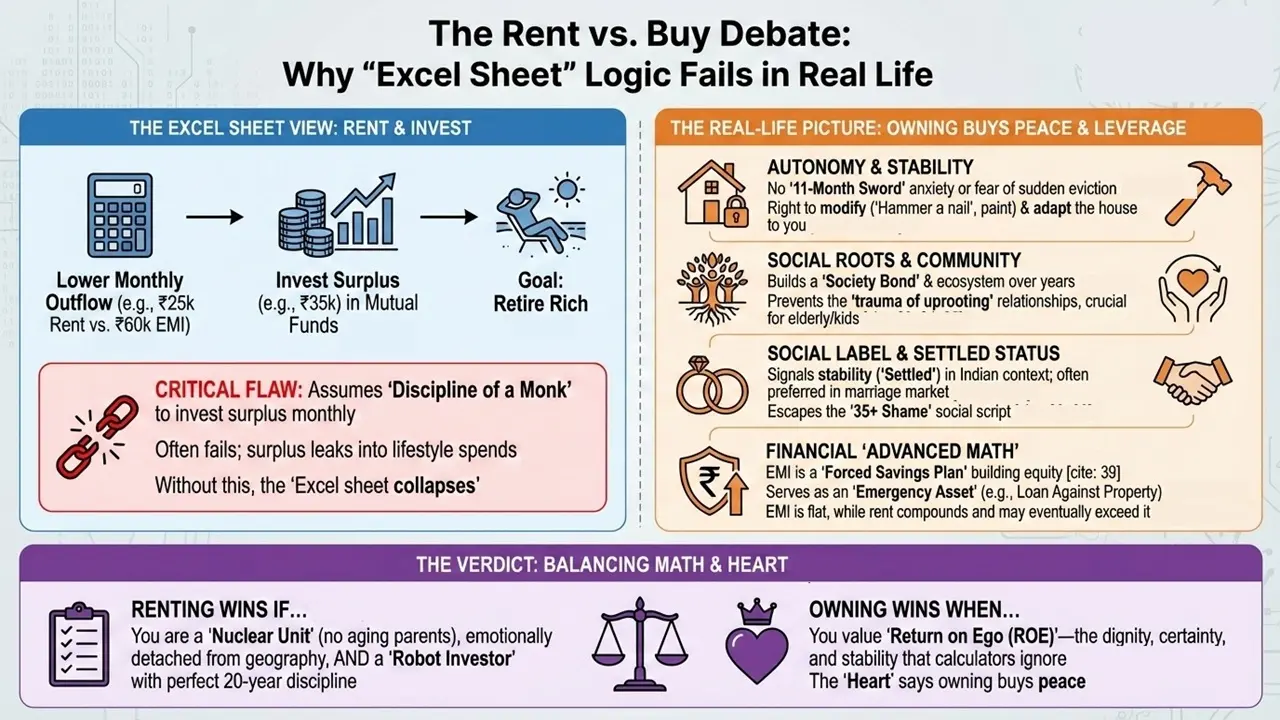
The Verdict: When does Renting actually win?
Renting is the superior financial choice, but only if you meet this specific checklist. You should rent if:
- You are a Nuclear Unit: You don’t have ageing parents living with you who need the stability of a permanent address and a consistent doctor/social circle.
- You are emotionally detached from geography: You don’t mind shifting zip codes every 2 years.
- You are okay with your child changing playgroups or schools, and you don’t attach deep value to neighbour friends.
- You are a Robot Investor: This is the hardest part. You must possess the discipline to invest the surplus every single month for 20 years without fail. You cannot pause the SIP for a vacation or a wedding. If you miss this discipline, the Excel sheet collapses, and you end up with neither the house nor the corpus.
The Bottom Line:
The Math says: Renting saves money.
The Heart (and the Advanced Math) says: Owning buys peace and leverage.
When you pay an EMI, you aren’t just paying for bricks. You are paying for the right to hammer a nail into the wall, the certainty that your child won’t lose their best friend because of a lease expiry, and the dignity of never being asked to vacate by next month.
Sometimes, the Return on Investment (ROI) matters less than the Return on Ego (ROE).