A viewer on our YouTube channel wants to know, “Which mutual fund category should I use to invest for a newborn child?”. It is heartening to note that you are seeking category names and not actual fund names. However, some work must be done before we can get there.
Our investing mantra is process-first, products-last. We create a financial plan suited to our needs, considering realistic inflation estimates. Then we consider the necessary risk for the goal, the risk we can emotionally handle and determine an asset allocation (mix of equity and fixed income) as a compromise between the two. Then we consider product categories in each asset class and, finally, the products. Let us break down the task into steps.
- We need a target corpus to achieve after 17 years (or 18 years, depending on when she was born). That is after school graduation.
- Some parents ask, “But what about school fees and other coaching fees?”. This is best funded from monthly income, or you are in trouble! When we refer to the child’s future here, it will only refer to the UG fee, PG fee, relocation expenses and marriage expenses if the parents see fit.
- Let us first set the target corpus = UG fee. The corpus can easily be enhanced to include other expenses. A UG fee of Rs. 1.5 lakh per semester x eight semesters + a joining fee of Rs. 5 Lakhs + another Rs. 5 lakhs for relocation, travel etc., sounds right to us. You can make enquiries and set a target too.
- So that is about Rs. 22 lakhs. Make that Rs. 25 lakhs as the current cost. That is, if your child were to enter a four-year UG program today, that is what it would cost approximately.
- What is the likely cost after 16/17/18 years, as the case would be for your child when we start planning?
- We will use inflation of 10%-12%.
- At 10% inflation, the corpus will be about Rs. 1.25 crores after 17 years.
- Suppose the parents can invest Rs. X each month for this goal. About 50-60% of X should be invested in stocks or equity mutual funds, assuming a post-tax return of 10% from equity.
- The remaining amount can be invested in debt instruments with a return of about 6%. Remember, this is not the return you will get the next year. This is the return you expect after 17 years.
- Now let us come to your question: Which mutual fund category should I use to invest for a newborn child? For the equity part, a Sensex or Nifty 50 index fund is all that is required. We recommend an aggressive hybrid fund (treat it as 100% equity) if you want an actively managed mutual fund.
- But which debt instruments? We recommend PPF and debt funds for the daughter’s education and Sukanya Samriddhi Yojana (SSY) for her marriage (if that is something important to you). Remember that you can withdraw 50% of SSY corpus for education only if the girl has turned 18. Many children get admitted to colleges before that. Also, there is only a 0.5 return difference between PPF and SSY. This is insignificant in an equity-heavy portfolio.
- For rebalancing and gradual shifting from equity to debt as the goal deadline nears, you can consider a money market mutual fund or an arbitrage fund (remember, returns do not matter here, just reasonable safety). Fund recommendations are available here: Handpicked List of Mutual Funds (Plumbline).
- The above-mentioned future target corpus is only for UG education. If you wish to include her PG education expenses, marriage expenses etc., please modify them as required.
- What is more important is asset allocation after we start investing. We cannot hold on to 50% or 60% for most of the journey. A string of poor returns will upset our plans. Entering the above details into our robo advisory tool, we get: 60% equity for 7-8 years and then a gradual tapering down to 0% for the rest of the journey. Many goal calculators use a single future return expectation as input to compute the monthly investment required. This is incorrect, as the asset allocation will vary.
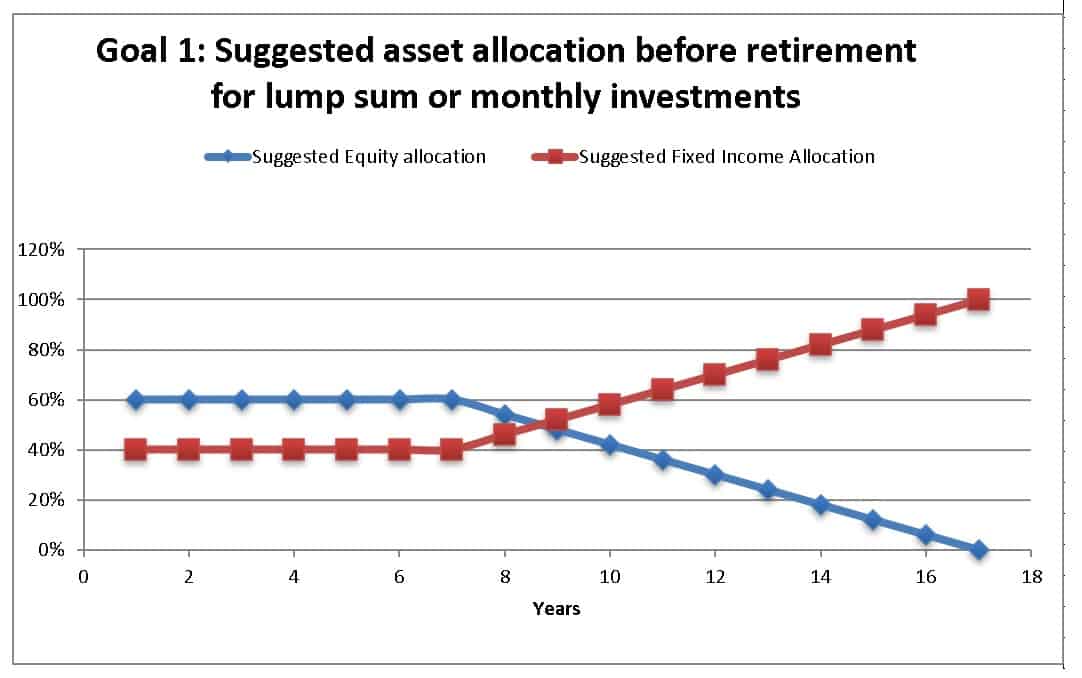
Suggested asset allocation by the freefincal robo advisory template for a child’s college education 17 years away. - With this variable asset allocation, the total monthly investment required in the first year of investing is Rs. 15 500. Each year after this, the investment should be increased by 10%.
- Do go rush to invest Rs. 1.5L a year in PPF just because it is tax-free with a guaranteed return. In the above plan, the total investment in debt will only be Rs. 74 K. Until the equity allocation starts decreasing, as mentioned above, the debt investment will not exceed Rs. 1.5 L a year. After this, a debt mutual fund may be added to accommodate the higher debt investment.
- The above calculation should be repeated each year with updated inputs and assumptions.
All the best!
For other illustrations, see:
- I am 30 and wish to retire by 50; how should I plan my investments?
- Retirement plan review: Am I on track to retire by 50?