Have you ever tried to sell something on OLX—maybe an old phone or a piece of furniture?
You list it for ₹15,000. You think it is a fair price. It has served you well.
Then, the messages start coming in: Bhaiya, ₹5,000 cash? or Last price ₹6,000.
You get angry. You feel insulted. You think these people are trying to cheat me! They don’t know the value of this item!
But here is the harsh truth: They are not cheating you. You are lying to yourself.
🔥Secure your future with our Robo-advisory tool trusted by over 3,500 investors and advisors. From effortless retirement planning to funding your children’s biggest dreams, turn your financial goals into reality. 🔥
Subscribe for money management solutions via email! (Link takes you to our email sign-up form) Join 32,000+ readers in our community.
👉 New Tool Alert! NaviPlan: A Privacy-Focused Multi-asset Tracker and Goal Planner 👈
This is called the Endowment Effect. In simple psychology, it means: We overvalue things simply because we own them.
About the author: Ajay Pruthi is a fee-only SEBI-registered investment advisor. He can be contacted via his website plnr.in. Ajay is part of the freefincal list of fee-only advisors and fee-only India.
The Twist: The Emotional Price Tag
In economics, the price of an item is determined by Supply and Demand.
In your head, the price is determined by Supply, Demand, and Feelings.
When you buy something, you pay the Market Price.
When you sell something, you try to charge the Emotional Price.
The gap between the Market Price and your Emotional Price is where you lose money.
Scenario 1: The Empty Flat Ego (The Rent Trap)
This is a classic scenario in Indian metro cities like Mumbai, Bangalore, or Gurgaon.
The Situation:
Mr. Verma owns a 2BHK. His previous tenant, who stayed for 3 years, was paying ₹40,000 rent. That tenant vacates. Mr. Verma puts the flat back on the market for ₹42,000 (expecting an increase).
The Market Reality:
In the last 3 years, two new gated societies have come up next door. They have a swimming pool, gym, and power backup. Mr. Verma’s building is old and has no amenities. Prospective tenants offer ₹35,000.
The Endowment Effect:
Mr. Verma refuses. He says, my last tenant paid ₹40k! Why should I take ₹35k? My flat is spacious and lucky! He feels that accepting less is a personal insult or a loss.
The Result:
He kept the flat empty for 4 months waiting for the right price.
- Loss from vacancy: ₹35,000 x 4 months = ₹1.40 Lakhs.
- Gain from waiting: Even if he gets a tenant at ₹40k later, it will take him 2 years just to recover the loss of those 4 empty months.
He lost real money to protect his rental pride.
Scenario 2: The Stock Market Trap (The Ego Hold)
This bias is the number one reason retail investors hold onto garbage stocks.
The Situation:
You bought shares of Company X at ₹500 because your friend recommended it. Today, the price has crashed to ₹300. The company’s profits are down, and the sector is doing badly.
The Rational Move:
Sell the stock. Take the loss of ₹200. Use the remaining ₹300 to buy shares in a strong company that will actually grow.
The Endowment Effect:
You refuse to sell. You think: I chose this stock. It is MY portfolio. If I sell now, I am accepting I was wrong. I will wait until it comes back to ₹500.
You value the stock more after you bought it than before. You are not holding it for profit; you are holding it to protect your ego.
The Result:
Company X slides further down to ₹100. You lose almost your entire capital because you were too emotionally attached to admit a mistake.
Scenario 3: The Dream House Dilemma (The Selling Trap)
The Situation:
Mr. Sharma wants to sell his independent house. He speaks to a broker.
- Broker’s Valuation: Sir, based on the area rates, this house is worth ₹80 Lakhs.
- Mr. Sharma’s Reaction: Are you mad? We have celebrated 20 Diwalis here. I painted these walls myself. I will not take less than ₹1 Crore.
The Problem:
Mr. Sharma is selling Memories. The buyer is buying Bricks.
Mr. Sharma sees the corner where his son learned to walk.
The Buyer sees a damp wall that needs repair.
The Result:
Mr. Sharma refuses the ₹80 Lakh offer. The house has been on the market for 2 years. The paint peels, the market softens, and eventually, he sells it for ₹75 Lakhs out of desperation. His pride cost him ₹5 Lakhs plus 2 years of lost investment returns.
Scenario 4: The Backup Phone Graveyard
Almost every Indian middle-class drawer has this graveyard.
The Situation:
Rohan buys a new iPhone. His old Android phone (bought 3 years ago for ₹30,000) is working fine, but has a small scratch. Exchange value offered by Amazon/Flipkart: ₹4,000.
The Endowment Effect:
Rohan thinks, only ₹4k? Are they looting me? I bought this for ₹30k! It has a great camera. I will keep it as a ‘Backup Phone’ for emergencies.
The Market Reality:
Electronics depreciate faster than rotting fruit. A phone is not an asset; it is a tool.
The Result:
The phone sits in a drawer for 4 years. The battery swells up and leaks. The Android version becomes obsolete. Final Value: ₹0 (E-waste). If he had sold it for ₹4,000, he could have used that money. Instead, he chose to own a depreciating brick.
Scenario 5: The Cable & Box Drawer (The Electronic Hoard)
Every Indian household has this one drawer or carton.
The Situation:
Rohan has a drawer full of old Nokia chargers, USB-A cables, a digital camera from 2010, and the box of an iPhone 6.
The Rational Move:
Throw it away or give it to e-waste recyclers to declutter space. These items have zero utility today.
The Endowment Effect:
Rohan thinks, this camera still works! I paid ₹15,000 for it. What if I need this specific cable someday? It’s good quality. He values the potential utility of his possessions higher than the actual value of a clean, organized home.
The Result:
He buys a new cupboard because he has no space. He pays for storage (real estate cost) to house trash.
Scenario 6: The Infinite Almirah Loop (Domestic Dead Stock)
This is visible in almost every Indian master bedroom. We treat our clothes like fixed assets that must remain on the Balance Sheet forever.
The Situation:
Mrs. Mehra’s wardrobe is overflowing. She struggles to shut the door. She needs space for her new Diwali shopping. Upon checking, she finds 20 heavy suits and kurtas she hasn’t worn since 2018. Some are tight, some are out of fashion.
The Rational Move:
Donate the old clothes to the house help or an NGO. They have zero market value to her since she doesn’t wear them. This would free up space for free.
The Endowment Effect:
She picks up an old Anarkali suit. I bought this for ₹5,000 for my cousin’s wedding! It is pure Georgette. How can I just give it away for free? I might lose weight and wear it next year. She values the clothes based on their Past Price, not their Current Utility.
The Solution (The Trap):
Instead of clearing the junk, she buys a new Godrej Almirah for ₹25,000 or orders expensive storage organizers from Amazon.
The Financial Reality:
She just spent ₹25,000 to store clothes that are worth ₹0. She is paying rent (in the form of furniture cost and expensive real estate floor space) to house items that provide no value.
The Result:
The new Almirah also gets full in 2 years. The old clothes eventually get fungus or smell musty and are thrown away 5 years later. Loss: She lost the space in her room + the cost of the new Almirah, just to delay the pain of parting with old fabric.
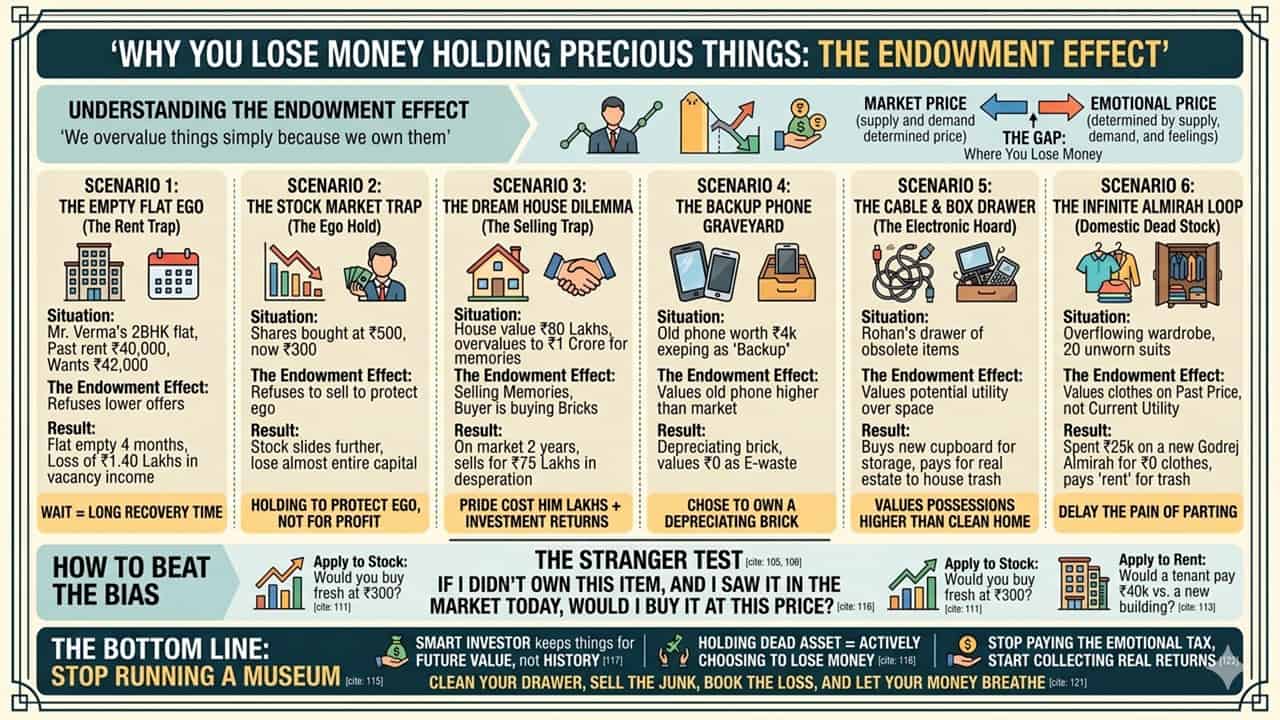
How to Beat the Bias: The Stranger Test
The Endowment Effect makes us hoard dead assets, hold losing stocks, and lose rental income. To defeat it, you need to detach your emotions from your assets.
Use the Stranger Test.
Before holding or selling an asset, ask yourself this:
If I didn’t own this item, and I saw it in the market today, would I buy it at this price?
- For the Stock: If you didn’t own Company X today, would you buy it fresh at ₹300? If the answer is No (because the company is bad), then you must sell it immediately.
- For the Rent: If Mr. Verma was a tenant, would he pay ₹40k for his old flat when the new building next door has a pool for the same price? No.
The Bottom Line: Stop Running a Museum
Your home and your portfolio are not museums. A museum keeps things because of history. A smart investor keeps things because of future value.
Every day you hold onto a dead asset—whether it is a losing stock, an empty flat, or a suit you haven’t worn in three years—you are actively choosing to lose money. You are paying a daily fee to your ego.
Wealth flows to those who are practical, not those who are sentimental. Clean your drawer, sell the junk, book the loss, and let your money breathe. Stop paying the emotional tax and start collecting real returns.