Recently, someone on X referenced a trailing 5,7,10Y SIP returns comparison of direct plan large cap funds vs the Nifty 100 TRI and concluded that most active funds beat the index. They also noted that using SIP returns avoids the bias introduced by trailing returns.
I responded that using a 5Y or 10Y SIP is still a trailing return, since SIP returns depend on a specific sequence of returns, and that I would try a rolling SIP analysis. See: How the fate of your mutual fund SIPs is decided by “timing luck”
Regular readers may know that we have used rolling (lump sum) returns multiple times to show that most active funds, regardless of category, cannot beat the index.
- Active Large Cap Mutual Funds vs Nifty 100 performance analysis
- Active Mid Cap Mutual Funds vs Nifty Midcap 150
- Active Small Cap Mutual Funds vs Nifty Midcap 150
Each month, we also publish a unique, rolling-returns-based equity mutual fund screener.
How will the results change if we use rolling SIPs rather than rolling lump-sum returns? I was curious to find out. These calculators are part of the freefincal investor circle.
🔥Secure your future with our Robo-advisory tool trusted by over 3,500 investors and advisors. From effortless retirement planning to funding your children’s biggest dreams, turn your financial goals into reality. 🔥
Subscribe for money management solutions via email! (Link takes you to our email sign-up form) Join 32,000+ readers in our community.
👉 New Tool Alert! NaviPlan: A Privacy-Focused Multi-asset Tracker and Goal Planner 👈
There are several limitations to this study, though!
- It takes a long time to accomplish, so we decided to choose only one duration – 10 years.
- Regardless of duration, we cannot use direct plan funds because they were started only on 1st January 2013, and the number of data points would be limited.
- Even with regular plan funds, only 116 rolling SIP data points are available for 10Y returns. If I use only a 5Y duration, people will say, “We need to give active funds more time to perform”
- Several mutual funds have changed investment style on their own and due to SEBI in the past. The large cap space is a relatively safer bet as the changes were not as much here.
- Up to 1st Aug 2009, MFs had an entry load! This will reduce investor returns further.
- Given all these, I still prefer lump-sum rolling returns, as I do not expect much difference compared to a SIP. See: SIP vs Lump sum: Which is a better way to invest in mutual funds?
- With a lump-sum rolling return study, I can move the rolling return window by one business day. With a SIP, I will have to move it by 1 month. This naturally limits available data points, although it should not make any impact on conclusions (IMO)
- In a way, using regular funds for the analysis is fair, since most MF distributors are fans of (regular plan) active funds.
So what is it worth? I studied 19 large cap funds that are at least 15 years old. These are the results.
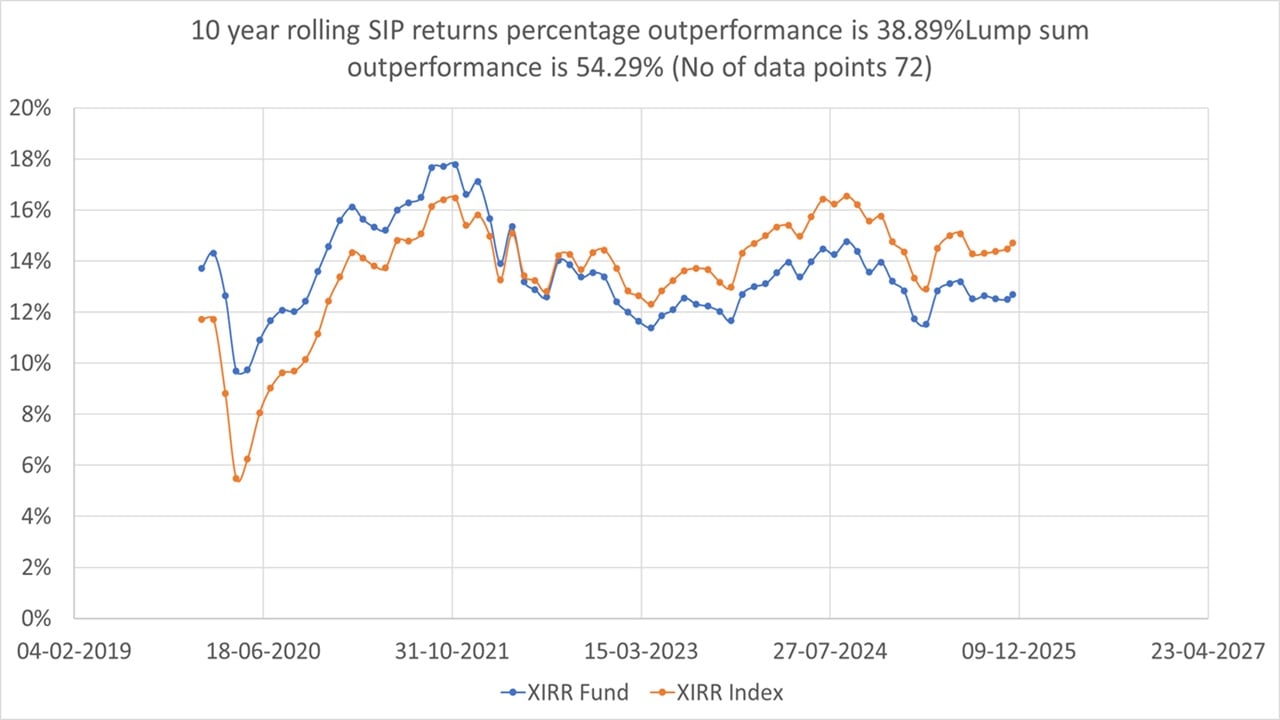
Please do not invest in the best-performing funds in these lists! Past performance does not represent future performance.
| Fund | Number of 10Y Rolling SIP or lump sum Data points | Rolling SIP outperformance |
| Canara Rob Large Cap Fund-Reg(G) | 64 | 100% |
| ICICI Pru Large Cap Fund(G) | 91 | 86% |
| Nippon India Large Cap Fund(G) | 101 | 74% |
| Mirae Asset Large Cap Fund-Reg(G) | 93 | 73% |
| SBI Large Cap Fund-Reg(G) | 116 | 71% |
| HDFC Large Cap Fund(G) | 116 | 59% |
| Aditya Birla SL Large Cap Fund-Reg(G) | 116 | 41% |
| Axis Large Cap Fund-Reg(G) | 72 | 39% |
| Edelweiss Large Cap Fund-Reg(G) | 79 | 34% |
| Franklin India Large Cap Fund(G) | 116 | 20% |
| Invesco India Largecap Fund-Reg(G) | 72 | 18% |
| Tata Large Cap Fund-Reg(G) | 116 | 16% |
| DSP Large Cap Fund-Reg(G) | 116 | 9% |
| JM Large Cap Fund-Reg(G) | 116 | 1% |
| HSBC Large Cap Fund(G) | 116 | 0% |
| UTI Large Cap Fund-Reg(IDCW) | 116 | 0% |
| Taurus Large Cap Fund-Reg(G) | 116 | 0% |
| Bandhan Large Cap Fund-Reg(G) | 86 | 0% |
| Kotak Large Cap Fund(IDCW) | 59 | 0% |
Observations
- Only 11 funds yielded more than 100 data points.
- Only six funds have an outperformance consistency above 50%. Only five are above our usual criterion of 70%. Even among these, one fund is quite young, and two others offer fewer than 100 data points.
We compared the SIP and Lump sum rolling returns for identical tenures
| Fund | Rolling SIP outperformance | Rolling Lump sum outperformance |
| Canara Rob Large Cap Fund-Reg(G) | 100% | 0.825397 |
| ICICI Pru Large Cap Fund(G) | 86% | 1 |
| Nippon India Large Cap Fund(G) | 74% | 0.979798 |
| Mirae Asset Large Cap Fund-Reg(G) | 73% | 0.956044 |
| SBI Large Cap Fund-Reg(G) | 71% | 0.869565 |
| HDFC Large Cap Fund(G) | 59% | 0.486957 |
| Aditya Birla SL Large Cap Fund-Reg(G) | 41% | 0.808696 |
| Axis Large Cap Fund-Reg(G) | 39% | 0.542857 |
| Edelweiss Large Cap Fund-Reg(G) | 34% | 0.64557 |
| Franklin India Large Cap Fund(G) | 20% | 0.278261 |
| Invesco India Largecap Fund-Reg(G) | 18% | 0.178082 |
| Tata Large Cap Fund-Reg(G) | 16% | 0.252174 |
| DSP Large Cap Fund-Reg(G) | 9% | 0.226087 |
| JM Large Cap Fund-Reg(G) | 1% | 0 |
| HSBC Large Cap Fund(G) | 0% | 0 |
| UTI Large Cap Fund-Reg(IDCW) | 0% | 0 |
| Taurus Large Cap Fund-Reg(G) | 0% | 0 |
| Bandhan Large Cap Fund-Reg(G) | 0% | 0 |
| Kotak Large Cap Fund(IDCW) | 0% | 0 |
Only four funds had SIP performance greater than the lump-sum performance. This means that using lump-sum rolling returns is actually a lenient way to evaluate active funds, and they still fail (see links above).
Conclusion: A SIP rolling return study points us in the same direction – use index funds if you want to avoid fund manager risk and fees. Buying active funds in the hope of beating the market is NOT a reasonable risk! See: Reasonable and unreasonable risks in investing and money management.
If you want to claim that direct plan funds will do better than regular plan active funds, yes, that is obvious, but even with a less stringent guideline like rolling lump sum, many still fail to beat the market. If you wish to insist on a rolling SIP study with direct plans, that is still some years away. It makes no sense to wait! Young investors are better off with index funds and could focus their time and energy on increasing their income.