Last Updated on June 7, 2016 at 8:50 am
The Omega ratio is an interesting performance evaluation metric that can be used for evaluating a mutual fund with its benchmark and also compare funds. In this post, I present a simple, non-technical description of the omega ratio along with some examples.
The Omega ratio has been part of the mutual Fund risk vs return analyzer since inception. I refer to it as interesting because it is superior to commonly used metrics like the Sharpe and Sortino ratios because it does not require returns (monthly/weekly/daily) returns to fall on a nice bell curve (the which they don’t!). The Omega ratio considers fat tails too.
Although the calculation is quite different, the idea behind the Omega ratio is similar to the downside and upside capture ratios, but at the same time a lot more flexible.
Note: I would like to introduce different risk-return metrics because I am a student of the subject. Please do not confuse my curiosity with investment advice. My aim to learn, create tools and share them here. What you choose to use or not use is up to you.
🔥Secure your future with our Robo-advisory tool trusted by over 3,500 investors and advisors. From effortless retirement planning to funding your children’s biggest dreams, turn your financial goals into reality. 🔥
Subscribe for money management solutions via email! (Link takes you to our email sign-up form) Join 32,000+ readers in our community.
👉 New Tool Alert! NaviPlan: A Privacy-Focused Multi-asset Tracker and Goal Planner 👈
To understand what the Omega ratio is, it is important to recall what the downside and upside capture ratios refer to.
Downside capture ratio = Downside CAGR of fund/Downside CAGR of index
Downside CAGR of the fund (or index) is the annualised return by counting only those months/weeks/days when the index return was negative (<0).
A low downside capture ratio implies the fund has lost less than its index when the index did poorly.
Similarly,
Upside capture ratio = Upside CAGR of fund/Upside CAGR of index
Upside CAGR of the fund (or index) is the annualised return by counting only those months/weeks/days when the index return was positive (>0).
A large upside capture ratio implies the fund did better than the index when the index did well.
Capture ratio = Upside capture/Downside Capture
I had purposely indicated the >0 and <0 in bold brown. What if you could your own threshold?
The Omega ratio allows us to do this by setting a minimum acceptable return (MAR) – which could also be 0%!
However, the Omega ratio does not calculate the CAGR. Instead, for a given MAR, it finds how many monthly/weekly/daily returns in a given sample set (over 1,2,… etc years) are above the MAR and how many below.
A positive return is one which is above the MAR and a negative return one below it.
Omega ratio = positive return spread/ negative return spread. The value depends on the MAR chosen by the user.
The value depends on the MAR chosen by the user. For those technically inclined, the spread is actually an area or rather the probability associated with the distribution.
A higher Omega ratio is better. A fund consistently having a higher Omega ratio that its index is a ‘good fund’.
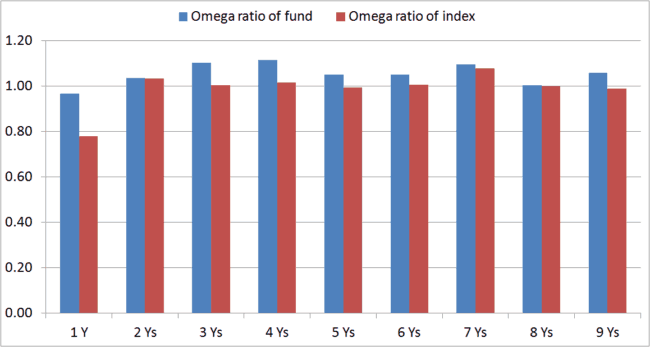
This quantum long-term equity (QLTE) vs Sensex total returns index for an MAR of 10%.
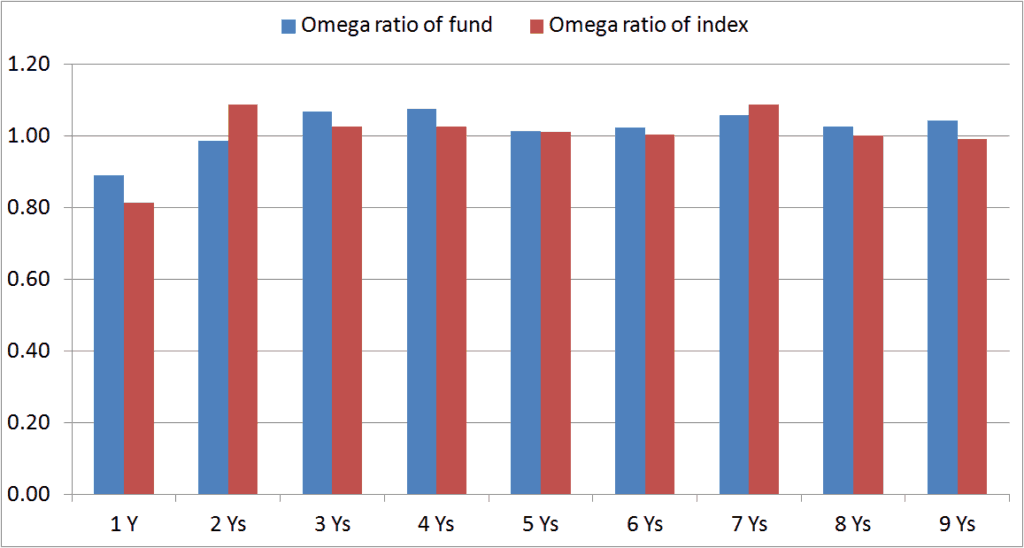
HDFC Equity vs BSE 500 (TRI)* with MAR of 10%. Notice that HDFC Equity has lower Omega ratio than QLTE and is not consistent in beating the benchmark.
* The appropriate benchmark is CNX 500, but the BSE 500 should be a reasonable replacement since TRI values are available.
Resources/References
Article about the Omega ratio from evestment.com