Last Updated on July 10, 2022 at 8:18 am
Have you ever wondered what drives stock market returns? Is it linked to the GDP? Is it related to company earnings? Elections? RBI policy decisions? In this post, I list the findings of several studies which have attempted to ask the same question.
This is a followup to the last three posts:
- Why should I invest in equity if it comes with no guarantees?!
- Basics of Personal Portfolio Management
- A Mutual Fund SIP is Hope, Not a Strategy!
The key message in yesterday’s post was, just because a security increases over the long-term, does not mean investors who buy and sell it will get good returns. A question that came out of that discussion was, will the stock market (index) always increase over a period of time?
Which naturally brings us to the question ‘what drives the stock market?’
🔥Secure your future with our Robo-advisory tool trusted by over 3,500 investors and advisors. From effortless retirement planning to funding your children’s biggest dreams, turn your financial goals into reality. 🔥
Subscribe for money management solutions via email! (Link takes you to our email sign-up form) Join 32,000+ readers in our community.
👉 New Tool Alert! NaviPlan: A Privacy-Focused Multi-asset Tracker and Goal Planner 👈
GDP as a market driver
The gross domestic product is an indicator of the health of the economy. It is widely believed that long-term stock market returns should match GDP. Does actual data show any such evidence?

Jerry Bowyer argues in Forbes that there is a ‘good enough’ connection between 10Y equity CAGR and 10 Y GDP CAGR.
Credit demand as a market driver
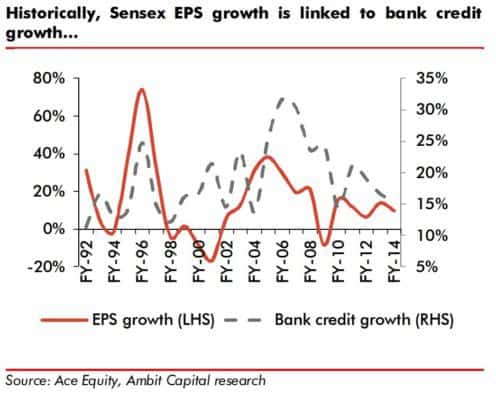
When industries seek more credit from banks, they have some hope of doing well and this typically increases earning and in turn the stock market does well.
Gross fixed capital formation (GFCF) as a market driver
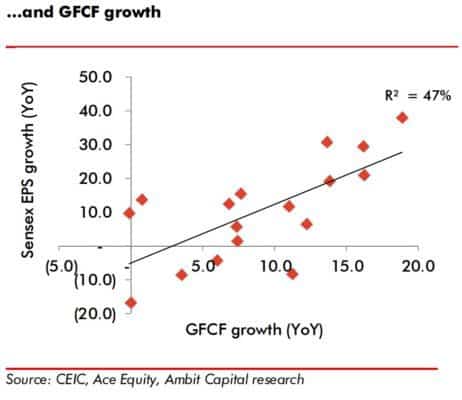
The GFCF is a measure of how much net revenue is invested back for fixed asset creation (with an aim to increase productivity). Higher the GFCF, higher the earnings. If I am not wrong, the CAPEX is closely related to the GFCF.
The index earnings growth is a strong driver of bull markets as show by an equitymaster article
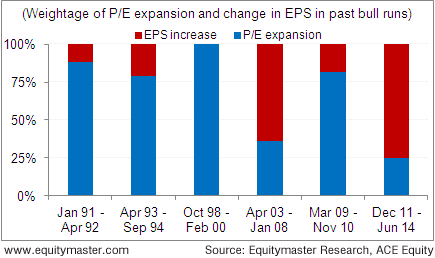
I think it is reasonable to conclude that the GDP, and corporate earnings can drive bull markets and can be thought of as “long-term” drivers of the stock market.
Market returns are not governed by long-term drivers alone. Short-term drivers can serious hurt investor returns. Long-term gains can vaporise in a single crash.
PE as a market driver
Ambit research (Jan 2014) report believes the PE is a short-term (~1Y) driver. I would like to disagree.
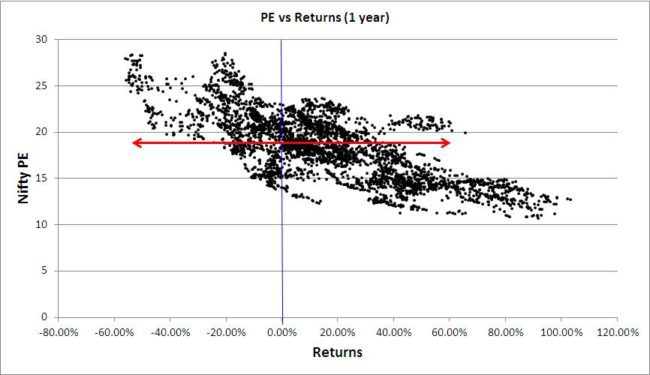
The spread is simply too much! Read more: Relevance of the Nifty PE for the long-term investor
Political Cycles as a market driver
Ambit makes another interesting correlation.
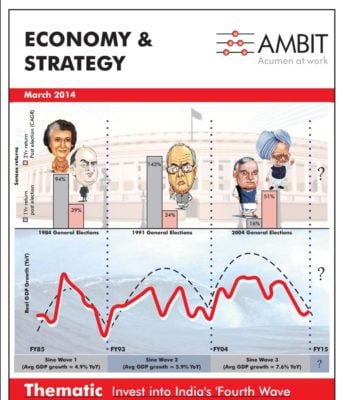
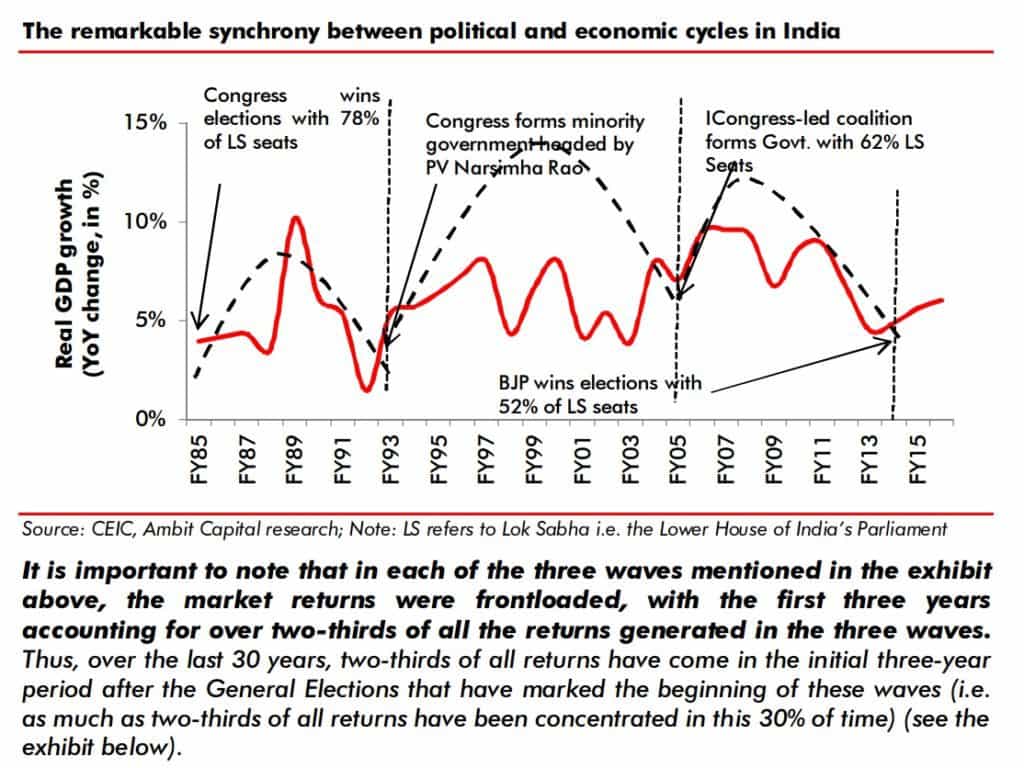
Each time a strong govt has taken office, the market tends to revive for next 3-4 years.
whilst over the entire 30-year period, the Sensex has delivered 16% (in CAGR terms), in this initial three-year window following these three critical elections, it has delivered ~33% (in CAGR terms)
Ambit Reseach report Nov 2014
These cycles can destroy as wel as destroy wealth. Therefore, it may not be a bad idea at to rebalance in year or so before elections. With an election looming, if the financial goal is only a few years away, it makes sense (to me) to shift out of equity.
Central Bank policy as a market driver
Vivek Kaul notes central banks have played a key role in determining market returns in many countries. This again is a short-term driver.
Moral of the story: While the stock market may (typically) increase over the long-term, short-term drivers determine actual wealth created by investors.
Ps. Stock market need not always increase. Japan is often quoted as an example. Before asking if India can become another Japan, we should ask, when Japan became a Japan!
I hope I have made some sense here. Do share your thoughts on what drives the market.