Last Updated on January 6, 2022 at 7:50 am
Dynamic equity funds or dynamic asset allocation funds change their equity:fixed income allocation depending on market conditions. Here is why those who wish to chase returns should not invest in such funds.
Dynamic equity funds could either
invest directly in a mix of stocks, arbitrage opportunities and bonds (in which case they will be classified as equity funds if they maintain 65% of equity+ arbitrage positions at all times, else as debt funds )
or they could be fund-of-funds. That is they invest in one equity and one debt fund from the same AMC and change allocations. In this case, they will be classified fund as debt funds.
🔥Secure your future with our Robo-advisory tool trusted by over 3,500 investors and advisors. From effortless retirement planning to funding your children’s biggest dreams, turn your financial goals into reality. 🔥
Subscribe for money management solutions via email! (Link takes you to our email sign-up form) Join 32,000+ readers in our community.
👉 New Tool Alert! NaviPlan: A Privacy-Focused Multi-asset Tracker and Goal Planner 👈
The strategy used for changing asset allocation could be:
Index PE (eg. Franklin Dynamic PE fund of funds)
200 days daily moving average (Try the Moving Average Market Level Indicator) (eg. Can anyone let me know of an example)
A combination of PE and 200 DMA (eg. IDFC Dynamic Equity Fund)
Yield Gap (a ratio of bond yield and equity yield) (eg. DsB BR Dynamic Asset allocation fund, Kotak asset allocator). Read more: Dynamic Asset Allocation Mutual Funds: Yield Gap vs. P/E Ratio
I had earlier written a detailed post on the performance of Dynamic Asset Allocation Mutual Funds.
I reopen this topic for two reasons:
1. I have said it before and I will say it again: Timing the market is to produce better returns per unit risk (that is a risk-adjusted return). The investment strategy of dynamic equity funds gives the illusion to an uninformed investor that they will time the market, prevent losses and produce better returns. Nothing could be farther than the truth.
Their primary aim is to reduce downside and lower volatility. This may or may not result in lower returns. We have only a few such funds which 5 years or more old. While the previous post gives detailed performance analysis, you can compare the 5Y or 10Y returns in this category (some are in Hybrid: asset allocation category at VR and some in Hybrid:equity oriented) with large cap or multi-cap funds.
You will notice that these funds have a return that is 5%-10% (or more) lower than several diversified large cap or large cap oriented funds. Therefore, if you are wish to chase higher returns dynamic equity funds are not for you. They are meant for investors who do not have high risk tolerance and prefer lower volatility at the cost of some returns.
However, during a sustained sideways market, dynamic equity funds can outperform diversified equity funds. At the same time, when the market moves up, such funds can be terribly frustrating to hold. Which bring me to the second point.
2 Motilal Oswal has a new NFO: The Focussed Dynamic Equity fund that will use a combination of Nifty PE, PB and Div Yield to time the market. Read more about this strategy here: Deconstructing the Motilal Oswal Value Index (MOVI).
In its presentation document, there is an interesting back-tested chart.
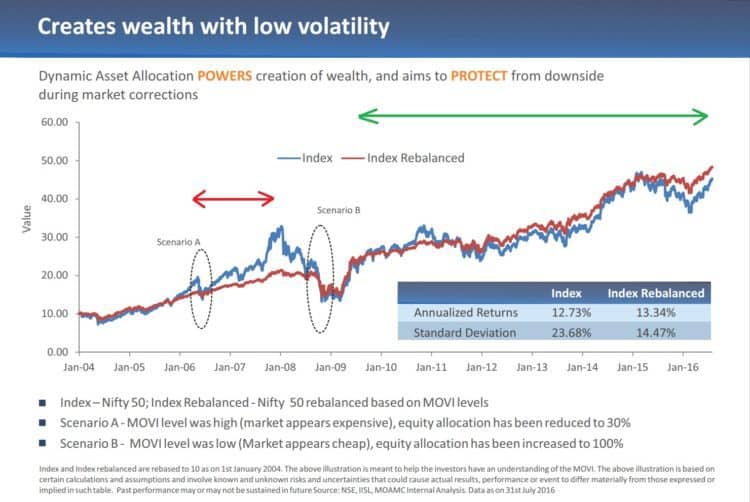
The index is the Nifty and the index rebalanced is the backtested value of a portfolio that uses the MOVI as a valuation index. For this period, notice the considerable reduction in volatility as seen in the lower standard deviation. The returns are quite comparable. All this gymnastics of changing asset allocation and rebalancing periodically has not lead to a significant improvement in returns.
Now, have a look at the period bounded by the red arrow (inserted by me). The fund had reduced equity allocation to 30% more than two years before the 2008 crash!! During the intervening period, every tom, dick and harry fund would have beat this dynamic equity fund. Only investors who have the maturity to stomach such “underperformance” (temporary with the benefit of hindsight, impossible to judge in real time) should buy this NFO or any other such fund.
Now have a look at the period bounded by the green arrow. Due to the extended sideways market, the dynamic equity fund has done quite well. And it has carried forward this good performance during the recent market run.
To reiterate, dynamic equity funds should be purchased for the right reasons. Do not buy them in the hope that their market timing strategies will provide better returns. Their main aim is to reduce volatility. Investors who can stomach some volatility are better off with diversified equity funds.