Last Updated on August 30, 2021 at 3:34 pm
Many mutual fund SIP buyers and sellers incorrectly believe that SIP is a disciplined form of investing that reduces market risk because it averages the cost of purchase. In part 2 of “this is how a real market crash “feels” like“, let us travel with a SIP started ten years apart and see for ourselves how well they manage to reduce risk.
Let us stop and think for a moment how the SIP works. Equate your corpus to the water in a bucket. Initially, you have no wealth to speak of and the bucket is empty. Each month you receive a salary – say some amount of water in the salary bucket.
Each month, after the salary arrives, you take a mug, dip into the salary bucket and transfer it into the corpus bucket. Gradually the corpus bucket grows in size. Due to market forces, the corpus bucket can gain or lose some water over and above what has been filled in each month.
In an earlier post, we discussed why Do Stock Markets Crash? When both long-term and short-term investors think alike and withdraw from the market, it comes crashing down. If this happens tomorrow, what would happen to your corpus bucket?
🔥Secure your future with our Robo-advisory tool trusted by over 3,500 investors and advisors. From effortless retirement planning to funding your children’s biggest dreams, turn your financial goals into reality. 🔥
Subscribe for money management solutions via email! (Link takes you to our email sign-up form) Join 32,000+ readers in our community.
👉 New Tool Alert! NaviPlan: A Privacy-Focused Multi-asset Tracker and Goal Planner 👈
You can manually or automatically fill the corpus bucket with water, but that will not prevent the bucket itself from developing a leak or a huge crack.
Crude as it may be, this is what happens in an unmonitored SIP too. Sometimes the SIP may result in more fund units (when NAV is low) and sometimes lesser units. This is what the “averaging” refers to. How will this protect the corpus when the markets crash? A few months ago, I showed how a Rs. 500 a month SIP started about 7-8 years ago could be worth more than a lakh now. I find it amusing when investors worry about when to invest the next 500 (in the name of timing the market) instead of trying to safeguarding the one lakh accumulated.
That is enough ranting. Let me use the Franklin Prima Fund NAV history in combination with the Mutual Fund SIP XIRR Tracker to generate three SIP journeys:
A: 24-year SIP started in Dec. 1993
B: 14-year SIP started in Dec. 2003 (ten years later)
C: 4-year SIP started in Dec. 2013 (another ten years later)
The analysis was done on July 5th 2017 but is equally applicable if the market crashes now
A: 24-year SIP started in Dec. 1993
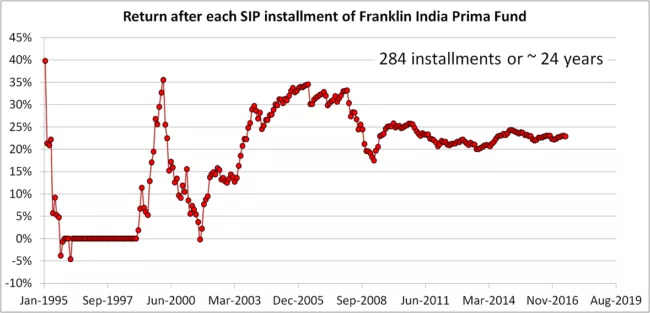
What you see above is the return (XIRR) after each SIP instalment starting from the 13th instalment (when SIP is one year old). The sharp hill around 2000 is the dot-com bubble and burst. As in part one, we shall consider the impact if a similar fall occurs today.
But first, let us look the actual history. Notice the huge swings in XIRR, gradually stabilising with time.
The 2000-crash occurred “only” 7 years after the SIP was started. (The mf industry definition of “long-term” depends on market conditions. In a bull run, it would say 1Y, in a bear market, it will quickly become 10+ years)
The 2008-crash was “only” 15 years after the SIP started, yet you can clearly spot it. This is what I referred to as a leaky bucket above. Kindly do not delude yourself saying, “even after 2008, the return fell only to ~16%”. All falls hurt, and we do not know how the next 24-25 years will pan out.
Now, let us simulate a 2000-like crash happening 24 years after the SIP started. There was a comment in the previous post that falls of such magnitude “will not occur today”. Excuse me for disagreeing – if we can start expecting and predicting market behaviour, then it will cease to be a “market” and so will our reward from it.
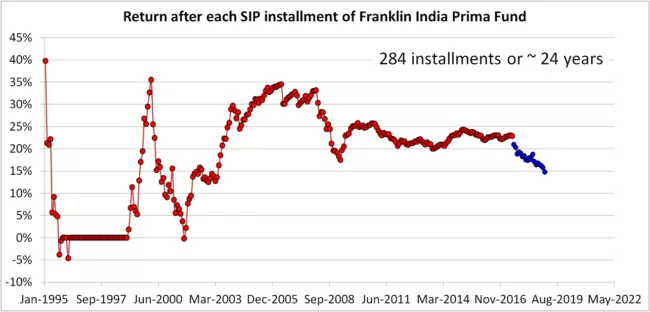
The blue dots represent the simulated returns. The inference is simple: Whether you are cooking a dish or running a SIP, you cannot afford to leave it unmonitored.
Mutual Fund SIPs do not Reduce Risk!
A 24-year SIP is a bit too extreme (also unrealistic- SIPs as we know today did not exist in the 90s – lot less noise). So let us move the clock by 10 years from 1993 to 2003.
B: 14-year SIP started in Dec. 2003 (ten years later)
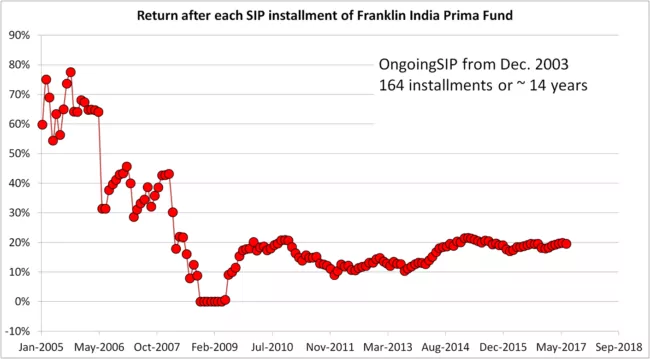
A 14-year SIP, still long enough. Started just at the start of the bull run, the dramatic returns dropped soon and then came the crash. Five years after the SIP was started, the XIRR became 0%. This just means, the XIRR approximation algorithm (Newton-Raphson) cannot estimate a return.
Now, let us add the 2000-like crash.
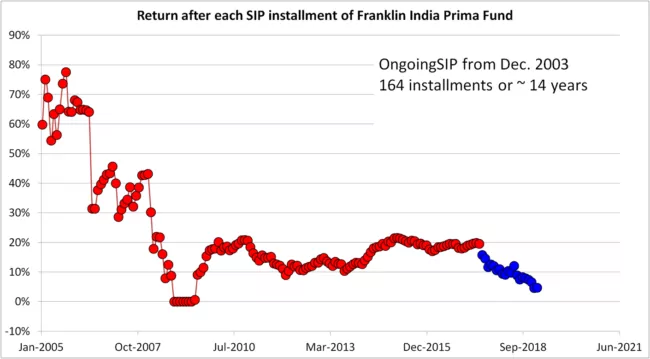
If the markets went south, the return even after 14-15 years of “disciplined investing”, “holding through ups and downs”. the final return is equal to that of an SB account. Perhaps a good time to say a prayer – “Thank you God for making me financially literate and showing me that equity SIP is the best way to beat inflation over the long term”.
C: 4-year SIP started in Dec. 2013 (another ten years later)
This SIP journey is not of much relevance now, but for what it is worth this is the data.
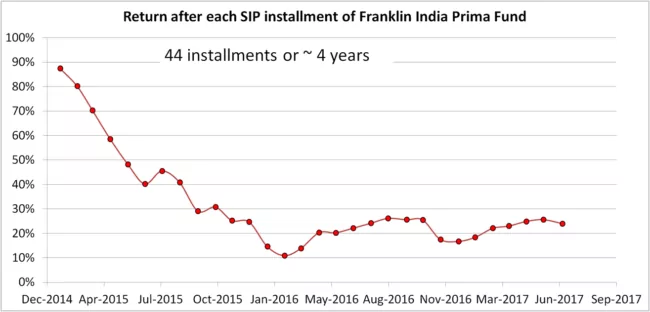
The fate of this SIP when a “2000” occurs today, I leave to your imagination.
What is the solution?
Solution = risk management. Have covered this many times before:
Simple Steps to De-risk Your Investment Portfolio
How to systematically reduce the risk associated with a SIP
Managing Risk Without Stopping Mutual Fund SIPs
In addition to this, one could adopt a PE-based or daily moving averaging strategy to reduce risk. The problem starts when people start claiming that such methods can generate higher returns. That is hogwash – sometimes they do and sometimes they don’t, pretty much a coin toss – Is it possible to time the market?
The notion of staying invested through market ups and downs is a sound one, but investors should know when to stay invested and when to run for cover. Goal-based investing is a simple way to clarify this.
Beware of misinformation
Mutual Fund SIPs Do Not Reduce Risk!
Well, that is not true. They do reduce the risk of irregular income to mutual fund houses and their sales guys. In fact, a SIP pretty much guarantees it!