Last Updated on August 30, 2021 at 3:33 pm
Risk management is the key to investing in volatile instruments like equity (or gold). De-risking refers to a process of containing losses. This typically is achieved by targeting a better risk-adjusted return instead of a ‘better return’.De-risking can passive or active. Here are some simple steps to de-risk your investment portfolio
Cautionary note: A mutual fund SIP does not minimise risk. It is being sold as a means to ‘build wealth’ – all one needs to do is to run the SIP through market ups and downs. To say the least, this is silly! Read more: What you need to know before starting a mutual fund SIP
1. Start investing early
Boring as it may sound, there is no better way to lower risk than beginning early. The more time you have in your hands, the more time you will have to recover. So start investing asap.
In the simple compound interest equation,
🔥Secure your future with our Robo-advisory tool trusted by over 3,500 investors and advisors. From effortless retirement planning to funding your children’s biggest dreams, turn your financial goals into reality. 🔥
Subscribe for money management solutions via email! (Link takes you to our email sign-up form) Join 32,000+ readers in our community.
👉 New Tool Alert! NaviPlan: A Privacy-Focused Multi-asset Tracker and Goal Planner 👈
Value = investment x (1+ return) duration,
Duration and quantum of investment (not returns) are responsible wealth creation. So ensure you maximise both.
2. Expect less
This is the most important step in de-risking. The lower your return expectations, the lower the risk.
Investors who want a minimum of 20% return from their equity portfolios will have to take a lot more risk than investors who only want 10%.
The long term return from Indian equity markets is not the 15% that everyone says it is. That number is heavily influenced by the Harshad Mehta scandal. If no such scandal occurs, the long-term return drops to 10% (see how here).
So we need to be realistic in our expectations. This is vital in keeping us calm.
Remember we pose the biggest risk to our folios! So the calmer we are, safer the folio.
Most investors become jittery because they fail to understand how equities ‘compound’. We expect 10% long-term returns from equities. This means one should not expect 10% year after year in investment.
Some years will be good, some excellent and some terrible. What you get is the net effect:
Value = investment x [(1+ good return) x (1+ terrible return) x (1+ excellent return) x…… ]
So the key is to stay the course.
3. Asset allocation
Naturally, one cannot afford to be in 100% equity. The terrible return would then negate the effect of the good returns, and one would be left with nothing.
The only logical solution is to limit the fluctuations in the portfolio returns due to swings in equity return.
Therefore, one must include safer assets like (fixede income instruments) bonds to reduce the overall risk to the folio.
Here safety refers to the poor (small) correlation between the movements of equity markets with debt markets. Fluctuations in one will generally not affect the other too much.
How much should the equity:debt proportion be, depends entirely on the goal duration and nature. Here is an example
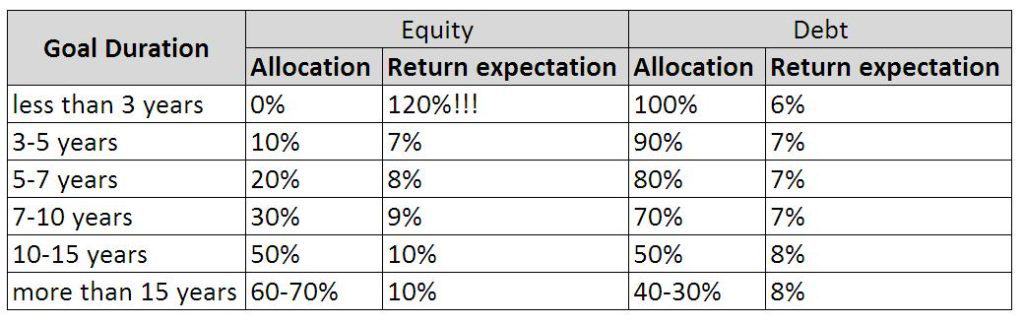
4 Choose wisely
Conservative asset allocation and return expectations are important but amount to nothing if the right kind of investments are not chosen.
The simplest and most important measure of risk investors must understand is the standard deviation – a measure of how much a set of returns deviation from their average.
Lower the standard deviation, lower the risk.
The first step is to choose the right category of instruments. Here is a step-by-step guide to help you do that.
As a general thumb rule, lower the investment duration, lower should be the standard deviation of the instrument.
For example, choosing an equity-oriented balanced fund for a 5-year investment duration is madness.
Read more: Equity investing: How to define ‘long-term’ and ‘short-term’
5 Diversify
Asset allocation represents diversification across asset allocation. One should also diversify within an asset class. For example, equity holdings should be spread across market cap, sectors, nature of stocks and geography.
Diversification is the second most important step (expecting less is the first). Use this tool to find out how diversified your equity mutual funds are.
A well-diversified portfolio with reasonable expectations will significantly reduce downside risk.
These are mandatory requirements of any investor.
Read more: How to build a diversified mutual fund portfolio
Minimalist Portfolio Ideas for Young Earners
The above-mentioned ideas represent passive de-risking. For a goal that is say 20 years away, passive de-risking is all that is required for the first few years. Active de-risking becomes necessary after that.
6 Periodic Review
It is essential to monitor the performance of instruments and take corrective action. However, this has to be done with meaning benchmarks.
How to Review Your Mutual Fund SIPs
How to review a mutual fund portfolio
7 Rebalancing
One can do a little better. You start with some asset allocation in mind. With time gains or losses in individual instruments will skew the allocation and it will begin to deviate.
For example, a 60:40 equity:debt investments started a year ago could easily be 65:35 or 70:30 because of the upward swing in the equity market.
If this skewed allocation is reset to 60:40 by pushing some amount from the equity folio to the debt folio, the gains made in a volatile asset (equity) are shifted to a less volatile asset (debt) thereby preserving them.
This is known as rebalancing. There are several ways to do this. Learn more here.
Check out this volatility simulator to understand how rebalancing can be used to de-risk a folio and enhance gains.
Rebalancing requires no special know-how. All it requires is discipline. The discipline to shift capital from a well-performing asset class to a safer one!
Rebalancing is not profit booking.
Read more: How to Rebalance Your Investment Portfolio
8 Tactical asset allocation
When markets rise, they will soon become overvalued. Stocks will be priced higher than they are worth and one can expect prices to fall … sooner or later.
A simple indicator market valuation is the P/E ratio or the price/earnings ratio. Another is the 200-day daily moving average.
Tactical asset allocation refers to the change in asset allocation of the portfolio according to market conditions.
Tactical asset allocation can be implemented many ways. For example,
1) when PE value is high, say > 22, stop investments, accumulate them and invest when the PE value becomes lower, say < 18. Read more about this here
2) when PE is high, say >22, stop investment and shift to debt. Move back and resume investment when PE value become lower. Read more about this here
This requires even greater discipline than rebalancing and extraordinary level-headedness. For example, the markets could increase after we pull out. If we are ones who tend to regret and lose focus, this is not for us.
Tactical asset allocation is not profit booking.
Note: Tactical asset allocation is timing the market. Personally, I do not indulge in this.
Read more:
- Is it possible to time the market?
- Relevance of the Nifty PE for the long-term investor
- Misconceptions about the Nifty PE
9 Quit while ahead
Equity holdings should be decreased gradually as the goal approaches. Three – five years before the deadline, the portfolio should be in pure low volatile debt instruments with no equity.
This means the last few years, the returns would be much smaller than your overall expectations. A simple way to account for this while planning for goals is to reduce the duration by two years.
If your child’s education goal is 14 years away, assume it is 12 years away. Therefore, few years years before the actual goal date, much of the corpus is accumulated, and can be kept away safely.
In the case of retirement, some amount of equity can remain, depending on the health of the portfolio.
There are no hard and fast rules here. If say, 6-7 years before the goal the returns are very good, then equity exposure can reduced to zero in one shot. On the other hand, if returns are small even after years of equity investing, then one will have to exit (with or without regret)
~~~~~~~~~
With these simple guidelines –most of which is commonsense – one can de-risk the portfolio effectively, remain calm and focused.
First published May 28, 2014. Republished after a rewrite.