Last Updated on July 28, 2025 at 4:37 am
Investors get jittery and unsure what to do when the stock market is overheated or when the stock market goes nowhere. Here is a simple market-independent strategy via systematic risk reduction that would be far more productive.
Why? We have no control over market returns. Yes, asset allocation with regular rebalancing and diversification within each asset class will reduce this uncertainty, but we are still slaves to market turbulence. See, for instance: My retirement equity MF portfolio return is 2.75% after 12 years!
So a market-independent investment strategy aims to ensure any point in the investment journey, the current corpus is above or close to the required target corpus (at the time of review).
The benefits of doing this are obvious. We invest systematically and manage risk in the portfolio, regardless of market conditions. There is no need to follow market news or market valuations. No need to take media “experts” seriously and worry about what to do. Once set up, the systematic management can be run on auto-pilot with no more than 30 minutes of portfolio review once a year!
🔥Secure your future with our Robo-advisory tool trusted by over 3,500 investors and advisors. From effortless retirement planning to funding your children’s biggest dreams, turn your financial goals into reality. 🔥
Subscribe for money management solutions via email! (Link takes you to our email sign-up form) Join 32,000+ readers in our community.
👉 New Tool Alert! NaviPlan: A Privacy-Focused Multi-asset Tracker and Goal Planner 👈
Steps to systematically reduce portfolio risk
- Be clear about when you need the money. This may seem trivial, but it is the most crucial step in the investment process. It decides how much risk we can take and, therefore, the asset allocation.
- Have reasonable return expectations. For example, for long term goals, one should not expect more than 9-10% from equity after tax. Even today, getting 7% after-tax from fixed-income instruments is difficult. So after several years, this will be no more than 5-6%.
- Decide the initial asset allocation. For a goal more than ten years away, 50% of equity and 50% of fixed income is just about perfect. See: Will Benjamin Graham’s 50% Stocks 50% Bonds strategy work for India? At best, you can increase equity to 60%—any higher than that, the risk will be too high. See the asset allocation risk matrix here: I have just started investing in MFs how much loss should I be prepared to face?
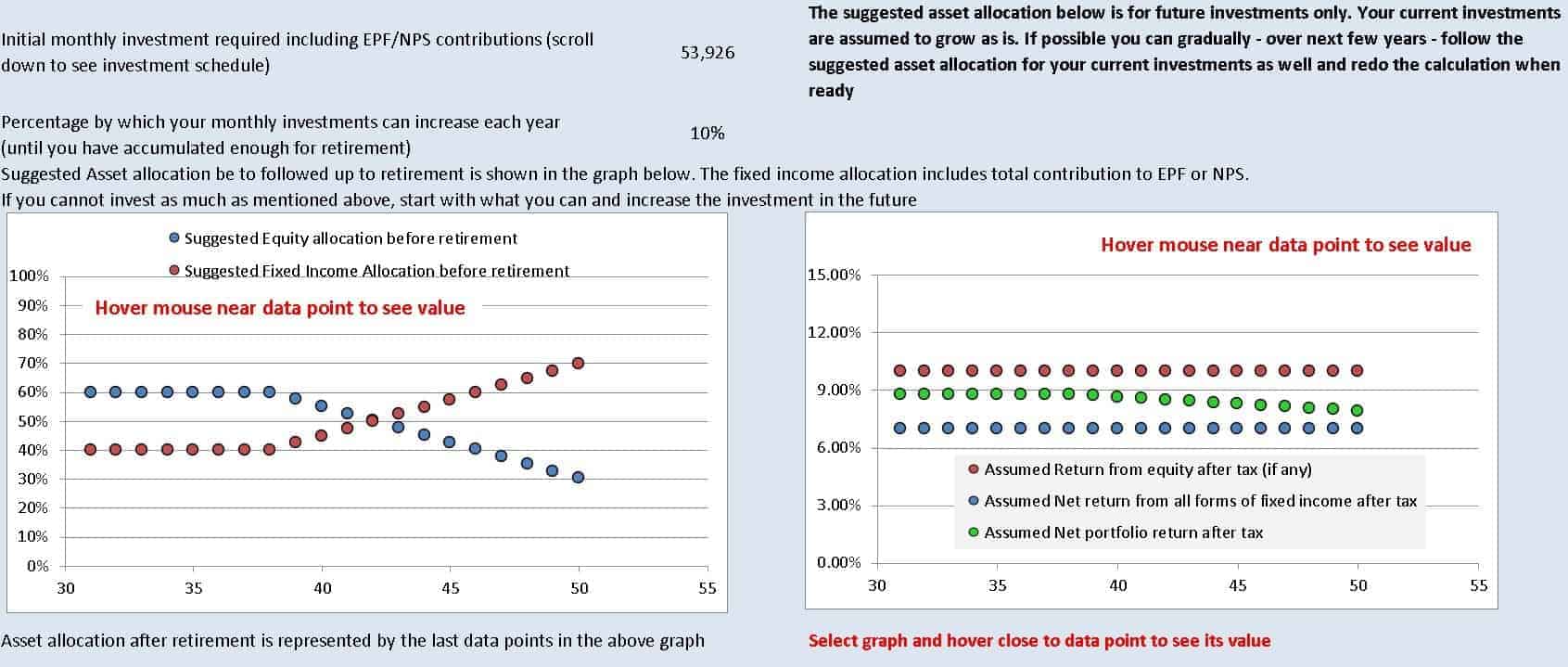
- At this stage, one usually starts systematic investing. However, there is a catch – the key step is missing. Market returns are unknown and uncertain. To ensure we achieve our target corpus, no matter how equity markets behave, we need a variable asset allocation plan. How will we reduce the equity exposure so that the overall corpus does not deviate too much from the target corpus? The target corpus and the amount invested must be calculated using this asset allocation plan. This is automatically accomplished with the freefincal robo advisor tool. The supporting backtest is here: How to reduce risk in an investment portfolio.
- Equity exposure can be reduced in a step-wise manner or continuously. Either way, this must be done well before the goal deadline. See or example: I am 30 and wish to retire by 50 how should I plan my investments?
- Now systematic investing can start. The other side of the coin – systematic risk management is already planned out in the above step. We only need to review the portfolio once a year, check our actual asset allocation and rebalance it if necessary to bring it in line with the expected values per the variable asset allocation plan. The use of simple products like index funds will make the portfolio review even simpler.
- If the need arises, one can shift gains from equity to debt after a huge market upswing (e.g. Mar 2020 to Sep 2021). This will further reduce portfolio risk. See: I rebalanced my retirement portfolio twice this year thanks to the bull market.
That is it! This simple strategy will help you achieve your financial goals independent of market conditions. We have extensively backtested different variable asset allocation strategies, and the results are available in our goal-based portfolio management course.