Last Updated on August 22, 2022 at 11:15 pm
Anyone interested in money management would have, at some point in time, heard the saying that gold is a hedge against inflation. Does the data support this adage? Let us find out.
For an asset to be considered an inflation hedge, an investor must have a reasonable chance of earning a return higher than inflation over the long-term or short-term.
We have shown earlier that equity provides such a reasonable chance despite unknown future returns – Why should I invest in equity mutual funds when there is no guarantee of returns?
How does Gold fare in this regard? Before we begin, we would like to point out that in situations of extreme inflation, when the currency becomes worthless, gold can be used as a universal currency and, therefore, an efficient inflation hedge. However, the typically 10% or 15% exposure to gold funds or ETFs will not last long during such a time! In this article, we only discuss the efficacy of gold as an inflation hedge during normal circumstances.
🔥Secure your future with our Robo-advisory tool trusted by over 3,500 investors and advisors. From effortless retirement planning to funding your children’s biggest dreams, turn your financial goals into reality. 🔥
Subscribe for money management solutions via email! (Link takes you to our email sign-up form) Join 32,000+ readers in our community.
👉 New Tool Alert! NaviPlan: A Privacy-Focused Multi-asset Tracker and Goal Planner 👈
The 15 year rolling returns of Gold price per troy ounce in INR compared with Nifty 500 TRI vs Sensex Price vs I-BEX gilt index are below.
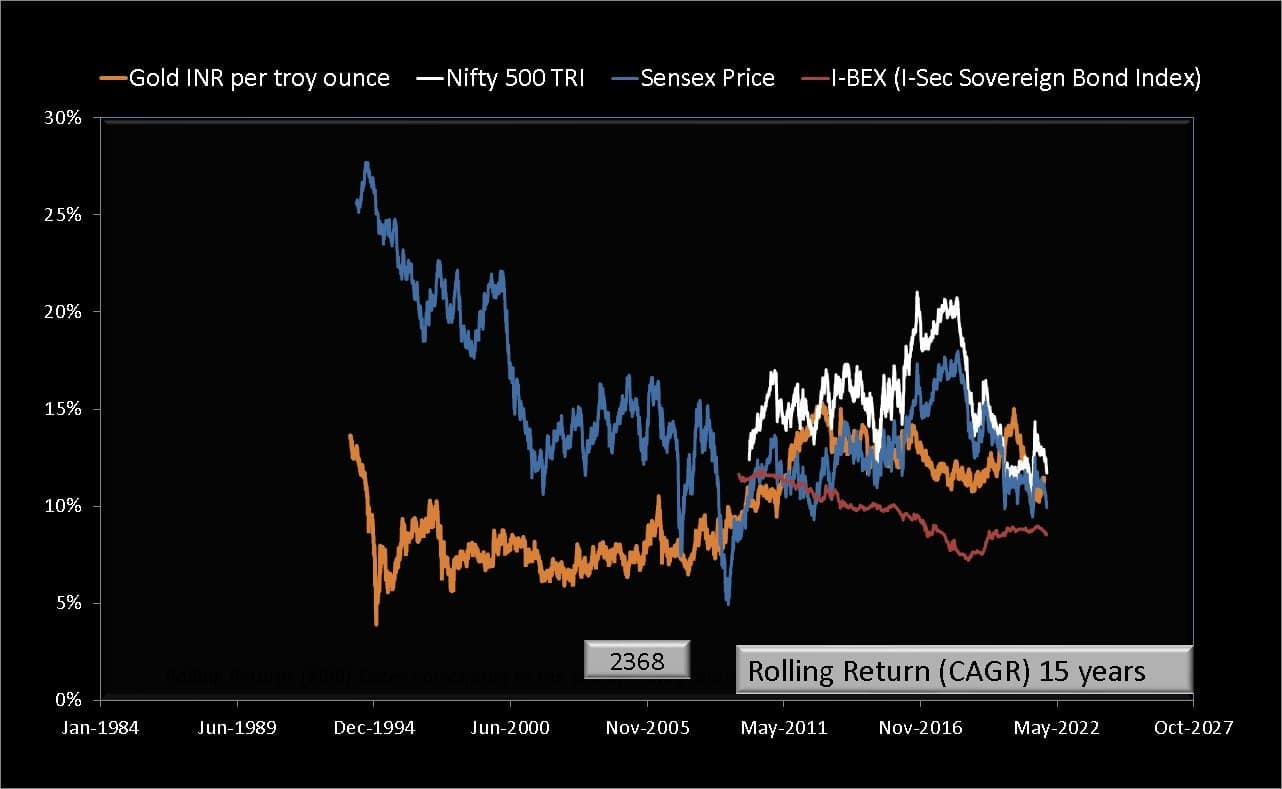
For much of the 1990s and 2000s, 15-year gold returns (before tax) were well below 10%. During this period, fixed deposits and small savings scheme returns were much higher with zero volatility, reflecting the presence of high inflation. The Sensex price return (about 1-2% lower than the total index return) was much higher.
Only in the last decade, gold 15-year returns have done well, but again equities have done better. Long-term gilt returns are below that of gold and equity but comparable to PPF rates in the period.
The biggest problem with gold is its long-term risk vs reward imbalance. The 15-year rolling standard deviation of Gold price per troy ounce in INR vs Sensex Price vs I-BEX gilt index is shown below.
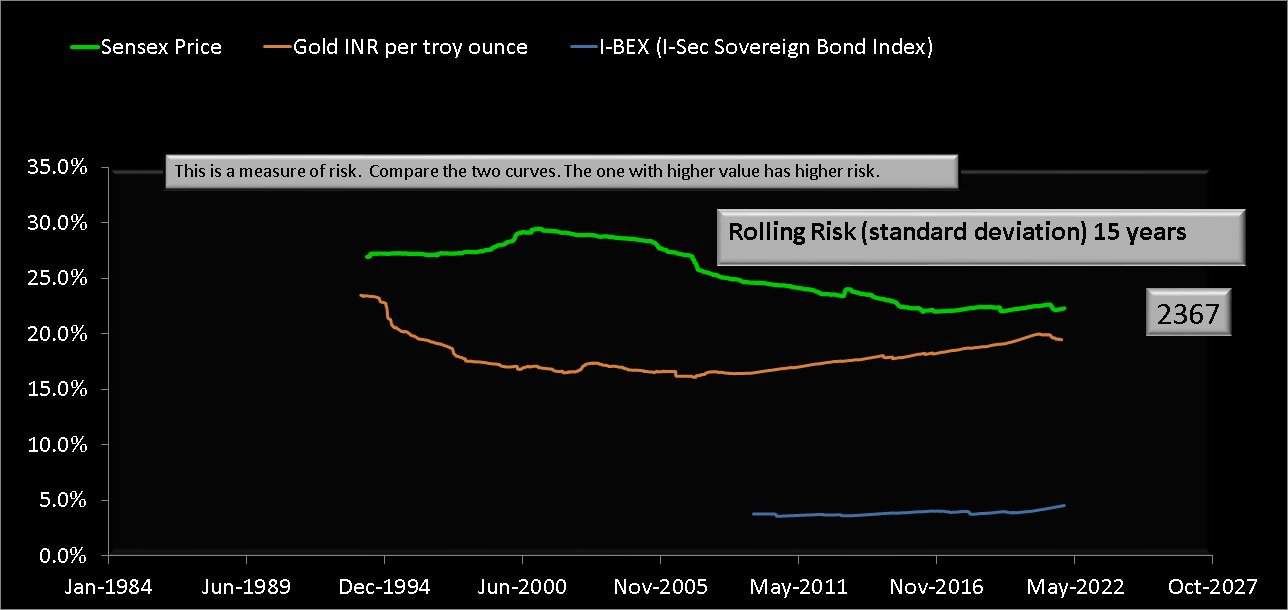
The 15-year rolling standard deviation of Gold price per troy ounce in INR vs Sensex Price vs I-BEX gilt indexNotice that gold has volatility well above gilts and is comparable to equity but typically does not provide a commensurate reward. Thus gold is an unsuitable inflation hedge over the long term or, at best, is an inefficient one.
What about the short term? Does gold price react when inflation increases? The gold price per troy ounce in INR vs consumer price inflation rate is shown below. The inflation data is sourced from macrotrends.net.
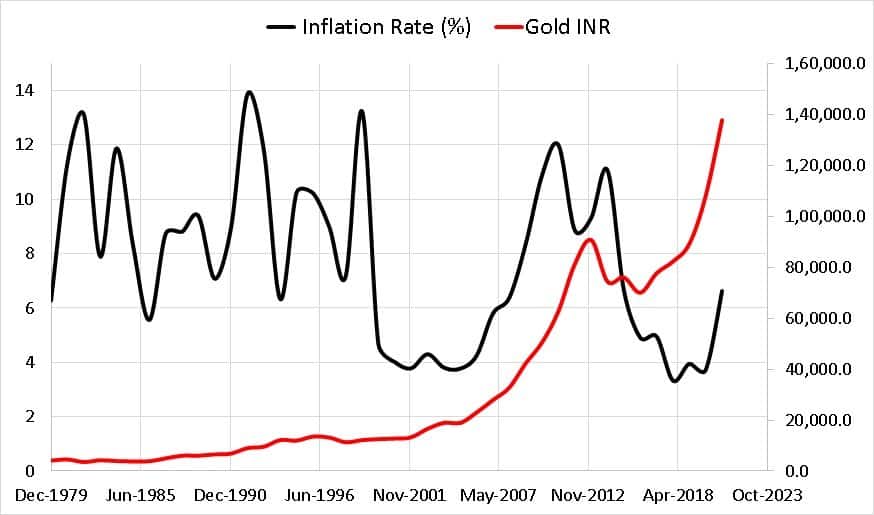
Gold price per troy ounce in INR vs consumer price inflation rateIt is hard to decipher much from the image so let us consider the correlation coefficient between inflation rate and gold return between the same dates.
The overall correlation is -0.08. However, a further inspection is necessary. The 16-year rolling returns data for Gold price per troy ounce in INR and USD is shown below. This is taken from: Are Sovereign Gold Bonds safe?
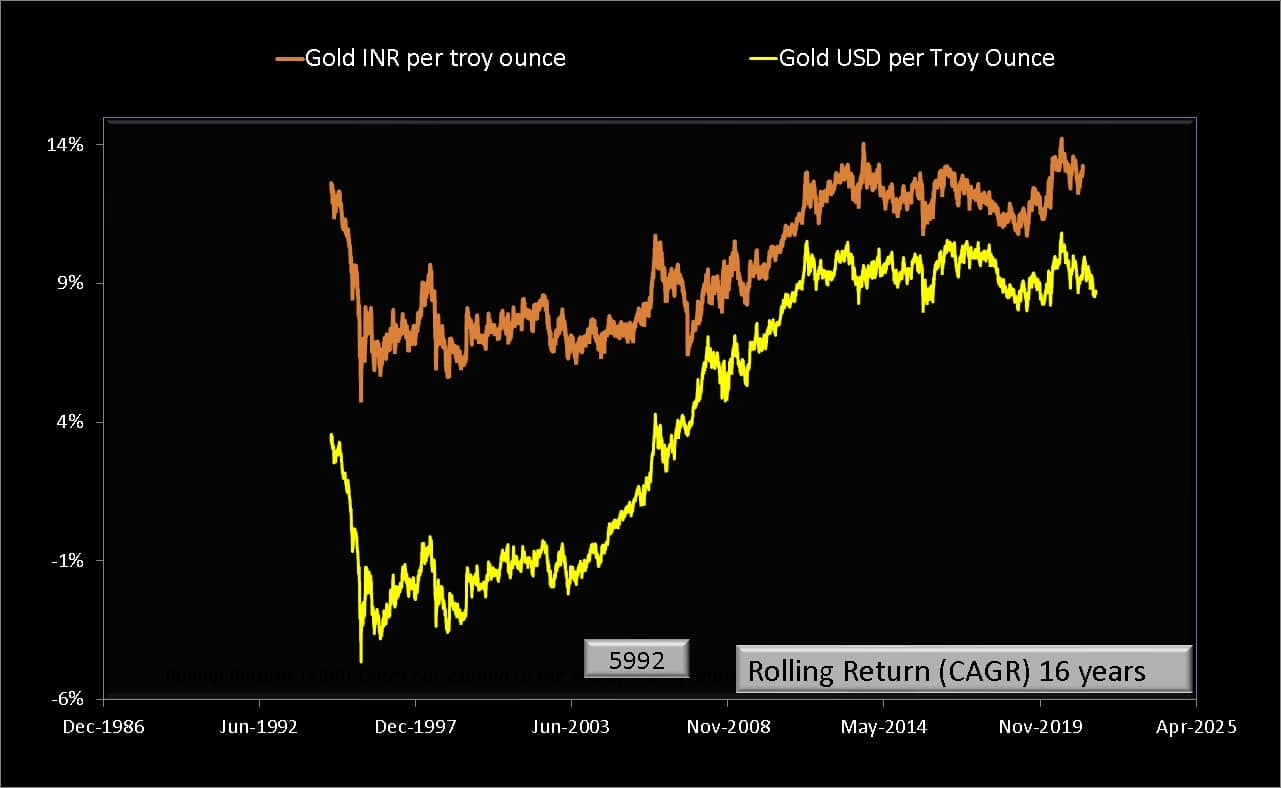
Notice that gold INR price movement only recently looks in line with gold USD price movement. Since the opening of our economy in the early 1990s, our currency has gone through a long period of devaluation and only in the last two decades attained stability. Read more: Gold Price Movement: USD vs INR
Thus if we consider the correlation between inflation rate and gold INR return from 1980 to 2000, it is -0.017. However, from 2000 to 2020, the correlation has jumped to 10%.
Thus recently, gold INR has reacted to inflation changes much better than it did in the past (when our currency was still unstable). However, the correlation is still quite small.
Finally, the Gold price per troy ounce in INR vs RBI Repo Rate is shown below. Data source: RBI Repo Rate History
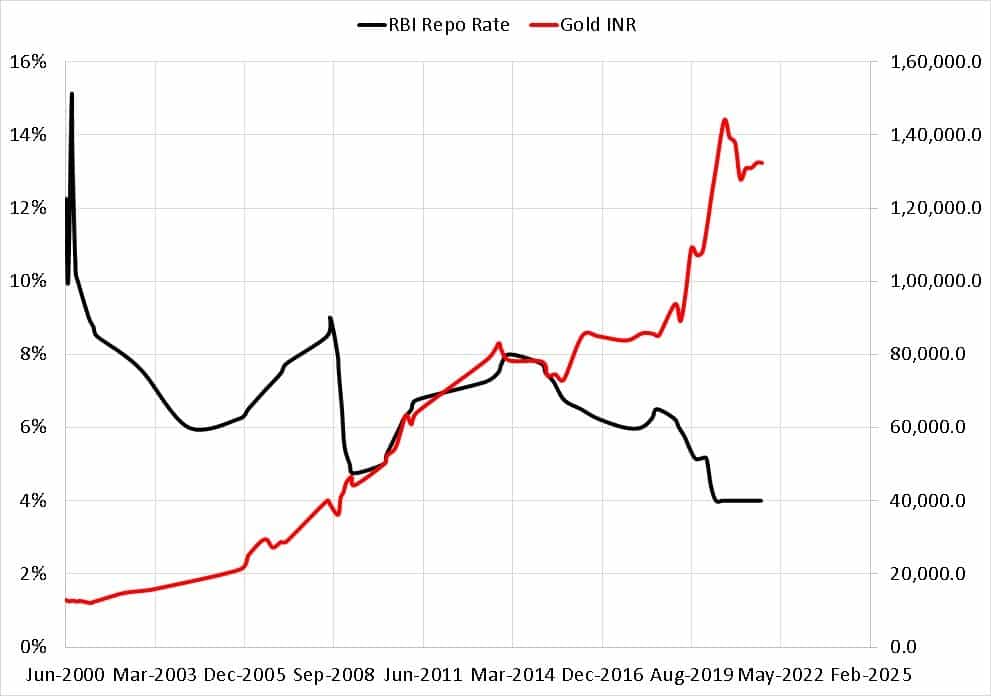
The correlation coefficient between the change in the repo rate and gold price change is about 0.19. Just as we cannot expect the gold price to fall when the repo rate fall (or vice-versa), we also should not expect gold to move up in value when the repo rate increases.
In summary, long term gold returns have only recently edged past fixed income returns. The associated reward is incommensurate with the risk, especially when compared to returns from govt bonds.
Over the short term, the gold price has only recently started reacting to changes in inflation, but the correlation is still quite low. As shown above, this is because of currency instability in the ’90s. Thus, gold is an inefficient inflation edge and not worth banking on since most investors will not have significant liquid exposure.