Last Updated on September 20, 2026 at 10:32 am
Over the last couple of weeks, three readers have asked me why their Sovereign Gold Bonds decrease in value and how they can lose their principal in a bond with a sovereign guarantee. So, what is sovereign about these bonds?
First, consider a simple bond issued by either RBI or the central or state governments. These have a sovereign guarantee, but on what?
Suppose the bond has a tenure of ten years. The government is offering you a guarantee (except on rare occasions of default) that it will pay the interest on the bond each year (bi-annually). It will return the purchase price after the tenure competition or if the bond is called back.
A Sovereign Gold Bond (SGB) works quite differently if you buy one, the govt. Is guaranteeing the payment of the 2.5% interest as an “incentive” and is guaranteeing that the redemption value will be equal to the average of the previous three business days gold price. That is all. This is quite different from the guarantee in a normal bond.
🔥Secure your future with our Robo-advisory tool trusted by over 3,500 investors and advisors. From effortless retirement planning to funding your children’s biggest dreams, turn your financial goals into reality. 🔥
Subscribe for money management solutions via email! (Link takes you to our email sign-up form) Join 32,000+ readers in our community.
👉 New Tool Alert! NaviPlan: A Privacy-Focused Multi-asset Tracker and Goal Planner 👈
The RBI FAQ puts this across in an amusing way:
Are there any risks in investing in SGBs? There may be a risk of capital loss if the market price of gold declines. However, the investor does not lose in terms of the units of gold that he has paid for.
Right, most comforting! So there is no protection for your capital in a Sovereign Gold Bond. There is another important distinction. If you buy a gilt or RBI bond and monitor the bond’s market price, it would fluctuate quite a bit (longer the tenure, more the fluctuation).
You get your money back if you hold a gilt to maturity, but there can be a capital gain or loss if you sell it mid-way. In the case of SGBs, loss or gain is possible if you sell mid-way or hold to maturity.
Many SGB investors are under the incorrect assumption that “gold will always move up in the long term”, which means they will never lose money.
I am afraid this is quite incorrect. The price of an asset moving up over the long term has nothing to do with its return over the long or short term. Many stock investors also make this mistake. Here is the actual data for both stocks and gold.
- Gold: 11% annualized return in 41 years, but there is a catch
- The stock market always moves up in the long term, but returns move up and down!
We have already shown that gold is an extremely volatile asset, and returns cannot be predicted: How much return can I get from Sovereign Gold Bonds?
Here is an updated rolling returns chart for gold in INR. This shows every possible eight-year tenure (9083 data points). Data is sourced from gold.org.
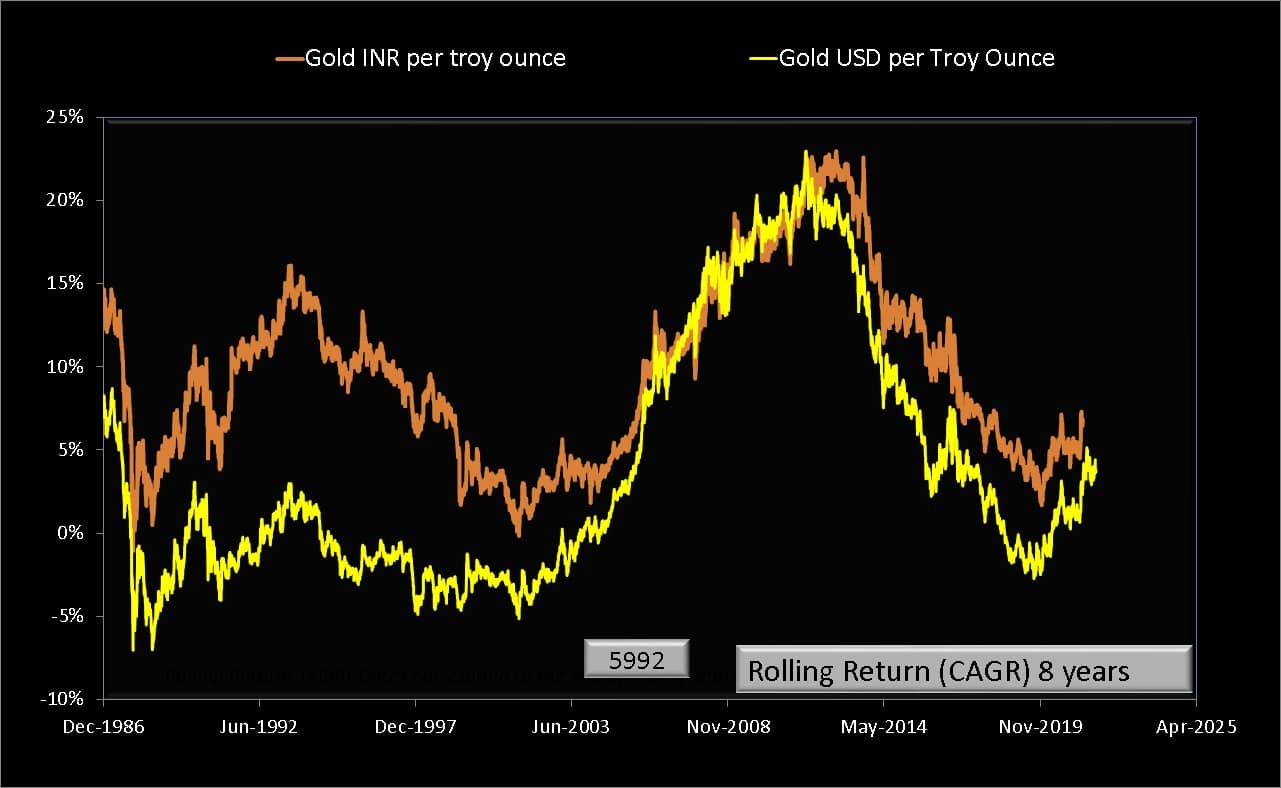
You can see how much the gold price can fluctuate over the tenure of an SGB, and it is just about potluck what return you get. Gold INR will not always offer a better return than GOLD USD over eight years.
This volatility will not go away! These are 6997 16-year rolling returns.
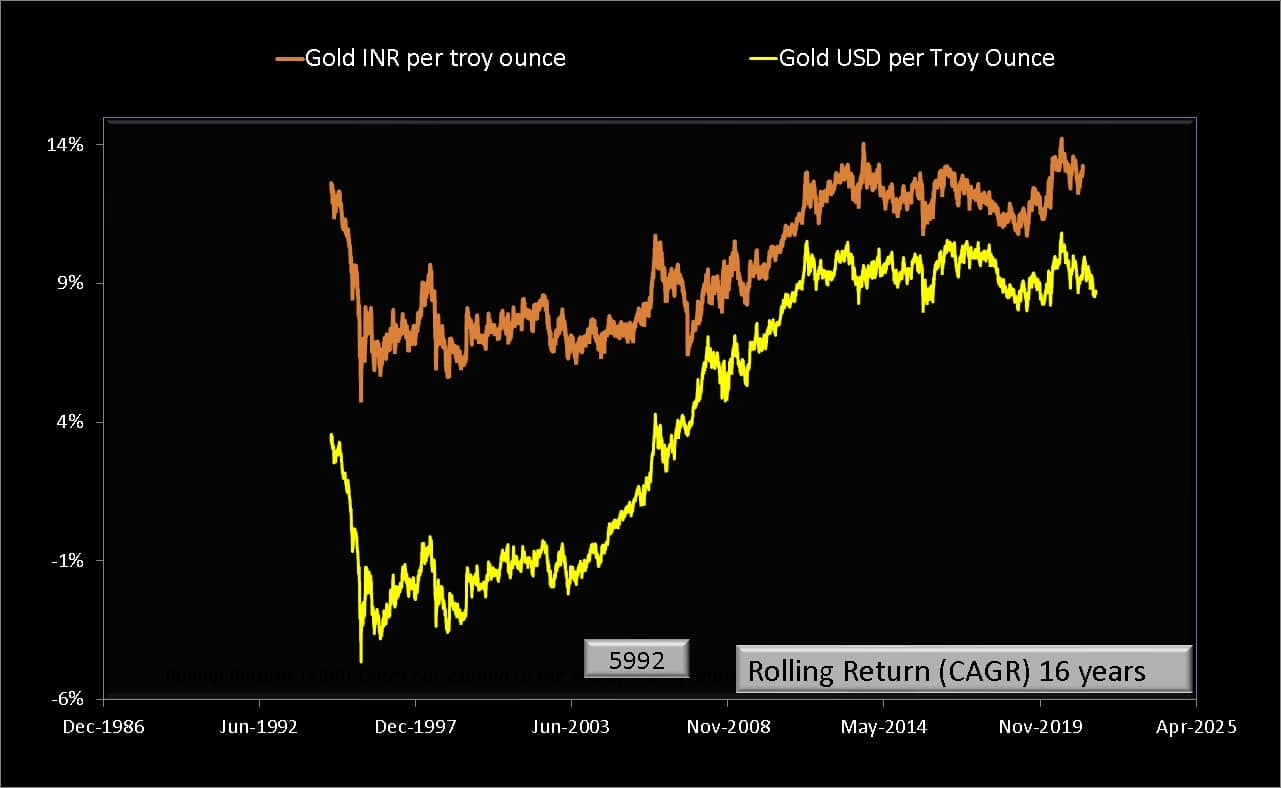
Gold INR returns have ranged from 5% to 14%. Please note that a 5-6% return from gold after 16 years is a loss considering the kind of volatility you will have to suffer. Notice how the current arbitrage has dramatically reduced over this tenure – an example of “India shining”! Eight years or 16 years tracking gold price is not a guaranteed hedge against inflation. Physical gold is a hedge against current collapse, but we must have enough oodles of it!
What should investors do?
- Do not assume SGBs are “safe”.
- Do not BUY SGBs if you intend to profit from gold price (systematically or tactically) or for portfolio diversification. Use a simple gold fund for that. You can buy and sell with complete freedom. Also see: Will including gold in my portfolio help?
- If you wish to adopt a tactical strategy, check out our backtest: Is this a good time to buy gold? A tactical buying strategy for gold
- Buy SGBs only if you wish to buy and hold, and your ultimate aim is to buy physical gold with the proceed. Then and only then SGBs are risk-free. Also, see Sovereign Gold Bond Scheme: When to buy and when not to!