Last Updated on December 29, 2021 at 6:27 pm
So many readers and viewers on YouTube want to know more about floating rate mutual funds as there has been enough propaganda that these funds would benefit if there is an increase in interest rate. Does it make sense to invest in floating rate funds? Are there any simpler alternatives?
What are floating rate funds? In a fixed rate bond (or a normal bond), the interest rate is fixed, and the market value will fluctuate as per demand and supply. This is also known as duration risk. New bonds become more attractive when interest rates increase, and the older bonds will fall in value.
In a floating rate bond, the interest payments change with rate movements, and the bonds’ value fluctuates relatively less than a fixed rate bond – at least in theory. Read more about them here: How Floating Rate Debt Mutual Funds Reduce Interest Rate Risk. Also, see RBI Repo Rate History.
So when we expect the rates to increase, everyone chants, buy floating rate funds and avoid gilt funds (as they have the highest duration risk – likelihood to fall).
🔥Secure your future with our Robo-advisory tool trusted by over 3,500 investors and advisors. From effortless retirement planning to funding your children’s biggest dreams, turn your financial goals into reality. 🔥
Subscribe for money management solutions via email! (Link takes you to our email sign-up form) Join 32,000+ readers in our community.
👉 New Tool Alert! NaviPlan: A Privacy-Focused Multi-asset Tracker and Goal Planner 👈
The reality is:
- Floating rate funds are complex products. Just reading the scheme objective should tell you that: “An open-ended debt scheme predominantly investing in floating rate instruments (including fixed-rate instruments converted to floating rate exposures using swaps/derivatives).”. Read more about swaps here: Interest Rate Swaps: A way for MFs to reduce interest rate risk.
- Floating rate funds can invest in a wide range of bond durations. The average maturity of funds in this category range from 6.72 years to 1.17 years. This means there can be a significant variation in the NAV volatility (higher the average maturity, higher the volatility)
- They can invest in less than AAA-rated bonds. This is the credit rating allocation as of Sep 30th 2021. Source: Debt mutual fund screener (Oct 2021) for selection, tracking, learning.
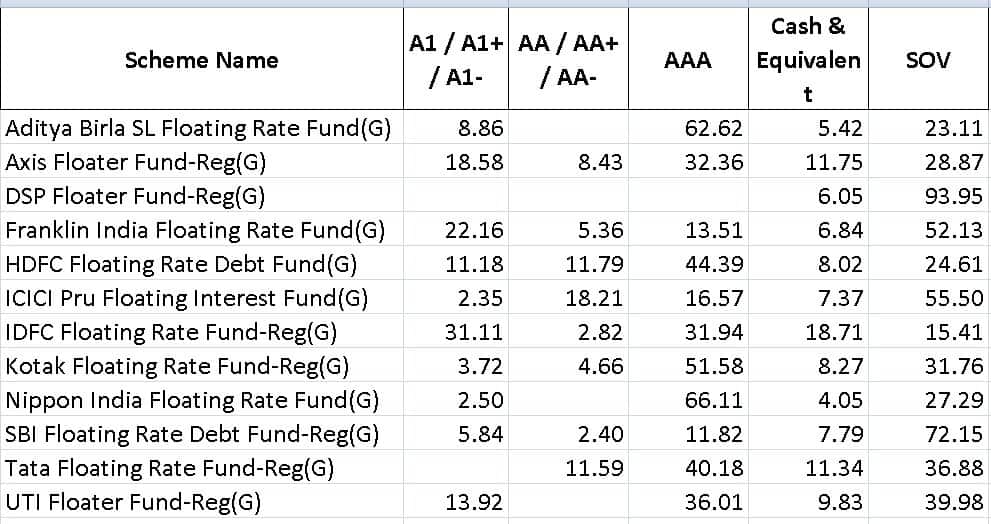
- Floating rate funds are volatile. If we consider the standard deviation (a measure of ups and downs in the NAV on a monthly basis) over the last three years, some of these funds have volatility comparable to gilt funds or medium-long duration funds.
All that aside, do floating rate funds accomplish what is claimed on the tin: responds to interest rate changes? The answer is yes but with caveats.
To appreciate this, ideally, we would need data of a floating rate index. Since this is available publically, we will have to make do with one of the oldest floating rate funds.
Thanks to Anish Mohan for suggesting HDFC Floating Rate Fund. HDFC offered two floating rate variants – a short-term plan and a long-term plan. The long-term plan opened in Oct 2003 and closed (merged) in May 2018. The short term plan had a merger of various short-term plans and was rechristened as a “floating rate fund” in May 2019. We will study the returns up to these end dates. Please note that active fund manager calls are involved here. So we much exercise caution and not take too much away from the graphs.
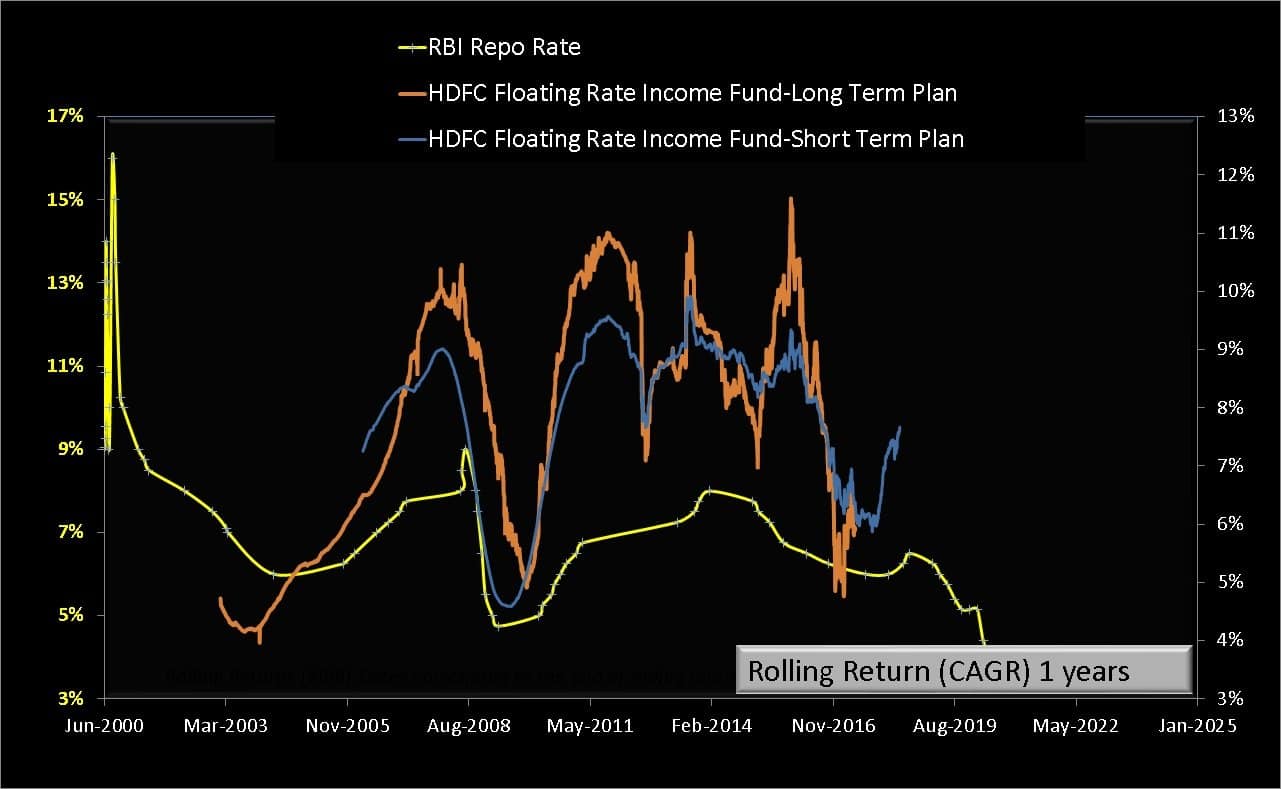
The RBI REPO rate is plotted on the left. The one-year rolling returns of the two HDFC funds are on the right. So We see above the returns of the two floating rate funds one year after the RBI REPO rate announcement.
Notice that the 1Y return of the floating rate funds generally follows the changes in interest rates, but this is not always true (late 2016).
A floating rate fund that buys long term bonds will be significantly more volatile in return (cuts both ways). The short-term floating rate fund reacts a bit faster to rate changes.
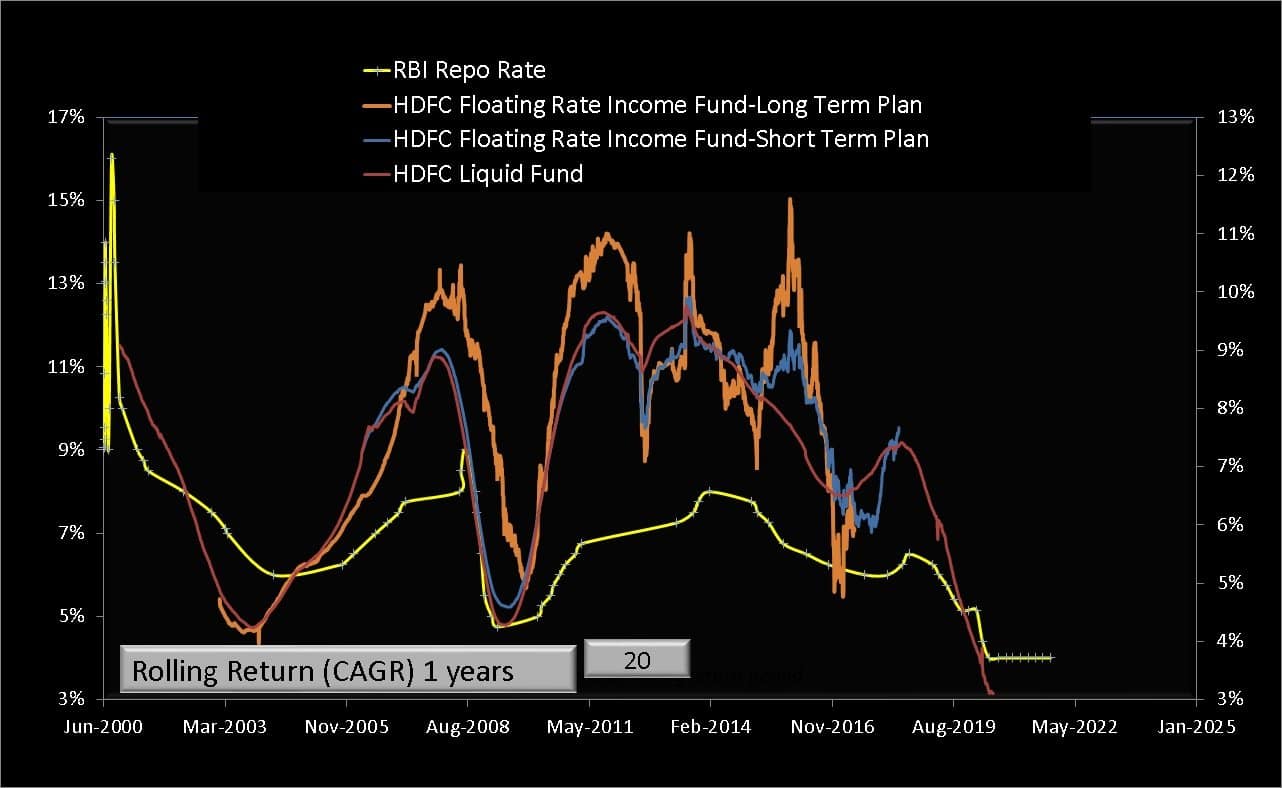
Now we add a liquid fund into the mix. Technically it would be more appropriate to use a money market fund, but we do not have a history of such style-pure funds. Ultra short-term funds can be used, but they can have credit risk issues, unlike liquid and money market funds.
Next, let us look at the one-year rolling returns of gilts funds and a gilt index.
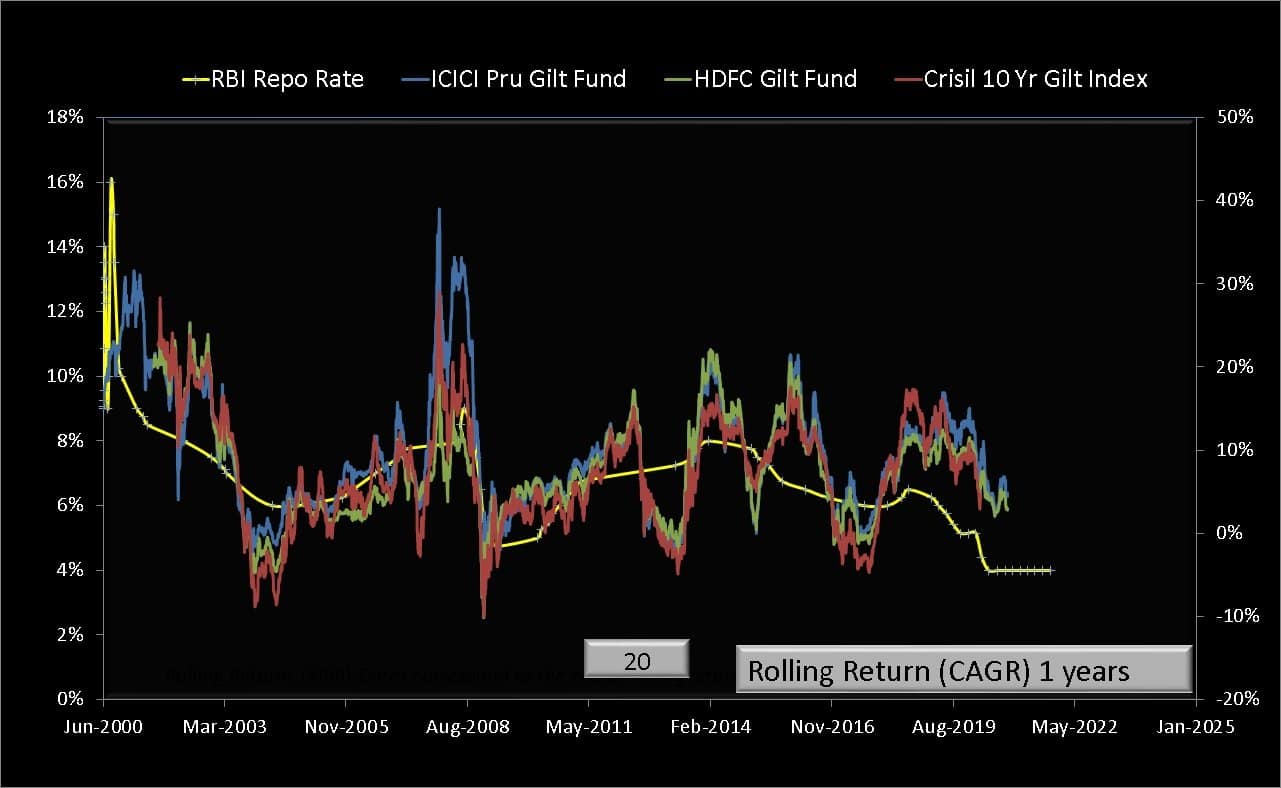
Gilts funds do correct sharply when the rate increases but in most cases, there will be a lag due to the higher average maturity of the portfolio.
Also, demand-supply mismatches can result in much bigger price fluctuations, and a one to one correlation with rates is not possible. This is because the rate that is modified is the overnight rate. So short-term debt funds will reach immediately.
This change has to trickle through to the higher end of the bond maturity spectrum, and that can take long or sometimes not happen if a change is already priced in.
Investors must appreciate that speculation in the Indian bond market has significantly increased over the years, making a correlation with rates harder. If you are holding gilts, there is no need to fear a rate hike. Yes, there will be losses, but it can be handled as long as the investment and risk management is goal-based.
Finally, let us now consider a money market fund. This fund may not have been a pure money market fund in the past.

A money market fund also reacts favourably when rates increase, but they are subject to sharp but short-term demand-supply mismatches in the money market.
What do these results indicate? And Should we invest in floating rate MFs? If we want to gain from interest rate hikes, there is no need for a complex product like a floating rate fund.
When rates increase, the change will slowly permeate from the overnight bond to the short-term bond and higher duration bonds. Not just floating rate funds, even liquid funds, money market funds and ultra short term funds will also react to such a change.
Therefore a layman investor wanting to keep it simple and avoid credit risk may benefit from a rate hike with a simple liquid fund or a money market fund. Savvy investors capable of appreciating credit risks may dabble with ultra short term funds. There is no need for floating rate funds in the portfolio.
Also, there is no need to panic and exit gilt funds if the rate increase. This change may or may not permeate into the longer-term segment of the bond market. Also, most gilt funds are also dynamic bond funds. So active fund management calls might soften the blow.
Most importantly, if an investor is capable of viewing risk and reward at the asset level (and portfolio level) a simple mix of a liquid or money market fund with a gilt fund will work in both up and down portions of the rate cycle.