Last Updated on September 17, 2026 at 6:47 pm
In Aug 2026, we published a report comparing Active Mid-Cap Mutual Funds with the Nifty Midcap 150. We used 5-year, 4-year and 3-year rolling returns. What about the performance over longer time frames? Is it worth staying invested in an active mid-cap fund, paying a high management fee in the hope that it will beat the index?
The freefincal active equity mutual fund screener, published monthly, uses the Midcap 150 to compare mid cap funds via rolling returns. We have now extended this study up to 10 years for this article.
We have used only direct-plan mid-cap funds. This limits both the number of schemes and their history. I am not too enthusiastic about including regular plan funds, as their higher fees (due to commissions) will reduce the outperformance margin.
Rolling returns outperformance consistency.
🔥Secure your future with our Robo-advisory tool trusted by over 3,500 investors and advisors. From effortless retirement planning to funding your children’s biggest dreams, turn your financial goals into reality. 🔥
Subscribe for money management solutions via email! (Link takes you to our email sign-up form) Join 32,000+ readers in our community.
👉 New Tool Alert! NaviPlan: A Privacy-Focused Multi-asset Tracker and Goal Planner 👈
Rolling returns are a simple estimate of how consistently a fund has outperformed a benchmark. Take, for example, the Tata Midcap Fund – Growth – Direct Plan vs Nifty Midcap 150 (graph below) between January 1, 2013, and Aug 21, 2026. There are 2124 5-year rolling returns. If we plot the returns for each duration for the fund and index together, we get a graph like this.
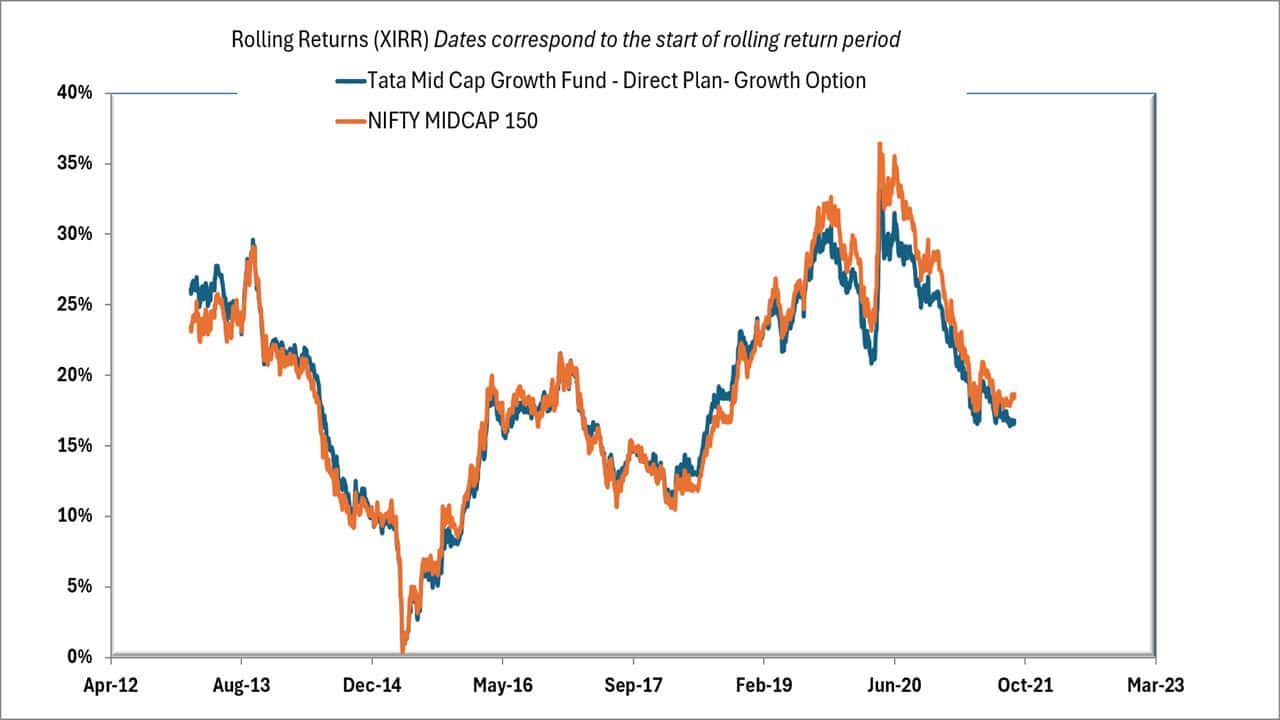
The fund outperformed the index only 886 out of 2124 times. Thus, rolling-return outperformance consistency over seven years is 886/2124 = 41.71%, indicating poor performance. A consistent performer should beat the index at least 60% to 70% of the time. So, the more consistent the rolling-return outperformance, the better.
Given the high fees AMCs charge, we expect 70% performance consistency. If they fail, they don’t deserve such high fees. We are better off with an index fund.
Active Mid Cap Funds vs Nifty Midcap 150 TRI
- Over 3 years, only 5 out of 27 funds qualified (rolling return outperformance consistency of 70% or more).
- Over 4 years, only 4 out of 23 funds qualified.
- Over 5 years, only 4 out of 21 funds qualified.
- Over 6 years, only 6 out of 20 funds qualified.
- Over 7 years, only 8 out of 19 funds qualified.
- Over 8 years, only 6 out of 18 funds qualified.
- Over 9 years, only 5 out of 17 funds qualified.
- Over 10 years, only 4 out of 16 funds qualified.
As mentioned before, using direct plan funds limits both the number of funds and the number of rolling return data points. However, I won’t put too much money into regular plan funds that are doing better.
I think the data is sufficiently clear that it makes little sense to pay high fees and keep the faith with an active mid cap fund in the hope it will continue its past good performance or that it will do better in future.