A reader asks, “I am 27 years old. My current monthly expenses are about Rs. 30,000. I don’t intend to get married. Can I achieve financial independence at 40 if my net worth today is zero?”
Let us determine what the freefincal robo advisor tool coughs up for this scenario. The assumptions and inputs are listed below. Please note that this is only an illustration and should not be considered a financial plan. There are many other considerations when using the robot tool for retirement planning.
- Age at the end of the current year: 27
- Age you wish to retire 40
- Years to retirement 13
- Total average monthly expenses (annual/12) Rs. 30,000
- Percentage by which your monthly investments can increase each year (until you have accumulated enough for retirement): 10% This is not easy to pull off, but if you insist on quitting a salaried job in just 13 years, this is highly recommended. You can even try to exceed this rate whenever possible!
- Post-tax return expected from equity investments 9% (expect less, and you will not be disappointed!)
- Post-tax return expected from current taxable fixed income 6%
- Rate of return expected from current tax-free fixed income 7%
- Inflation before retirement is 6%. Most likely, this is an underestimate. You will have to be extremely careful about lifestyle creep.
- The assumed life expectancy: 90
- Inflation during retirement: 6%
- Years to retirement 13
- Monthly expenses in the first year of retirement: Rs. 63,988
- Years in retirement: 50
Results:
- Retirement Corpus required 2,98,39,853
- Initial monthly investment required, including EPF/NPS contributions, Rs. 46,331
The investment schedule generated by the robo tool is given below.
| Age | Monthly investment in equity | Monthly investment in fixed income, including total EPF/NPS contribution. If the EPF/NPS contribution is greater than this, adjust the equity investment to align with the suggested asset allocation (above graph or columns H & I |
| 28 | 27,799 | 18,533 |
| 29 | 30,579 | 20,386 |
| 30 | 33,636 | 22,424 |
| 31 | 37,000 | 24,667 |
| 32 | 40,700 | 27,133 |
| 33 | 42,680 | 31,937 |
| 34 | 44,648 | 37,431 |
| 35 | 46,583 | 43,703 |
| 36 | 48,459 | 50,856 |
| 37 | 50,245 | 59,002 |
| 38 | 51,902 | 68,269 |
| 39 | 53,389 | 78,799 |
| 40 | 54,654 | 90,753 |
The suggested asset allocation schedule is given below.
🔥Secure your future with our Robo-advisory tool trusted by over 3,500 investors and advisors. From effortless retirement planning to funding your children’s biggest dreams, turn your financial goals into reality. 🔥
Subscribe for money management solutions via email! (Link takes you to our email sign-up form) Join 32,000+ readers in our community.
👉 New Tool Alert! NaviPlan: A Privacy-Focused Multi-asset Tracker and Goal Planner 👈
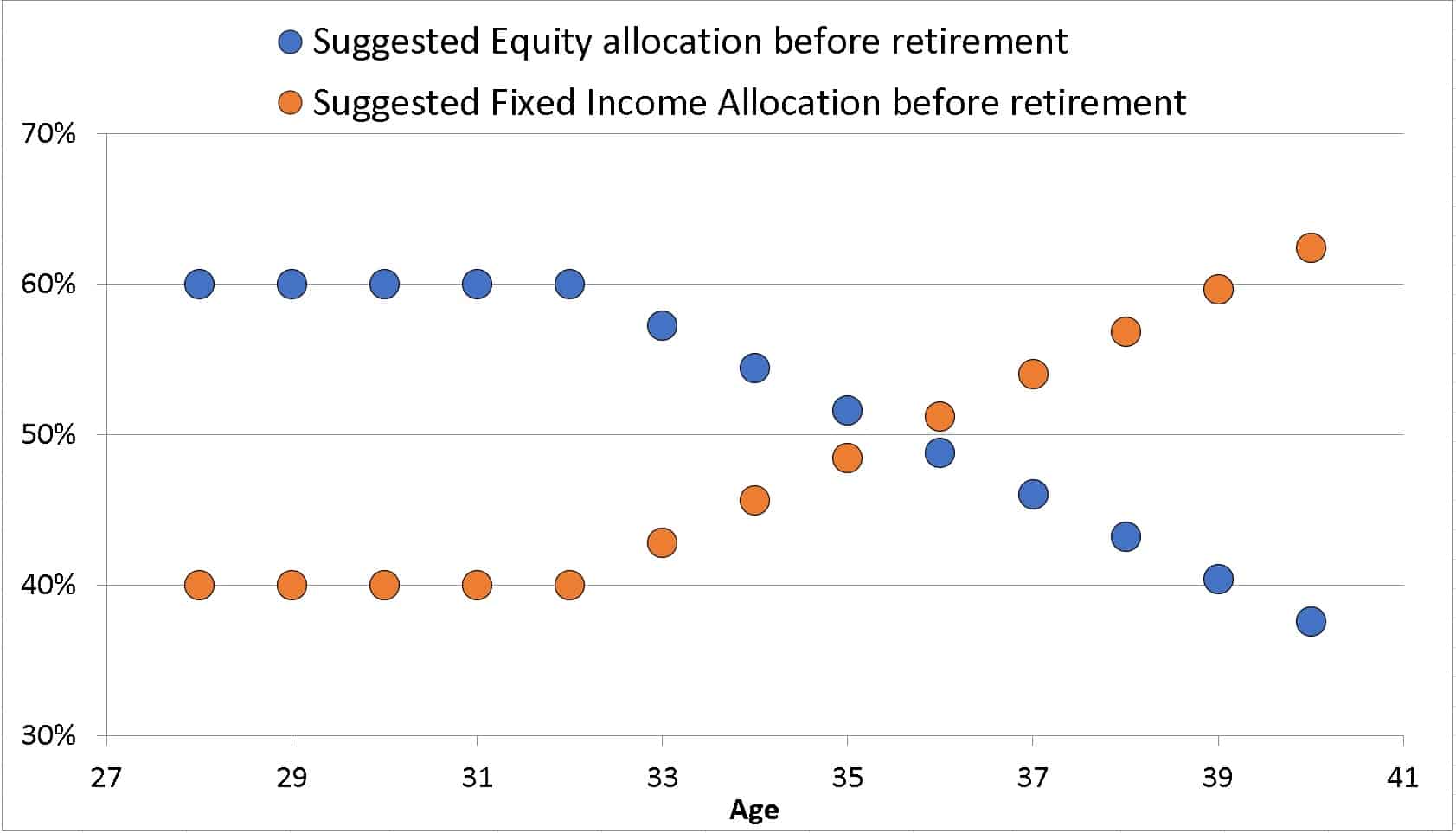
After retirement, the calculation assumes the use of a retirement bucket strategy as explained here:
- I am 30 and wish to retire by 50; how should I plan my investments?
- Retirement plan review: Am I on track to retire by 50?
Can the reader achieve financial independence in 13 years, starting from scratch? Only if he can invest more than twice his current monthly expenses. This is only possible with a large total income and low expenses.
If this is not possible, start investing what you can immediately. Increase the monthly investment by as much as possible and review it yearly. See: How to audit your financial freedom portfolio.
You still need proper gainful employment via your business, consulting, or freelancing after early retirement. So, work on that today. This income could be a great support when you quit your salaried job. However, we recommend not depending on this income while planning for retirement.
Another option is to quickly accumulate a corpus that will provide inflation-index income for 5-10 years and then quit your job to start your venture (if you have a proper plan for this). This is not financial independence or early retirement. This corpus is just a cushion while you transition into a new role.
Whatever you choose to do, try to balance needs, wants, and future goals without depriving yourself of any pleasure – especially those that can only be enjoyed when you are young.
If you cannot invest the suggested amount, we recommend not fretting about financial independence and investing whatever you can. You will still be on course to normal retirement by age 50-55.