We discuss what investors should appreciate before selecting an index fund tracking the Nifty LargeMidcap 250 Index Fund. At the time of writing, five fund houses – Edelweiss, HDFC, ICIC Pru, Mirae Asset and Zerodha offer index funds tracking this index. See our earlier review: Zerodha Nifty LargeMidcap 250 Index Fund Review.
The Nifty LargeMidcap 250 Index is 50% of Nifty 100 + 50% of Nifty Midcap 150. This covers nearly 85% of all the traded equity stocks at NSE. This makes it distinctly different from a pure market-cap-weighted index like the Nifty 500. See: Nifty 50 or Nifty 500, which index fund should I choose?
In the LargeMidcap 250 index, the aggregate weight of large and mid cap stocks is capped at 50% each (quarterly reset). Within each segment, the stocks are weighted by free-float market capitalisation.
So, this certainly increases the risk, but the reward is neither proportional nor guaranteed. When the mid caps soar, this fund would look like a great investment; when they don’t, it would seem a terrible place to be in. We shall refer to the index as the “250” below.
10-year rolling return of Nifty 50 vs Nifty Next 50 vs Nifty LargeMidcap 250 TRI
🔥Secure your future with our Robo-advisory tool trusted by over 3,500 investors and advisors. From effortless retirement planning to funding your children’s biggest dreams, turn your financial goals into reality. 🔥
Subscribe for money management solutions via email! (Link takes you to our email sign-up form) Join 32,000+ readers in our community.
👉 New Tool Alert! NaviPlan: A Privacy-Focused Multi-asset Tracker and Goal Planner 👈
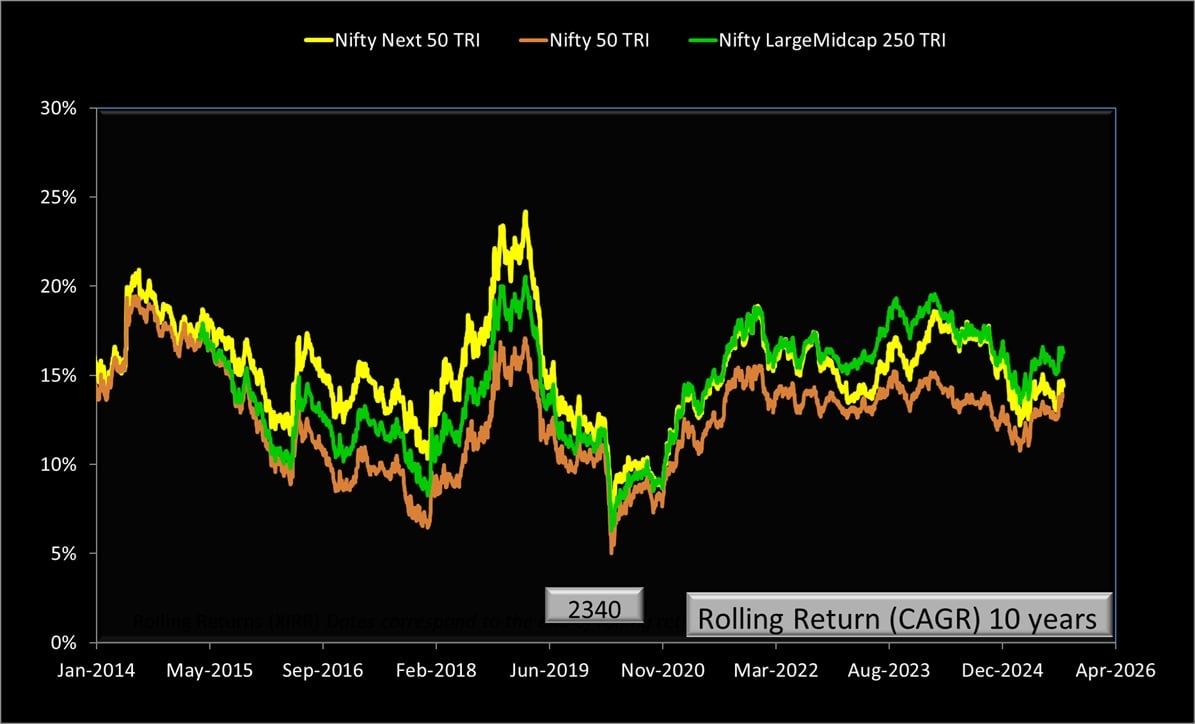
Recently, the LargeMidcap 250 index has had a return spread close to that of the Nifty Next 50. If it continues, it could mean holding a 250 index fund could be just as frustrating as holding a next 50 index fund (as many members of our community can attest).
There is a reasonable chance of outperforming the Nifty 50. Still, like all other funds, the margin and frequency of outperformance vary from time to time, depending on the performance of the mid-cap segment.
10-year rolling return of Nifty 500 vs Nifty Next 50 vs Nifty LargeMidcap 250 TRI
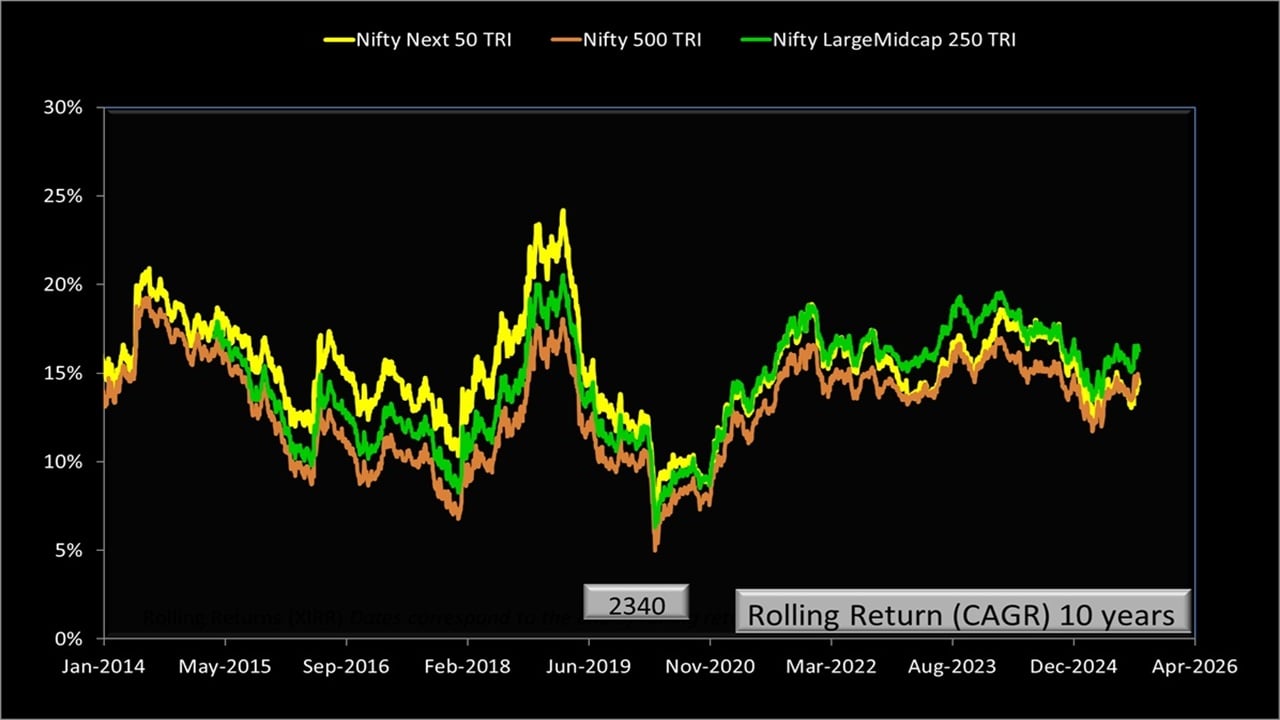
If we replace the Nifty 50 with the Nifty 500 in the comparison, the margin of the periodic outperformance is narrower.
10-year rolling standard deviation of Nifty 500 TRI vs Nifty 50 TRI vs Nifty Next 50 TRI vs Nifty LargeMidcap 250 TRI
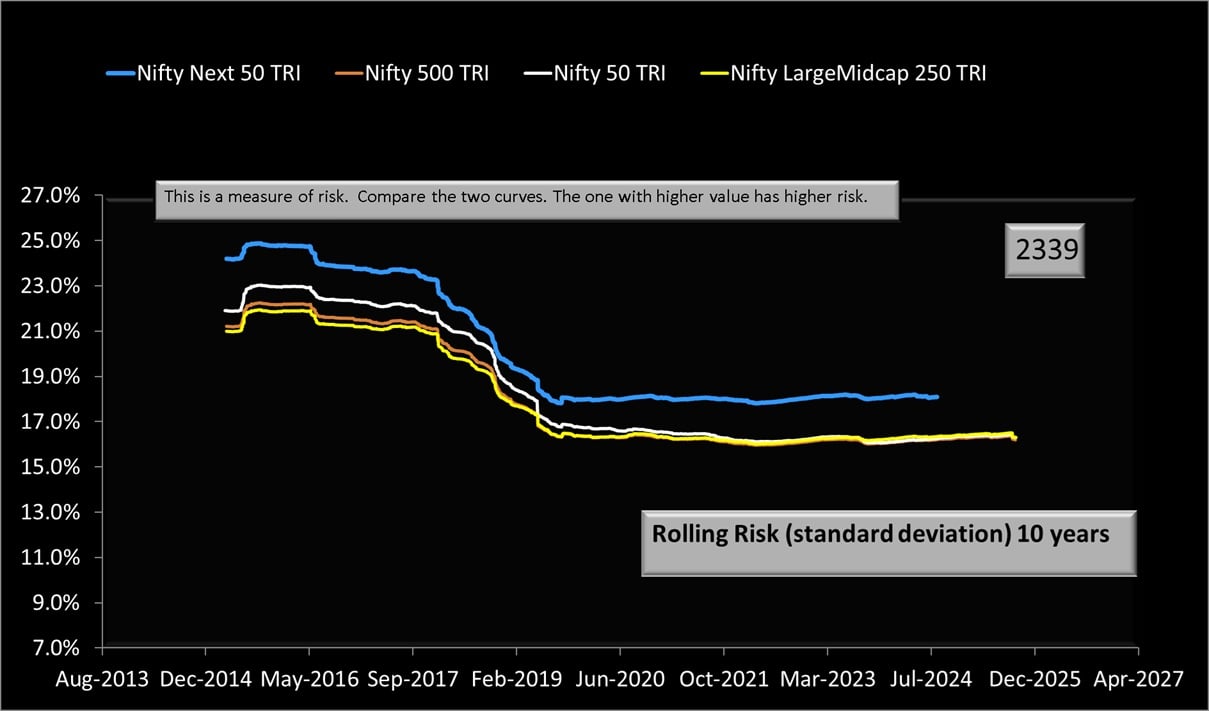
The rolling standard deviation (volatility) shows there is not much difference between the Nifty 500 and the Nifty 250 indices.
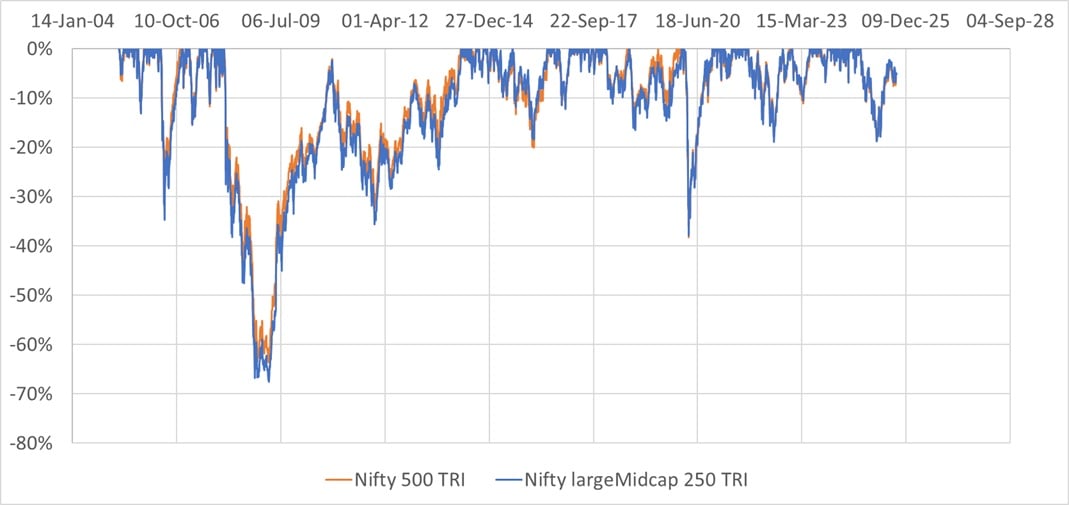
Drawdown of Nifty 500 TRI vs Nifty LargeMidcap 250 TRI
This is a measure of how much an index falls from a peak and how long it stays “underwater”. The Nifty 500 is a bit less risky than the 250 index.
Drawdown of Nifty Next 50 TRI vs Nifty LargeMidcap 250 TRI
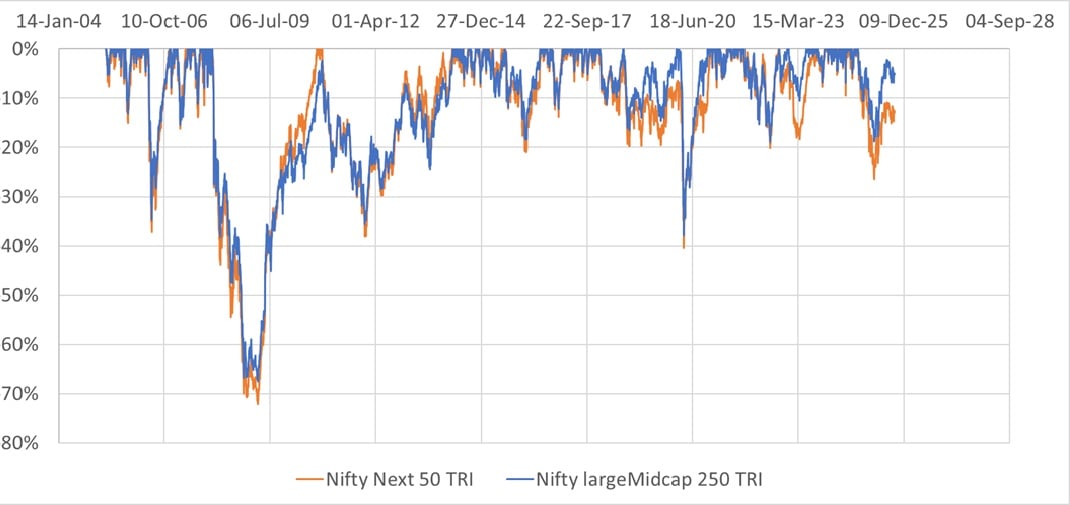
The Nifty Next 50 is riskier to hold than the 250 index.
Our recommendations
The main problem with the “250” is the high exposure to mid cap stocks. This can be extremely frustrating to hold when the mid caps don’t do well for an extended period. I know many young investors are eager to claim without experience that “they have the risk appetite” to hold such an index, but from what I’ve seen, much of that usually is ‘talk’. So we recommend the following.
- If you can conquer FOMO and can be happy with only large cap exposure, stick to the Nifty 50.
- If you cannot conquer FOMO and want exposure from “other segments”, buy the Nifty 500.
A Nifty LargeMidcap 250 Index Fund is certainly not a terrible idea, but investors must appreciate that the high exposure to midcap stocks can be a double-edged sword.