Last Updated on September 27, 2023 at 3:53 pm
Jan 1st, 2017, marked the fourth anniversary of direct mutual funds plans. These are mutual funds you can buy without any commission, directly from the AMC, its aggregation portal MF Utility or one of the many new direct mutual fund + robo advisory portals. This is the fourth anniversary report.
If you are already a direct fund investor, please do consider sharing this article with your friends and colleagues who do not understand the difference and still losing money.
If you think you are no paying any charges by investing via your bank, stock broker or so-called “free portal”, please think again. The commissions are paid by the AMC, all right. But where do they get the money to pay commissions from? They get it from your investment value. That is why so- called regular plans or any fund name with no “direct plan” appended to it have a NAV lower than direct plans.
Update: You Can be Rich Too With Goal Based Investing is now 23% Off at₹ 307 (Hard Cover). Get it now from Amazon
🔥Secure your future with our Robo-advisory tool trusted by over 3,500 investors and advisors. From effortless retirement planning to funding your children’s biggest dreams, turn your financial goals into reality. 🔥
Subscribe for money management solutions via email! (Link takes you to our email sign-up form) Join 32,000+ readers in our community.
👉 New Tool Alert! NaviPlan: A Privacy-Focused Multi-asset Tracker and Goal Planner 👈
What about advice? Who will advise people who go direct?
Well here the options:
1: DIY (as long as you have what it takes). Invest directly with AMC or use MF Utility.
2: Consult a fee-only financial planner who is registered with SEBI as a Registered Investor Advisor, pay a flat fee for advice and invest in direct plans. I have a list of such advisors.
3: Invest via robo advisory portal: Invezta and Kuvera (independent of MF Utility) or (Unovest, Orowealth, Bharosa Club, Wixifi, and a few more apps dependent on MF Utility). This needs to be updated (will do soon) Comparison of Direct Mutual Fund Transaction Portals
Do not listen to anyone who says that you cannot get “professional” advice if you invest in direct plans. Switch to direct plans from your bank, free portal, sharebroker and mutual fund distributor (some call themselves fee-only financial planners) TODAY!!
Want proof before shifting? This where this report comes in.
Exhibit 1A: Difference in NAV
The difference in NAV between HDFC Top 200 or HDFC Top 200 regular plan and HDFC Top 200 Direct Plan
This is the price you have paid for “conveniently” investing via banks, share brokers and “free” portals. Make that, huge price.
Exhibit 1B: Difference in 1-Y SIP Returns
This is the extra return (in %) because of investing in direct plans. It may appear small now but will make a huge difference after a few years: Illustration: Direct Mutual Funds vs. Regular Mutual Funds

If you wish to know how I generated this graph from value Research, consult last year’s report: Returns Comparison 2016: Direct Mutual Fund vs. Regular Mutual Fund
The funds with lowest return difference are index funds!
Exhibit 1C: Difference in 3-Y SIP Returns
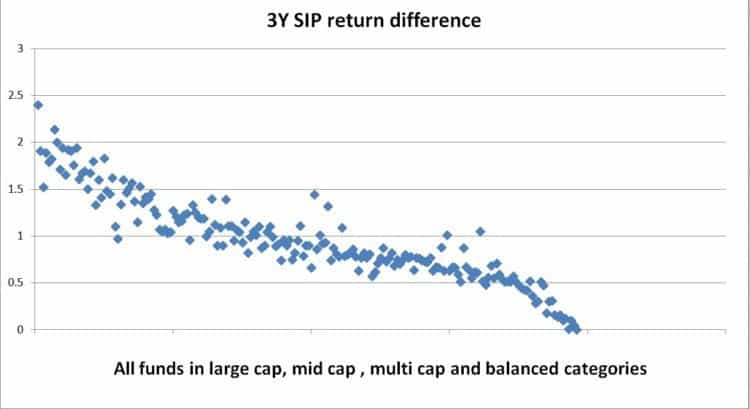
Now, don’t get misled by the fact the return difference is till the same over 3Y. This does not make it small. This is where compounding matters: The difference is the year-on-year difference in returns. So each year, the difference grows by that difference.
Exhibit 1D: 3Y vs 1-Y SIP Returns
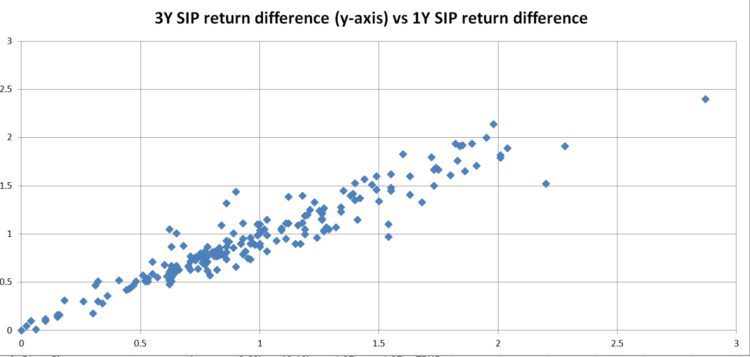
Notice the 3Y return difference falls in a straight line when plotted against the 1Y return difference.
To give you a rough estimate. If the difference in returns after 1Y is 0.8%, then
the difference in corpus = (1+0.8%) after 1Y.
the difference in corpus = (1+0.8%) x (1+ 0.8%) after 2Y.
the difference in corpus = (1+0.8%) x (1+ 0.8%) x (1+ 0.8%) after 3Y and so on.
The 0.8% difference will be the same (for this simple illustration) but the amount you lose for each you avoid switching to direct will keep growing. See above illustration link.
SO ACT NOW!!
Exhibit 1E: Some Examples
For the last 4Y, I have tracked the difference in returns and excess corpus because of investing in direct plans.
Some results from past 3Y data published in the 2016 report.


Now after 4Y:

The return difference will be the same but the excess corpus will keep on increasing.
I repeat: ACT NOW: How to Invest in, or Switch to Direct Mutual Fund Plans
Ps. TRUST NO ONE: Not me, Not the amc, not your “advisor”, not the media* – definitely not the media, not your fav mutual fund portal and the people who run it. Check facts for yourself. THERE IS NO FREE LUNCH.
*: Dr Narendra Nathan from ET is the only exception that I can think of.
Seize the day!

You Can Be Rich Too


My new book with PV Subramanyam, published by CNBC TV 18
The book comes with 9 online calculator modules to create your own financial plan.
It also has detailed selection guides for equity and debt mutual funds.
Amazon ₹ 307
Kindle (₹ 244.30)
Infibeam Rs. 307
Googe Play Books App Store (₹ 244.30)
Read a Sample Chapter and Buy Now!
What Readers Say
- Simple and powerful This book empowers the reader with the concepts in easy to understand & simple form. Those who have been reading blogs of both authors would know that they are not only good with finance domain but also have a knack of simplifying the methods of investing for their readers. This book by them is a gem of financial knowledge for people who are starting to invest or want to get better at it. The presentation and the thought process with calculators is extremely powerful.The book should be read & calculators used simultaneously to understand the concepts well. The calculators when used with real inputs will show you where you are & where you need to reach for each of your goals. Don’t ignore these numbers.Learnings from Chapters 7 to 11 will help you avoid going off path & saving your money from financially hazardous products. With discipline & right approach suggested here you wouldn’t need a financial advisor to build wealth.
- This is perfect book on personal finance. Very nicely explained about taxation about debt mutual fund. Topics like early investing and asset allocation are very well explained. – Mahesh Deshmukh
- Highly Recommended For anyone who wishes to take control of his/her finance this book is a must read. Very simply put, even an amateur in finance will be able to understand and implement. The author genuinely attempts to inculcate the habit of investing among the people who have the ability to invest but refrain from doing it, either due to lack of time , interest or understanding!. The message from the book is ” Investment done without setting a goal/ objective is like leaving for a trip without knowing the destination, not everytime the end result will be promising. Hence, it’s important to invest in a planned & disciplined manner.” A read is highly recommended ????
- A must book for everyone who wants to take control of personal finance. Nice explanation of how a debt mutual fund works. Bonds trading and indexation benefits in high inflation years were something new I learnt. After reading this book you will be able to easily choose any funds, because you will know what that fund does or how that fund works
Read all reviews here: Amazon Reviews