While preparing a slide deck for a talk at the Reserve Bank Staff College, I made a bespoke retirement calculator that factors in an indexed pension. Here is how that makes a huge difference to a retirement plan.
An indexed pension increases each year at a set rate or inflation rate. This is known as dearness relief. Until a few years ago, RBI employees had no dearness relief and only had a constant pension. Then, indexation was introduced. This is similar in structure to the unified pension scheme.
The freefincal robo advisor users can include up to three indexed income sources (pension, rent, dividends, etc.) while planning for retirement.
Let us look at an example. There are several conservative assumptions in estimating the pension and other aspects of the retirement plan here.
- Age at the end of the current year: 31
- No of years you expect to work: 29
- Current expenses per month (annual/12): Rs. 60000
- Expected inflation before retirement: 6.00%
- Expected inflation after retirement: 5.00% (this is perhaps a touch low, but I had to set it at 5% so that it approximately matches the pension indexation. This allows me to avoid macros/scripts in the Excel file)
- Estimated years in retirement: 25
- The average rate of return (after tax) expected before retirement: 9.00% (this a crude approximation)
- Anticipated post-retirement rate of interest (after tax): 6.00%
- The tool also factors in investments made in three different asset/tax types and their future value
- Annual increase in monthly investment: 5.00%
- Current monthy Basic pay: Rs. 50,000
- Approximate basic pay at the time of retirement: Rs. 2,70,919 (salary increase ~ 6% a year, factoring in increments, promotions and pay commissions)
- Approximate monthly pension at retirement: 2,25,766 (half of last drawn basic + 1/3rd of last drawn basic as DA). This is probably the most contentious assumption, as we do not know the DA rate at the time of retirement.
- Annual pension before tax Rs. 27,09,194
- Annual pension after tax Rs. 22,09,725 (assuming current new tax regime rates)
- Monthly post-tax pension Rs. 1,84,144
- Monthly expenses in 1st year of retirement Rs. 3,25,103
- Net monthy income reqd from the corpus in 1st year of ret Rs. 1,40,959
- Total retirement corpus required: Rs. 3,78,29,519
- Net corpus to be saved Rs. 3,17,43,428 (factoring in some current investments)
- Initial monthly investment required 12,050 (to achieve the net corpus).
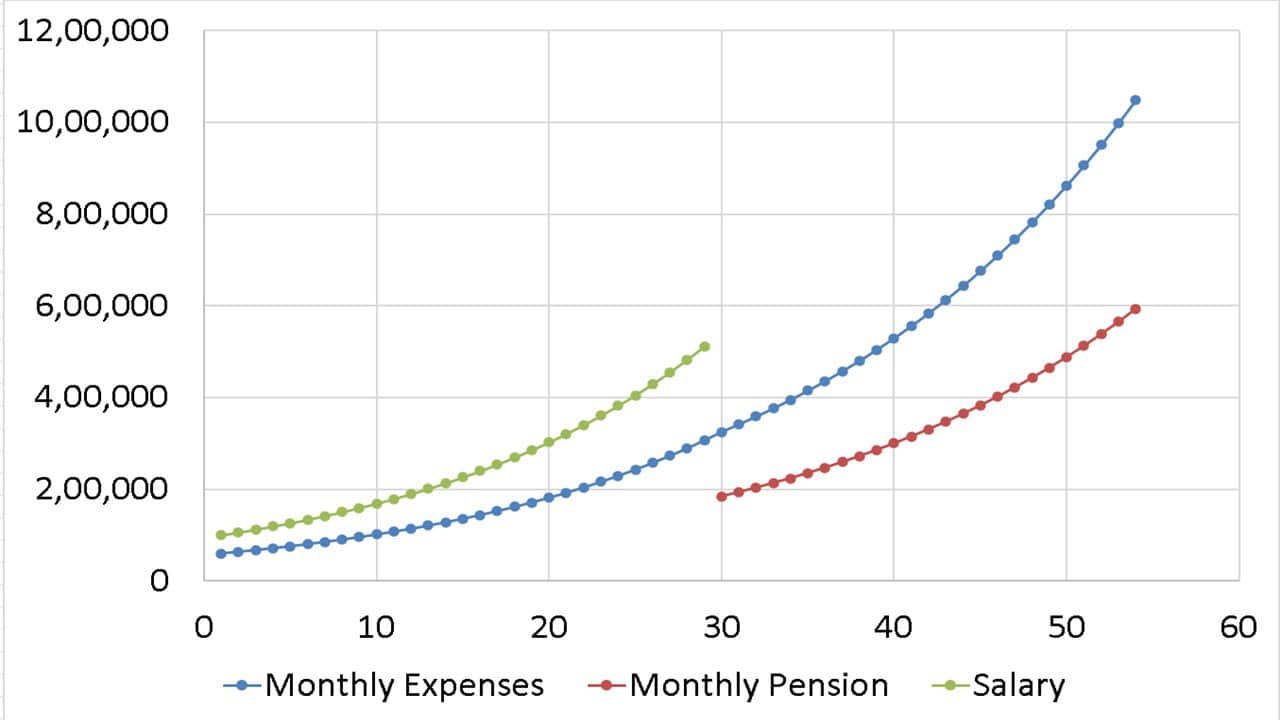
In this illustration, the gap between expenses and the indexed pension is handled using a bucket strategy using the Rs. 3.78 Crore corpus.
🔥Secure your future with our Robo-advisory tool trusted by over 3,500 investors and advisors. From effortless retirement planning to funding your children’s biggest dreams, turn your financial goals into reality. 🔥
Subscribe for money management solutions via email! (Link takes you to our email sign-up form) Join 32,000+ readers in our community.
👉 New Tool Alert! NaviPlan: A Privacy-Focused Multi-asset Tracker and Goal Planner 👈
For some illustrations, see:
- Retirement plan review: Am I on track to retire by 50?
- I am 30 and wish to retire by 50; how should I plan my investments?
- Can I retire by age 55? Retirement Planning Case Study
- Case Study: Achieving Financial Freedom for Early Retirement
- How should I plan if I want to retire in 20 years?
- Is it possible to combine a bucket strategy with income laddering after retirement?
Retirement Plan without any pension
Suppose we set the pension to zero. We have:
- Total retirement corpus required Rs. 8,72,48,475
- Net corpus to be saved Rs. 8,11,62,384
- Initial monthly investment required Rs. 30,810
That is a 131% increase in the total corpus and a 156% increase in the initial monthly investment required.
If the pension were constant throughout retirement without indexation, the total corpus required would be Rs. 5.73 Crores, the net corpus (considering the same investments) would be Rs. 4.49 Crores, and the initial monthly investment required to achieve this net corpus would be Rs. 17K.
Thus, an indexed pension makes a considerable difference to a retirement plan. It also significantly increases the government’s pension burden.