This article explains how a retirement bucket strategy can be combined with an income ladder in various ways. The goal is to reduce the management risks associated with a bucket strategy.
In an income ladder, we use fixed-income instruments that mature periodically in future, providing income to the retiree. Let us consider an example.
Suppose I need:
- 1 lakh for one year starting now
- 1.1 lakhs for one year, 12 months later (10% inflation) and
- 1.21 Lakhs for one year 24 months later.
Creating an income ladder: One lakh is kept away for meeting expenses for the first 12 months. Then one lakh is invested in a fixed deposit for one year, offering a return of 10% per anum (dream on!) and one lakh in a second fixed deposit for two years (@10% pa). The first FD matures after one year and provides for expenses in the second year. The second FD matures after two years and provides for expenses in the third year. This way, using a corpus of 3 lakhs, a total expense of 3.31 lakhs over three years can be covered.
Bucket Strategy: The retirement corpus is typically divided into three parts (buckets). A low-risk bucket with little or no equity. A medium-risk bucket with a small exposure to equity and a high-risk bucket with equity as the dominant constituent.
🔥Secure your future with our Robo-advisory tool trusted by over 3,500 investors and advisors. From effortless retirement planning to funding your children’s biggest dreams, turn your financial goals into reality. 🔥
Subscribe for money management solutions via email! (Link takes you to our email sign-up form) Join 32,000+ readers in our community.
👉 New Tool Alert! NaviPlan: A Privacy-Focused Multi-asset Tracker and Goal Planner 👈
Inflation-indexed income is withdrawn each year from the low-risk bucket. The goal is to ensure that there are enough funds in the low-risk bucket at any point in time to cover expenses (incl. inflation) for the next five years or seven years or as the retiree (or advisor) desires.
To ensure this, the funds in the medium-risk and high-risk must be actively managed (with switches at least once a year). If the high-risk bucket increases due to a bull run, some funds should be switched to either the low-risk bucker or medium-risk bucket. Those interested can see how this works with this free tool: The Retirement ‘Bucket Strategy’ Simulator.
Naturally, managing a bucket strategy is anything but easy. Even financial advisors in India do not have much experience with it. So when we designed our robo advisory tool, our primary considerations were two-fold:
- Minimize the sequence of returns risk as much as possible. This is the risk associated with substantial negative returns from equity and extended sideways markets, particularly in the early stages of retirement.
- Reduce the active management associated with buckets as much as possible.
Therefore, we combined the features of an income ladder and a bucket strategy and then further optimised it with additional features. Let us discuss this with an example.
The robo tool divides the retirement corpus into five buckets. That is, the retirement corpus will be divided into five parts. This is only one of many ways to construct a bucket strategy. The following assumes 45 years in retirement.
- An emergency bucket to handle unexpected expenses. Example: 5%
- Note: the overall equity allocation from the entire corpus is only 35% after retirement in this example.
- Income bucket that provides guaranteed income for the first 15 years of retirement. This minimises the sequence of returns risk to a great extent. During this time, investments are made in the following three buckets.
- Corpus from a low-Risk bucket that provides income from year 16 to year 26 in retirement. To provide this income, the low-risk bucket will have an asset allocation of 50% equity and 50% debt during the investment period (years 1 to 15 of retirement). This corpus weighs about 25%.
- Corpus from a medium-risk bucket will provide income from years 27 to 35 in retirement. To provide this income, this bucket shall have an asset allocation of 70% equity and 30% debt during the investment period (year 1 to year 27). This corpus weighs about 15%.
- Corpus from a high-risk bucket will provide income from years 36 to 45 in retirement. To provide this income, this bucket shall have an asset allocation of 100% equity during the investment period (year 1 to year 36). This corpus weighs about 9-10%.
- After 15 years, the low-risk bucket can be turned into 100% debt and provide income for about 11 years. After that, the other buckets can also be progressively used. One can always customize this usage after retirement.
- Please note that bucket allocations will change as per the user inputs and are auto-determined by the robo tool. Please do not blindly copy these numbers.
Here too, rebalancing among buckets and occasional profit booking is essential. However, unlike a regular bucket strategy where everything is fluid, each bucket is designed to progressively “mature” at different times in the future (like an income ladder) to account for future income. So in principle, one can manage the buckets without any “active” (that is, market-dependent) management and opt for annual rebalancing.
This advantage of combining features of an income ladder with a bucket strategy can be optimised further. The two features mentioned below are now part of our robo-advisory tool.
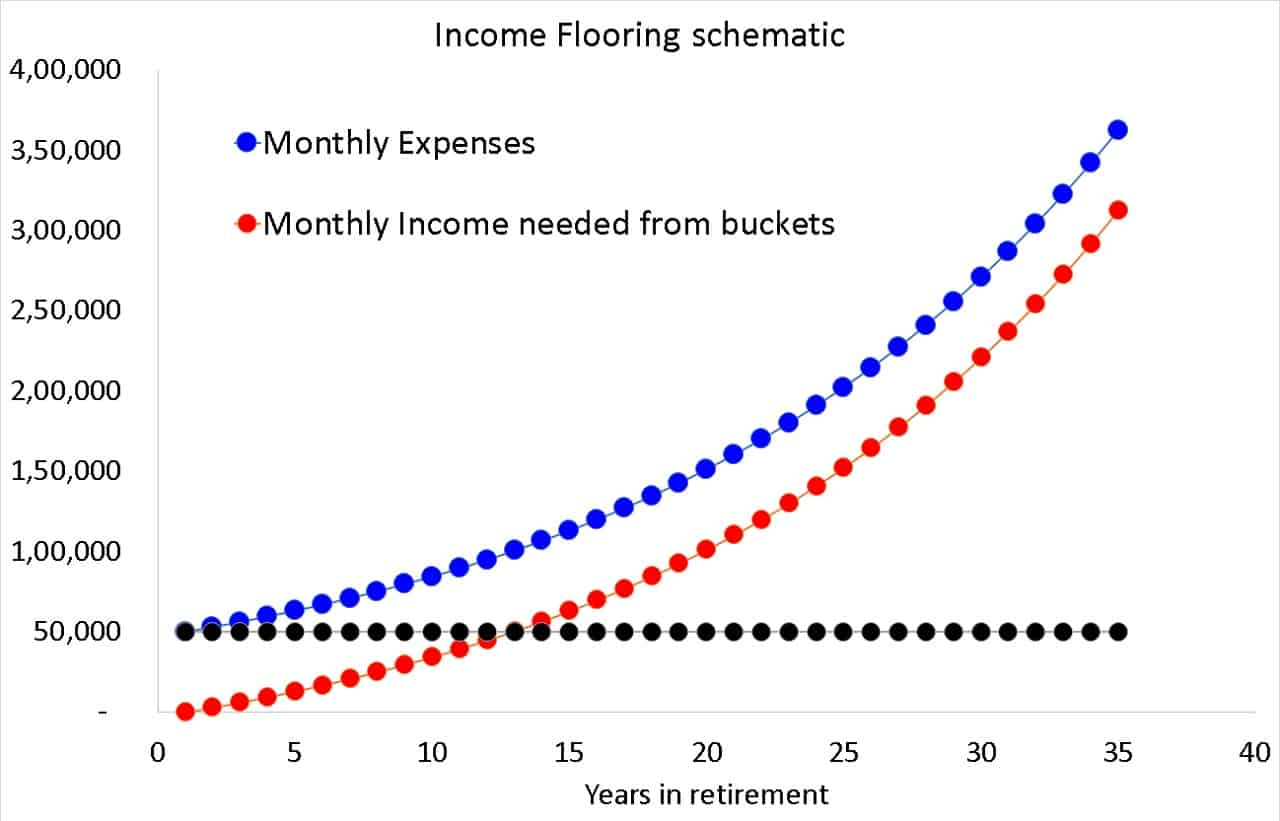
(1) Using income flooring: Here, we buy an annuity (pension) for an amount equal to the expenses in the first year of retirement. Then the expenses in the latter years are handled using the method detailed above. More details are here: How to beat inflation after retirement with a guaranteed pension. This further reduces the management of the retirement buckets.
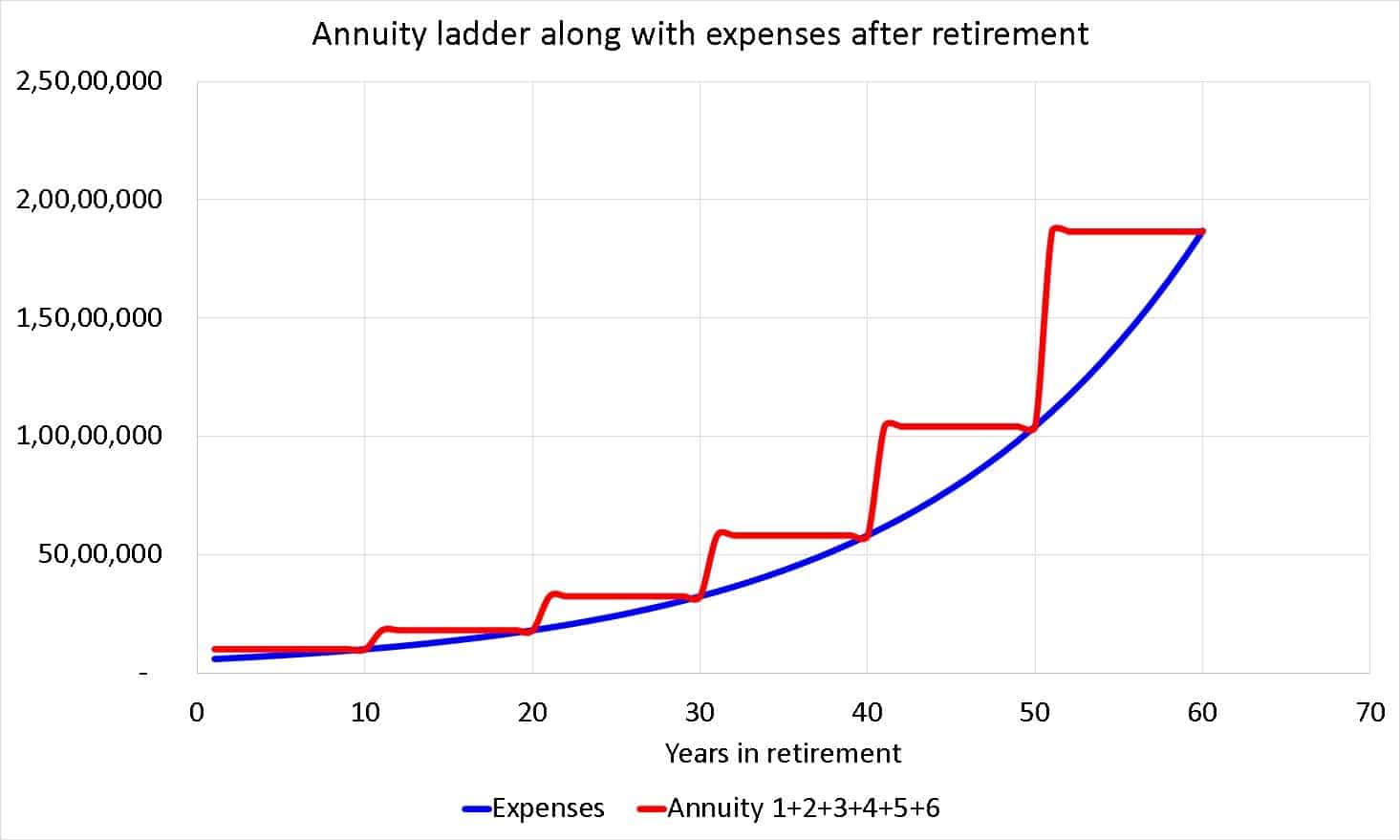
(2) Using annuity laddering: We considered a single annuity in the above example. We can buy additional annuities (say, every decade) and further reduce the management of retirement buckets. This is also a form of income laddering and exploits the higher interest rate on pensions as the retiree ages. Details are here: Use this annuity ladder calculator to plan for retirement with multiple pension streams.
Thus we can eliminate management risks associated with a plain bucket strategy with features of an income ladder and annuity ladders.