A reader says, “I have modelled my retirement plan using the freefincal robo advisor. The option to secure a part of retirement expenses with income flooring is particularly appealing after reading reader journeys like How I used RBI Retail Direct to buy government bonds and create an income source and The system I use to draw income and spend after retirement securely“.
“At 54, with retirement a few months away, I am sure that RBI Retail Direct is the right choice for this income source*. However, I am unsure how much corpus I should allocate to create the income floor. The robo tool allows me to set the percentage from 0% to 100% of my annual expenses and beyond. Can you please suggest an ideal percentage?”
* See: RBI Retail Direct for govt bonds: Who should use it and who should not
First, let us understand what income flooring is.
The conventional retirement calculation assumes a corpus X. After retirement, we invest this X in different buckets, and an income is drawn each month. We assume that each year, the monthly expenses increase at some rate of inflation (6-8% typically). If we expect to live for 30 years post-retirement, the X will reduce to zero at that age. So, the retirement planning calculation has two parts: What is X? How much should I invest to get X upon retirement? The robo template will also tell you the asset allocation (how much in equity and how much in fixed income) for each year up to retirement.
🔥Secure your future with our Robo-advisory tool trusted by over 3,500 investors and advisors. From effortless retirement planning to funding your children’s biggest dreams, turn your financial goals into reality. 🔥
Subscribe for money management solutions via email! (Link takes you to our email sign-up form) Join 32,000+ readers in our community.
👉 New Tool Alert! NaviPlan: A Privacy-Focused Multi-asset Tracker and Goal Planner 👈
Suppose I take a chunk of X and buy a Gilt (government) bond with it via RBI Retail Direct. Then, some of my expenses will be taken care of for life. The remaining expenses (which will increase due to inflation) can be handled via retirement buckets with the rest of the corpus and any other income source. This is a schematic.
The curve that moves up represents inflation-indexed expenses after retirement. The total income from the retirement corpus and other sources must keep pace with inflation to match this curve. A part of this is income is guaranteed for life with a Gilt bond purchase or insurance annuity and is known as income flooring,
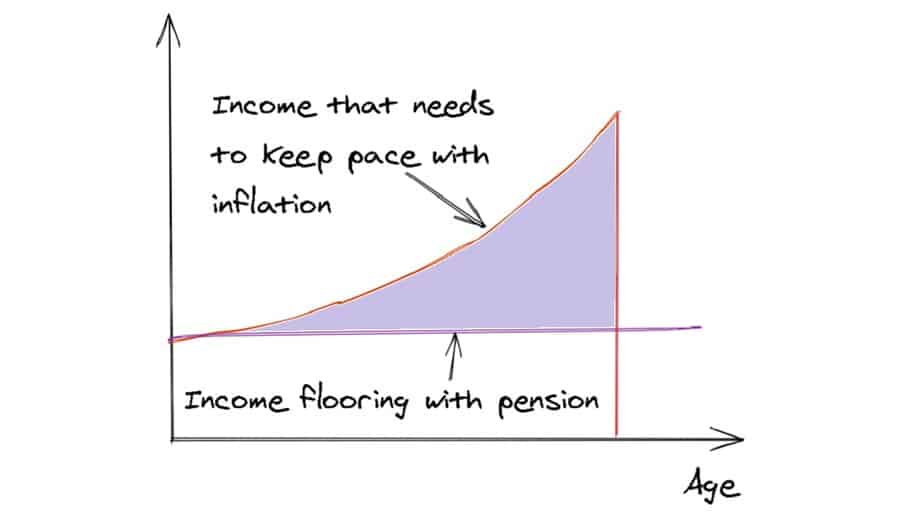
Given the expense curve above, the reader asks where I should place the income floor (the horizontal line). Or, suppose the reader’s annual expenses are Rs. 12 lakhs. What should be the annual interest he should get from RBI Retail Direct? Should it be less than, equal to or more than Rs. 12 lakhs? This value can be adjusted as a percentage of annual expenses in the robo tool.
Naturally, the higher the income floor percentage, the higher the total corpus required. Here is an example using the robo tool/
Inputs and some assumptions
- Current monthly expenses that will persist in retirement Rs. 1,00,000
- Annual expenses that will persist in retirement Rs. 1,00,000
- Your age at the end of the current year 55
- Age you wish to retire 55
- Inflation before retirement (%) 7
- Assumed life expectancy of younger spouse 90
- Inflation during retirement (%) 6
Years to retirement 0 - Monthly expenses in the first year of retirement: Rs. 1,08,333
- Years in retirement (until younger spouse reaches age 90) 35
Results (relevant to income flooring)
- Total Corpus required with no income flooring: Rs. 3.84 Crores
- Total Corpus required with 25% income flooring: Rs. 4.17 Crores
- Total Corpus required with 50% income flooring: Rs. 4.49 Crores
- Total Corpus required with 75% income flooring: Rs. 4.82 Crores
- Total Corpus required with 100% income flooring: Rs. 5.15 Crores
- Total Corpus required with 120% income flooring: Rs. 5.46 Crores
So, answering the reader’s question depends on how much corpus we have. If I have a large enough corpus, I will opt for an income floor or guaranteed annual income of about 110% to 120% of my annual expenses. I would recommend the same for anyone who can afford to do so.