Last Updated on December 29, 2021 at 5:48 pm
If you read the scheme information document of a typical debt fund, say PPFAS liquid fund, you would fund interest rate swaps mentioned in many places. An interest swap is a derivative product used to hedge interest rate risk by mutual funds. In this article, we explain with simple examples, how swaps work.
About the author: Harshini Gopu works in a global financial institution as a senior associate. She is experienced in credit risk and capital management. She is also a budding artist. In a previous article, we had explained how Floating Rate Debt Mutual Funds Reduce Interest Rate Risk. In this article, we explain in detail one particular technique of achieving this.
What are Interest Rate Swaps (IRS): An Interest rate swap is a derivative instrument which is available in the over-the-counter (OTC) market. This instrument is for institutions/companies and not for retailers. It is used between companies to swap their future interest rate payments from fixed to floating or floating to fixed interest rates.
For example, Company A is paying a floating interest rate for a loan it borrowed, and it is not happy paying the floating interest rate, and it wants to move to a fixed interest rate. A lender will not change the loans interest rate terms after entering into an agreement. How will the company A swap it’s floating interest rate to fixed? It can be done by entering an IRS agreement with another counterparty B.
🔥Secure your future with our Robo-advisory tool trusted by over 3,500 investors and advisors. From effortless retirement planning to funding your children’s biggest dreams, turn your financial goals into reality. 🔥
Subscribe for money management solutions via email! (Link takes you to our email sign-up form) Join 32,000+ readers in our community.
👉 New Tool Alert! NaviPlan: A Privacy-Focused Multi-asset Tracker and Goal Planner 👈
Company A has borrowed a floating interest rate loan of Rs.10 lakh from a Lender one (Banks/Other Financial institution). Lender one has lent the money for MCLR + 2% interest rate. MCLR (Marginal Cost of Funds based Lending Rate) rate is an internal reference rate for banks to determine the interest they can levy on loans. In other words, MCLR is the minimum rate that a bank can lend to a customer. MCLR depends on the Repo rate, which the Monetary Policy by RBI decides bi-monthly.
We also have another company B which has borrowed a loan from Lender two. This loan is borrowed at a fixed interest rate of 10%. Irrespective of the change in benchmark rate (MCLR), Company B has to pay the fixed-rate, i.e. 10%.
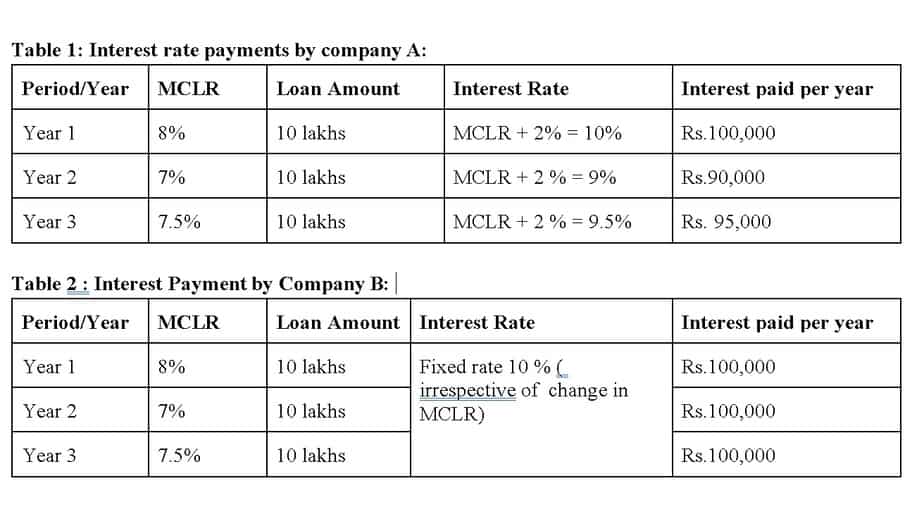
Neither companies are happy. Why? Company A thinks that their interest rate on the loans is unpredictable. It changes every year with the change in the benchmark rate. Due to the fluctuations in the floating interest rate, company A is not able to plan for how much they have to pay in the future, and they also predict that benchmark rate may increase in coming days. So, to avoid paying high-interest rates, they wanted to move over fixed interest rates.
Company B thinks that they are overpaying at a high fixed interest rate even if the benchmark rate in industry reduces and assumes that their peers are enjoying the benefit of floating rate. Also, they predict that the benchmark interest rate (MCLR) might further go down in the future, and so they wanted to switch over to a floating interest rate.
Clearly, both the companies are not happy about their interest rates, and neither of them can get out of these existing agreements with their lenders. Therefore, they decide to swap some or all of their interest rate payments with each other. Company A and B decide to enter into an agreement called interest rate swap, where company A agrees to pay a fixed rate payment of 8% to company B and company B agrees to pay a floating rate MCLR + 1% to company A.
These both interest rates are calculated on the same notional amount of Rs.10 Lakh which they initially borrowed from lenders. You may be wondering how this agreement will help both the companies to swap their interest rates. You will be clear once you finish reading this.
Mechanics of IRS The below image shows the interest rate movements between the two companies. The notional amount (Rs.10Lakhs) on which the interest rate is actually calculated are not exchanged between company A and Company B. Only the interest rates are exchanged under the IRS. The red highlighted transaction in the below image represents the interest rates swap.
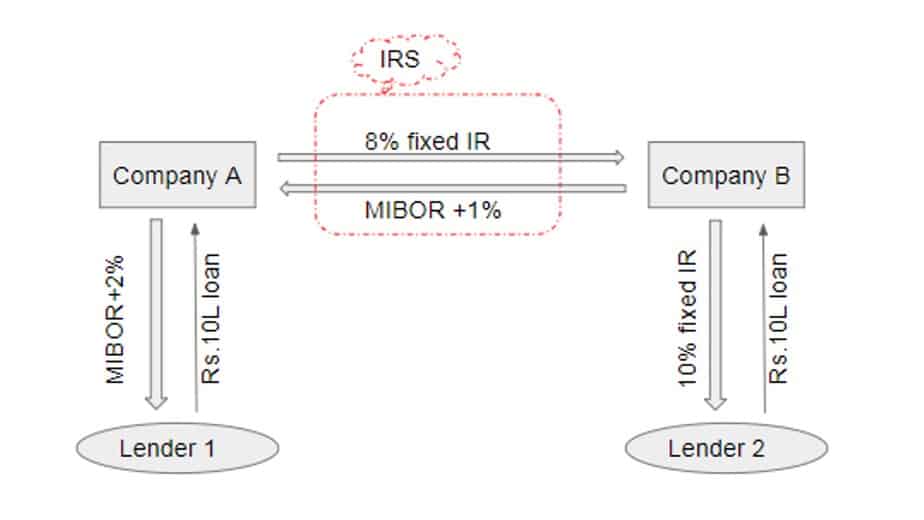
When we consider the whole picture, after entering into interest rate swap, company A will be paying the fixed interest rate, and company B will be paying a floating interest rate. And let’s discuss how this works. First, let’s take a look at the payment paid and received by company A in the below table.
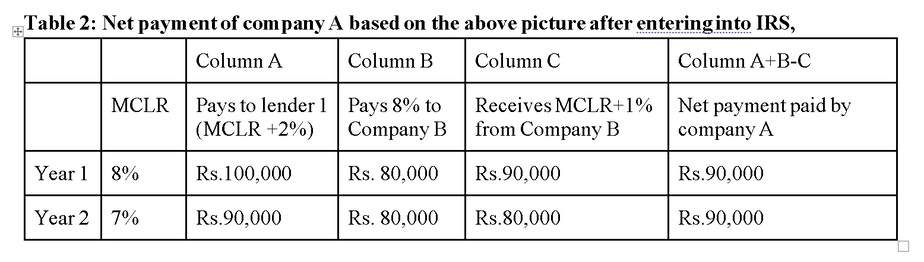
Based on Table 1 before entering into the IRS, company A was paying a floating interest rate. Now, after entering into IRS, Company A will end up paying a fixed amount of Rs.90,000 every year. Therefore, it has successfully swapped its floating interest rate loan to fixed-rate loan. And so the uncertainty of MCLR will not affect Company A. Now let us look at company B’s payment paid and received in table 3.
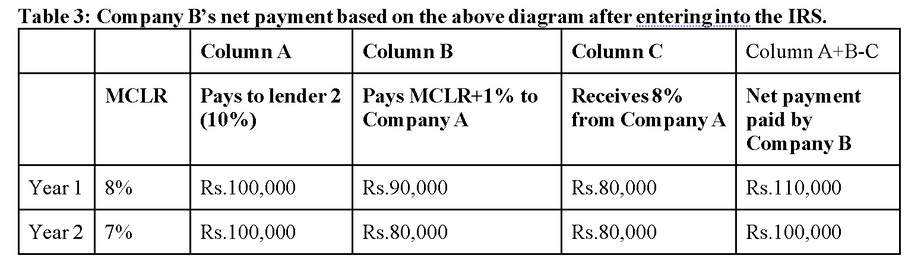
After entering into interest rate swaps, Company B now ends up paying a floating interest rate based on a change in MCLR. As predicted by Company B if MCLR falls in future, then it will be benefited from this IRS agreement. This is a simple example to understand the mechanics of interest rate swaps.
In addition, mutual funds are permitted to use forward rate agreements and interest rate futures for managing interest rate risk (see above link on floating rate funds). All transactions are regulated by SEBI and RBI.
We are on Google News
Use this button to add freefincal.com as a preferred personal finance source on Google News.

Explore 1,400+ videos on YouTube!

Subscribe to get posts via email!
Join 32,000+ readers and get free money management solutions delivered to your inbox! (Link takes you to our email sign-up form)Join our WhatsApp Channel

Explore our products
🔥Join our community of 9000+ users! 🔥- Use our Robo-advisory Tool to create a complete financial plan! More than 3,500 investors and advisors use this! Use the discount code robo25 for 20% off. Plan your retirement (early, normal, before, and after), plus non-recurring financial goals (such as child education) and recurring financial goals (such as holidays and appliance purchases). The tool helps anyone aged 18 to 80 plan for retirement, plus six non-recurring and four recurring financial goals, with a detailed cash flow summary.
- Our Flagship Course! Learn to manage your portfolio like a pro to achieve your goals regardless of market conditions! More than 3,500 investors and advisors are part of our exclusive community! Get clarity on how to plan for your goals and achieve the necessary corpus no matter the market conditions! Watch the first lecture for free! One-time payment! No recurring fees! Lifelong access to videos! Reduce fear, uncertainty and doubt while investing! Learn how to plan for your goals before and after retirement with confidence.
- Join the freefincal investor circle! An exclusive space for investors, advisors, fintech employees and students to access financial planning and insurance tools, mutual fund and stock analysis tools, coding strategies and Excel macros for data extraction. 750+ members are now part of our investor circle.
- Increase your income by getting people to pay for your skills! More than 900 salaried employees, entrepreneurs and financial advisors are part of our exclusive community! Learn how to get people to pay for your skills! Whether you are a professional or small business owner seeking more clients through online visibility, or a salaried individual looking for side or passive income, we will show you how to do it by showcasing your skills and building a community that trusts and pays you. (Watch the 1st lecture for free). One-time payment! No recurring fees! Lifelong access to videos!
- Portfolio Tracker! Track your mutual funds and stock investments with our Google Sheet!
- We also publish monthly screeners for
Our Podcast: Let's Get Rich With Pattu
On Spotify: Let's Get RICH With PATTU! Every single Indian CAN grow their wealth! On Audible: Listen to the Let's Get Rich with Pattu Podcast

Listen to the Let's Get Rich With Pattu podcast on YouTube.
Now watch Let's Get Rich With Pattu தமிழில் (in Tamil)!About The Author

Dr M Pattabiraman giving a lecture
- Dr M. Pattabiraman (PhD) is the founder, managing editor and primary author of freefincal. He is an associate professor at the Indian Institute of Technology, Madras.
- He has over 14 years of experience publishing news analysis, research and financial product development. He has over 28 years of teaching and research experience. He is also a public speaker and keynote presenter.
- He is a patron and co-founder of “Fee-only India,” an organisation promoting unbiased, commission-free, AUM-independent investment advice.
- Connect with him via @pattufreefincal on X LinkedIn YouTube
- Pattabiraman has co-authored three print books.

This book helps you ask the right questions and find the right answers. It also includes nine online calculators to create custom solutions.
(2) Gamechanger: Forget Startups, Join Corporate & Still Live the Rich Life You Want. 

Both the boy and girl versions of "Chinchu Gets a Superpower".
Most investor problems stem from a lack of poor decision-making. We made bad decisions and money mistakes when we started earning, and we spent years undoing them. Why should our children go through the same pain? What is this book about? As parents, what if we had to groom one ability in our children that matters not only for money management and investing but for every aspect of life? My answer: Sound decision-making. So, in this book, we meet Chinchu, who is about to turn 10. The story follows what he wants for his birthday and how his parents plan it, while also teaching him key ideas about decision-making and money management. What readers say! 
Feedback from a young reader after reading Chinchu Gets a Superpower!
Must-read book even for adults! This is something that every parent should teach their kids right from a young age. The importance of money management and decision-making based on their wants and needs. Very nicely written in simple terms. - Arun.
About freefincal & its content policy
Freefincal is a News Media organisation dedicated to providing original analysis, reports, reviews and insights on mutual funds, stocks, investing, retirement and personal finance developments. We do so without conflict of interest and bias. Follow us on Google News. Freefincal serves more than three million readers a year (5 million page views) with articles based only on factual information and detailed analysis by its authors. All statements made will be verified with credible and knowledgeable sources before publication. Freefincal does not publish paid articles, promotions, PR, satire or opinions without data. All opinions will be inferences backed by verifiable, reproducible evidence/data. Contact Information: To get in touch, please use our contact form. (Sponsored posts or paid collaborations will not be entertained.)Our publications
- Your Ultimate Guide to Travel. This is an in-depth exploration of vacation planning, including how to find affordable flights, budget accommodations, and practical travel tips. It also examines the benefits of travelling slowly, both financially and psychologically, with links to relevant web pages and guidance at every step. Get the PDF for Rs 300 (instant download)

- How to profit from content writing: Our ebook is for those interested in getting a side income via content writing. It is available at a 50% discount for Rs. 500 only!