In this article, we discuss whether there is a factor index that has consistently lower risk than broad-based indices or market capitalisation weighted indices like Nifty 50, 100, 500, etc.
A factor index is an intermediate between an active and a passive strategy. It is rule-based but also passive. The catch is, the rules tend to be arbitrary. See: Data Mining in Index Construction: Why Investors need to be cautious and Why Nifty Midcap150 Quality 50 index performance is a warning for factor investing fans.
We have a low volatility index, and many freefincal readers know that I am a fan of low volatility investing. See, for example, UTI S&P BSE Low Volatility Index Fund Review (I am an NFO investor in this fund).
But does low volatility mean low risk? Low volatility refers to low standard deviation. This means that if you measure the last 12 months’ monthly returns of the low volatility index, the deviation of each individual return from its average is less compared to that of the parent broad-based index.
For example, the Nifty 100 is the parent of the Nifty 100 Low Volatility 30 index. This does not mean the LV index will fall less than the parent when there is a market downturn. That is, low volatility does not guarantee a low drawdown.
🔥Secure your future with our Robo-advisory tool trusted by over 3,500 investors and advisors. From effortless retirement planning to funding your children’s biggest dreams, turn your financial goals into reality. 🔥
Subscribe for money management solutions via email! (Link takes you to our email sign-up form) Join 32,000+ readers in our community.
👉 New Tool Alert! NaviPlan: A Privacy-Focused Multi-asset Tracker and Goal Planner 👈
Low volatility sometimes results in superior returns and almost always produces a better risk-adjusted return than the parent index. Risk-adjusted return is a metric used to evaluate the return relative to the risk taken. The Sharpe ratio, Sortino ratio, and Treynor ratio are examples.
But this does not satisfy many investors. They do not appreciate that low volatility does not mean a low drawdown (fall from a peak). Both are different ways to measure risk in an instrument.
The Ulcer Index is a measure of drawdowns. We have explained this in detail recently – Evaluating mutual fund downside risk with the Ulcer Index. From October 2025, our equity mutual fund screener will use the Ulcer Index as a screening metric.
The lower the drawdown, the lower the Ulcer index and the lower the stress of holding the fund. We compare the Ulcer index of a fund and an index, or one index with another index and create an Ulcer Score. This tells you how consistently the fund has a lower drawdown risk.
If the Ulcer score is high, then the fund or index has had a consistently low drawdown or downside risk.
Nifty 100 TRI vs Nifty 100 Low volatility 30 TRI
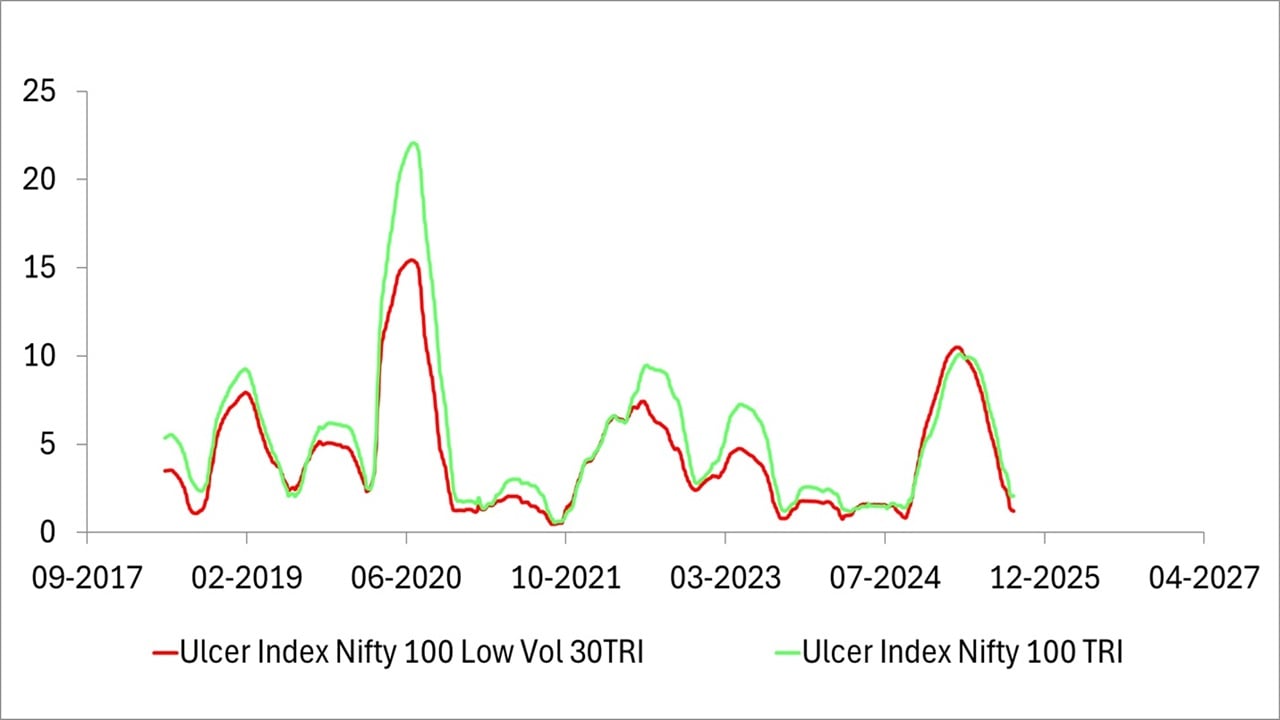
This is over the last 8 years. Sometimes the low volatility index has had a higher drawdown than the parent index (higher Ulcer index). The Ulcer scores tabulated below suggest that while low volatility is not a fool-proof method to get lower drawdowns, the performance is certainly not bad.
| Duration | Ulcer Score NLV30 vs N100 |
| 1 | 100% |
| 2 | 50% |
| 3 | 68% |
| 4 | 78% |
| 5 | 75% |
| 6 | 80% |
| 7 | 79% |
| 8 | 82% |
| 9 | 81% |
| 10 | 76% |
However there is one cavaet. Much of the low volatility index history is backtested and not seen in actual trading. This is a problem with all factor indices.
Can we do better? Is there a simpler index with a consistently lower drawdown than the parent? Yes, all we need to do is replace 35% of the broad-based (equity) index with a broad-based bond index to create an aggressive hybrid index.
We have sung the praises of such an index (no fund tracks this index as of now*)
- Why is diversification the only free lunch in investing?
- We are still waiting for an Aggressive Hybrid Index Fund
- Why we badly need an aggressive hybrid index fund!
* No, a passive FOF is NOT a passive fund! See: Can I invest in Zerodha Multi Asset Passive FoF?
Nifty 100 TRI vs CRISIL 65%-35% Aggressive Hybrid Index
The index comprises the S&P BSE 200 TR (65%) and the CRISIL Composite Bond Fund Index (35%).
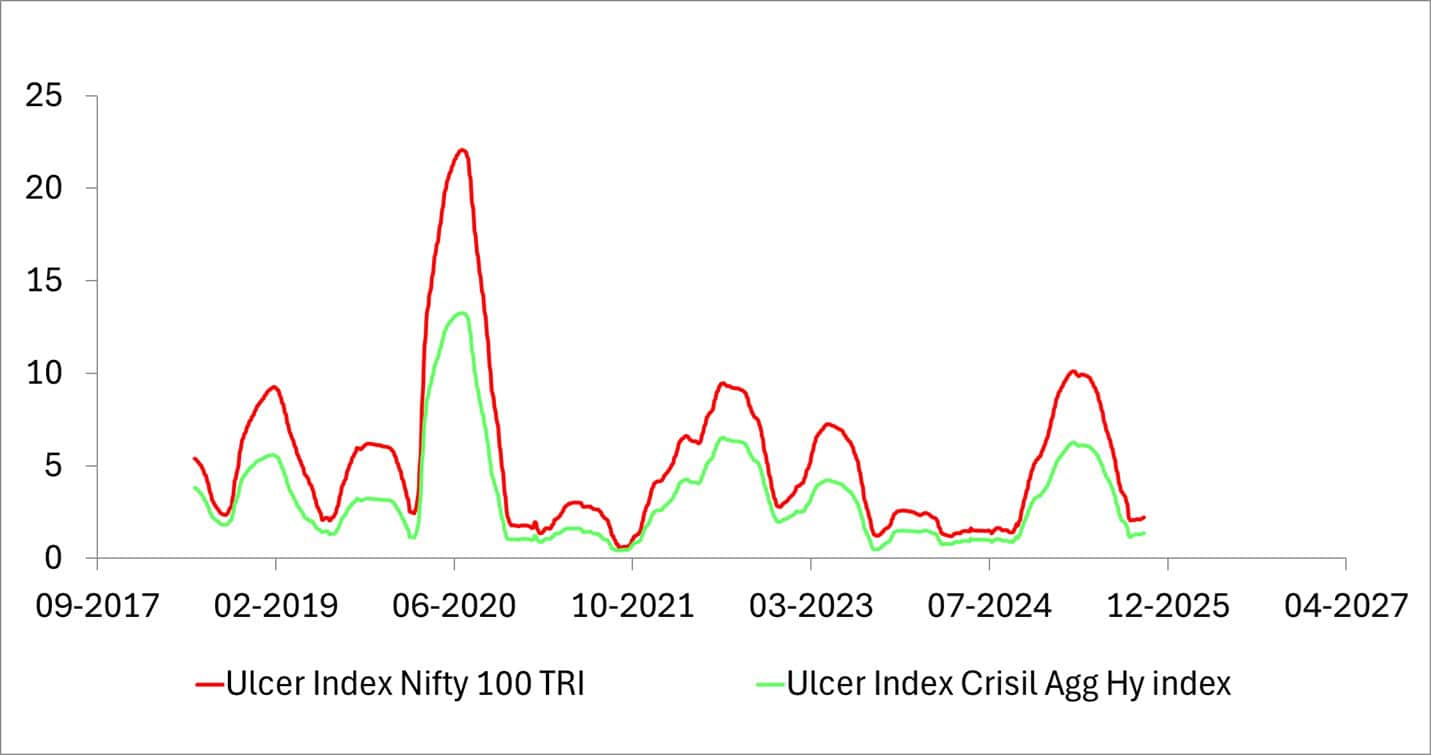
The hybrid index always has a lower Ulcer index than the parent index. The ulcer score for years 1-10 is 100%! The hybrid index will also naturally have a lower volatility!
It is as simple as that, replace a little equity with some bonds, and you have low volatility and low drawdowns – the true free lunch in investing! And it is not even a factor index! It is a simple capitalisation-weighted index! And we still do not have one!
Nifty 100 Low Volatility 30 TRI vs CRISIL 65%-35% Aggressive Hybrid index
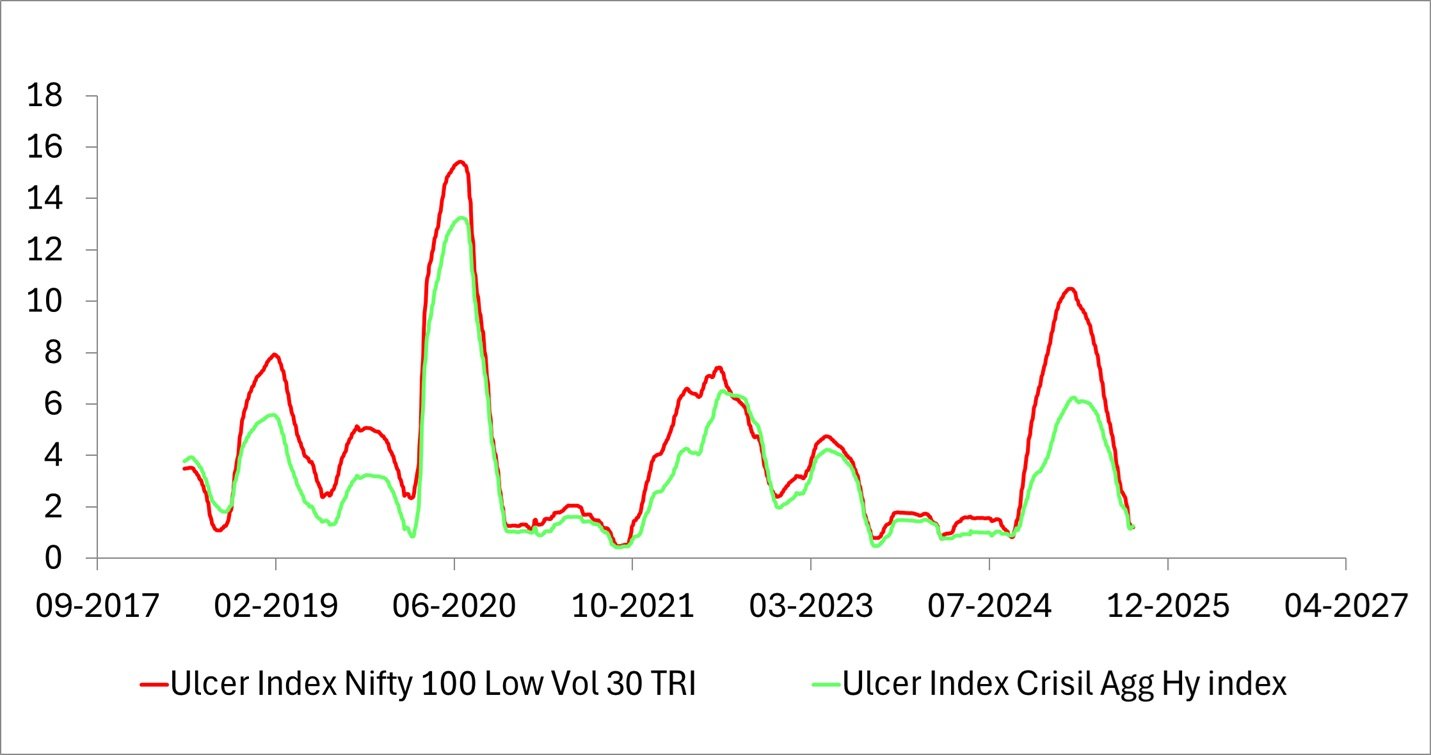
Naturally, the low volatility index has a higher drawdown than the hybrid index, but not as much as the parent Nifty 100.
The Ulcer scores, though, are quite poor.
| Duration | Ulcer Score Low Vol 30 vs Crisl Agg Hy |
| 1 | 3% |
| 2 | 3% |
| 3 | 2% |
| 4 | 11% |
| 5 | 8% |
| 6 | 7% |
| 7 | 6% |
| 8 | 10% |
| 9 | 10% |
| 10 | 9% |
We need simpler indices and index funds that are relatively less stressful. The wait continues.