I am amazed to see a ton of videos advising youngsters to invest in their 20s; the sooner they start, the better it is for them. Compounding is the eighth wonder of the world, etc. Maybe all of that’s true. But I didn’t start investing in equities until I was 29. I am 34 today, and my net worth is approximately ₹ two crores. Here’s my story.
Opinions expressed in reader stories do not necessarily represent the views of freefincal or its editors. We must appreciate multiple solutions to the money management puzzle and empathise with diverse views. Articles are typically not checked for grammar unless it is necessary to convey the right meaning and preserve the tone and emotions of the writers.
If you would like to contribute to the DIY community in this manner, send your audits to freefincal AT Gmail dot com. You can publish them anonymously if you wish.
Please note: We welcome such articles from young earners who have just started investing. See, for example, this piece by a 29-year-old: How I track financial goals without worrying about returns. We also have a “mutual fund success stories” series. See, for example, how mutual funds helped me achieve financial independence. Now, over to the reader.
2007: Topped 10th standard in school (Karnataka State Board), felt I was special.
🔥Secure your future with our Robo-advisory tool trusted by over 3,500 investors and advisors. From effortless retirement planning to funding your children’s biggest dreams, turn your financial goals into reality. 🔥
Subscribe for money management solutions via email! (Link takes you to our email sign-up form) Join 32,000+ readers in our community.
👉 New Tool Alert! NaviPlan: A Privacy-Focused Multi-asset Tracker and Goal Planner 👈
2009: Topped 12th standard and landed at an engineering college after an entrance exam.
2009-2013: Amongst the 4K+ students in the college, I felt ordinary. Every other person I met was a topper in their respective schools or colleges. I felt under-confident and wasted a ton of my time watching comedy shows, movies and other non-productive things. Managed to land a job at one of India’s largest IT outsourcing firms that paid me 3.16 LPA (~22K in-hand). The truth is, I was relieved and happy. I feared being jobless.
2014-2017: My happiness didn’t last long. If engineering had 4,000 people on a campus, the workplace had 22,000 people. I thought I wouldn’t last long. To my surprise, I did ok! Perhaps it was the fear of repeating the same mistakes I made in college, but I worked very hard. In fact, more than 80 hours a week (Narayan Murthy must be smiling somewhere!). Luckily, I got an on-site opportunity to work in Germany after 2.5 years of working on a project.
I think the following is what helped me:
I come from a Marwari Jain family, and most of my summer vacations (from 5th to 12th standard) were spent helping my cousin brother’s shop. I wasn’t paid (of course) but picked up a couple of intangibles:
- Have no shame in doing the menial tasks (Initially, the tasks assigned to me were to sweep the floors, get tea for the customers, etc.)
- Work in the Customer’s interest, and the customer will reward you for your service
And that’s exactly what I did at work. I did things that benefited the customers monetarily, and they rewarded me. My compensation in Germany was around 58K Euros annually.
2017-2019: In my 2 years at the client location in Germany, I saved around 38 lacs. I owe that to my family:
- I was prudent with my money, and my mother has a role to play here. Growing up, I saw my mother saving around 500 rupees monthly via the post-office scheme. I believe it was some kind of recurring deposit – but when it matured, my mother got her a necklace and a refrigerator for the house. Isn’t that insane?
- My Father is the 3rd eldest amongst 13 siblings. He had a decent job but also had a ton of responsibilities. Although we were comfortable (a red Chetak scooter, a rented house), my father was honest about his finances and never borrowed a rupee. I never saw the man spend recklessly on anything!
- My elder Brother completed his MBA and got a job that paid him well. He was good at what he did and travelled to the United Kingdom for work and was able to save 25 lacs in one year (2012) before he returned to India. I realised that to be able to make money, one must be good at something, and education is a good pathway to it.
Growing up in a small village in Karnataka, I didn’t have access to a lot of resources. I didn’t know who Bill Gates was and therefore, I couldn’t have him as my role model. I looked up to my family for inspiration. Mother’s prudence, Father’s honesty, and Brother’s focus on education were my true assets.
The only additional thing I had was some risk-taking ability (maybe because I was sheltered with both father and brother earning). From my savings in Germany, I enrolled for a master’s program in the US. With merit-based Scholarships and Assistantships, I was able to complete the course with the money I had saved until then and didn’t borrow a penny from Parents or Banks.
I performed well and secured a $98K job (2021) in a good company. Now that I was making decent money, I wanted to manage it well and ended up reading the following:
- The Psychology of Money – Morgan Housel (Life-changing book)
- The Little book of Common-Sense Investing – John C. Bogle (Founder of Vanguard)
- I will teach you to be Rich – Ramit Sethi (Most practical)
These books shape the way I live now.
2021-2024: I worked in the US for 3 years and was able to accumulate around 1.2 Crores. It was during this time that I got married. In the beginning, we as a couple had a tough time adjusting to my overly frugal behavior (Didn’t buy a car, a give-away sofa in the living room, minimal to no furniture). I wish I had handled this phase well but now that we’ve been married for almost 4 years, things are better. We’ve learnt to spend money on things that are meaningful to us (Travel, Experiences, and Family) and don’t plan on committing to big-ticket purchases like a house or a car anytime soon.
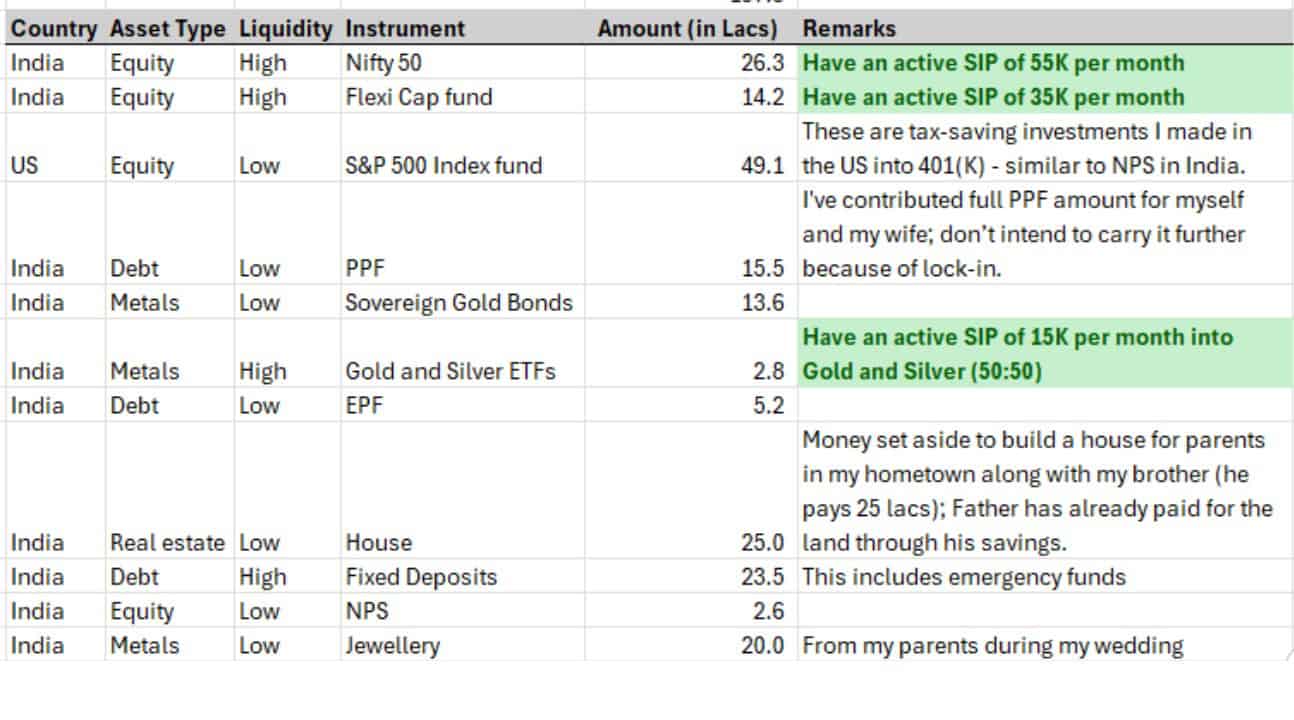
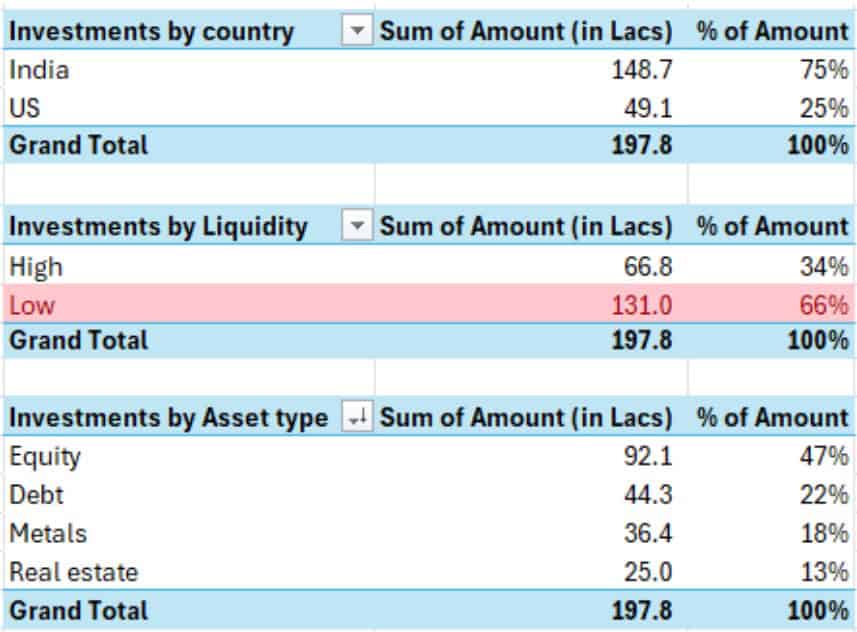
On that note, below are my assets accumulated between July 2021 and October 2025.
An area of concern:
66% of my net worth is tied to assets with low liquidity. I am working on improving this metric by contributing to Mutual funds through SIPs. Having said that, I shouldn’t have fallen for the tax deferred status of 401K in the US and should have only contributed what was mandatory and not max it out.
Ending notes:
If you’ve read the article till now, you must have noticed the fact that I’ve spent very little effort on financial instruments. The truth is, very early in the game I realized I am not a qualified financial analyst and have no bandwidth to research things on my own. I chose the passive strategy to invest the surplus (I’ve added Flexi Cap only recently). My true strength is disciplined investing through SIPs.
I want to emphasise that the most valuable asset you have is yourself. You must focus on developing skills and maximising your abilities. And once you start making decent money, educate yourself, learn from the right people and be disciplined.
As for me, I plan to continue my SIPs so that I reach my desired portfolio of 60% (Equity), 30% (Debt), and 10% (Metals). Once I do that, I intend to rebalance my portfolio on an annual basis. In addition, I have a 2Cr term-insurance policy and am actively hunting for
health insurance.
Reader stories published earlier:
As regular readers may know, we publish a personal financial audit each December – this is the 2024 edition: Portfolio Audit 2024: The Annual Review of My Goal-Based Investments. We asked regular readers to share how they review their investments and track financial goals.
- First audit: How Suhas tracks his MF investments and reviews financial goals.
- Second audit: How Avadhoot Joshi evaluates his investment portfolio.
- Third audit: How a single mom is on track to financial freedom
- Fourth audit: How Gowtham started goal-based investing & took control of his money
- Fifth audit: Why my financial independence & early retirement plans were postponed by four years
- Sixth audit: How Abhisek funded his marriage & is on track to financial freedom.
- Seventh audit: How Rohit’s early struggles defined his investment journey
- Eighth audit: Why my investments are still on track despite job loss and lower income.
- Ninth audit: How a retirement planning calculation scared me to take action
- Tenth audit: I made several investment mistakes but have turned my life around.
- Eleventh audit: My net worth doubled in the last financial year, thanks to patient investing!
- Update: How I achieved investing nirvana.
- Twelfth audit: My financial journey: from novice to goal-based investor.
- Thirteenth audit: My journey: from a negative net worth to goal-based investing.
- Fourteenth audit: From Fixed Deposits to Goal-based investing in MFs.
- Fifteenth audit: My 10-year financial journey – mistakes made and lessons learnt.
- Sixteenth audit (part 1): How I achieved financial independence without mutual funds or stocks.
- Sixteenth audit (part 2): Lessons from my financial independence journey and future investment plans.
- Seventeenth audit: How I plan to achieve financial independence and move to my native place
- Eighteenth audit: I used the current bull run to reduce my mutual funds from 14 to 4!
- Nineteenth audit: How a conservative investor created his financial plan
- Twentieth audit: I plan to achieve financial independence by 46; this is my master plan
- Twenty-first audit: I have made many investment mistakes but am on course to financial independence by 45.
- Twenty-second audit: I felt worthless six years ago but have achieved financial stability today
- Twenty-third audit: My financial journey was directionless until age 40: this is how I made up for lost time
- Twenty-fourth audit: Why I increased equity MF investments by 275% and reduced PPF contributions.
- Twenty-fifth audit: How I track financial goals without worrying about returns
- Twenty-sixth audit: I am 24 and started investing 1Y ago, but what am I investing for?
- Twenty-seventh audit: How we plan to achieve a retirement corpus 50 times our annual expenses.
- Twenty-eighth audit: I thought equity investing was a gamble, but now I aim to hold 60% equity for retirement
- Twenty-ninth audit: My journey: From 5 lakhs in debt to building a corpus worth six years in retirement
- Thirtieth audit: My investment journey: From random purchases to a goal-based portfolio
- Thirty-first audit: My investment journey: from product-driven to process-driven
- Thirty-second audit: How a young couple is trying to balance travelling and investing
- Thirty-third audit: My journey: From Rs. 30 bank balance to financial independence
- Thirty-fourth audit: Our journey: From scratch to a net worth of 18 times annual expenses.
- Thirty-fifth audit: From a net worth of Rs. 6000 to auto-pilot goal-based investing
- Thirty-sixth audit: How I retired from corporate bondage at 46, two years ago!
- Thirty-seventh audit: How I learnt to keep it simple and build a net worth 19 times my annual expenses
- Thirty-eighth audit: How Abhineeth plans to achieve financial independence and build a house.
- Thirty-ninth audit: How Sahil plans to achieve financial independence by efficient tracking
- Fortieth audit: My Journey to a Ten Crore Portfolio
- Forty-first audit: Burdened with debt for several years, I am now aggressively investing in equity
- Forty-second audit: From Engineer to Librarian after Financial Independence and Early Retirement (FIRE)
- Forty-third audit: I lost six months’ income in F&O and ditched it for systematic investing
- Forty-fourth audit: My retirement plan to handle the harsh realities of the IT industry
- Forty-fifth audit: My investment journey: mistakes, 10 years of MF investing and recovery
- Forty-sixth audit: My MF portfolio is worth six crores despite multiple mistakes
- Forty-seventh audit: Saving, Investing, and Running Marathons: My 25-year Journey to Financial Independence
- Forty-eighth audit: Never Too Late to Start: How I Became Financially Savvy at 40
- Forty-ninth audit: My Investment Journey to a net worth 29 times my annual expenses
- Fiftieth audit: How I audit my portfolio without tracking returns
- Fifty-first audit: Financial Lessons Learned During and After a PhD
- Fifty-second audit: Investment & Financial journey of a 23 year old
- Fifty-third audit: The system I use to draw income and spend after retirement securely
- Fifty-fourth audit: From Start-Up Employee to Millionaire: A Success Story of Resilience and Smart Investing
- Fifty-fifth audit: 25-Year-Old Software Engineer’s Investment Journey: From Stocks to Mutual Funds and Beyond
- Fifty-sixth audit: Crossing the Million Mark: Our Journey to the First Crore
- Fifty-seventh audit: Navigating Market Volatility: How an IT Professional Transformed His Investment Approach for Retirement
- Fifty-eighth audit: How Sahil achieved a 10X retirement corpus by efficient portfolio tracking
- Fifty-ninth audit: How I achieved financial freedom by 45 without onsite assignments or ESOPs
- Sixtieth audit: Building Wealth on a Government Salary: Lessons Learned
- Sixty-first audit: Minimalism, Index Funds, and Staying Calm: My Investing Journey at 28
- Sixty-second audit: Building Wealth and Breaking Barriers: How Swati Took Control of Her Financial Future
- Sixty-third audit: My financial journey: How I missed the Compounding Bus!
- Sixty-fourth audit: My MF investment journey: From thematic funds to a 3-fund portfolio
- Sixty-fifth audit: From Debt to ₹1 Crore Liquid Net Worth: My Journey of Financial Awareness.
These published audits have had a compounding effect on readers. If you would like to contribute to the DIY community in this manner, send your audits to freefincal AT Gmail. You can also publish them anonymously.