Last Updated on December 31, 2021 at 7:07 am
As regular readers may know, we publish an annual personal finance audit every December – our 2021 audit was posted a few days ago. Since last year regular readers have been sharing their investment journey and portfolio reviews. Suhas who was among the first to do this shared an update last week: Why I hiked my retirement corpus target though my networth doubled since Dec 2019.
This time it is Avadhoot’s turn to discuss his 2021 audit and explain why he redeemed from EPF to invest in Equity MFs. His 20220 audit is linked below. Please do read it first for better context. Suhas and Avadhoot are two model DIY investors who put their needs first and have the courage to make unconventional decisions if it suits them.
About this series: I am grateful to readers for sharing intimate details about their financial lives for the benefit of readers. Some of the previous editions are linked at the bottom of this article. You can also access the full reader story archive.
Opinions published in reader stories need not represent the views of freefincal or its editors. We must appreciate multiple solutions to the money management puzzle and empathise with diverse views. Articles are typically not checked for grammar unless necessary to convey the right meaning to preserve the tone and emotions of the writers.
🔥Secure your future with our Robo-advisory tool trusted by over 3,500 investors and advisors. From effortless retirement planning to funding your children’s biggest dreams, turn your financial goals into reality. 🔥
Subscribe for money management solutions via email! (Link takes you to our email sign-up form) Join 32,000+ readers in our community.
👉 New Tool Alert! NaviPlan: A Privacy-Focused Multi-asset Tracker and Goal Planner 👈
If you would like to contribute to the DIY community in this manner, send your audits to freefincal AT Gmail dot com. They can be published anonymously if you so desire.
Please note: We welcome such articles from young earners who have just started their investing journey. See, for example, this piece by a 29-year old: How I track financial goals without worrying about returns.
We have also started a new “mutual fund success stories” series. This is the first edition: How mutual funds helped me reach financial independence.
Hello friends! This is Avadhoot Joshi. Last year, I took my first Personal Finance Audit, for the year 2020, inspired by Pattabiraman Sir.
So, here is my second Personal Finance Audit, for the year 2021 with a lot of gratitude to Pattabiraman Sir for giving me this opportunity. Special thanks to Ashal Jauhari Sir, Pattabiraman Sir and AIFW community for shaping my financial journey.
Let’s start with the usual and our favourite question – “ARE THE BASICS COVERED?”
- TERM INSURANCE – DONE. With Max Life Insurance. Why? – Premium was the lowest compared to others.
- HEALTH INSURANCE – Being in PSU, cashless In-Patient health facilities in some reputed hospitals around the posting location is provided. For other hospitals (for both Inpatient & Outpatient treatment) expenses would be reimbursed after the claim (non-medical deductions and TDS). So currently comfortable with this. I have not yet opted for separate Personal Health Insurance. Maybe in future, I will opt for separate cover as well depending on developments.
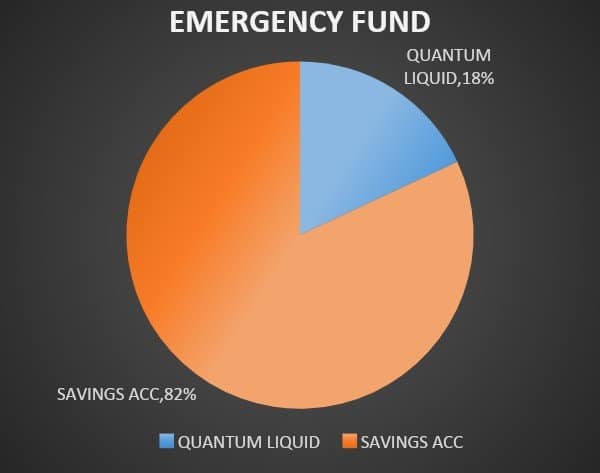
- EMERGENCY FUND – Current emergency fund is equal to 4 months’ expenses.
The Emergency Fund is parked as follows.
- FINANCIAL GOALS – Here comes the next and most important part of the audit.
1) Retirement (Officially 26 years away) – Currently I am 34 years old. My wife is 29 years old and a homemaker. Since the beginning, my retirement portfolio is debt-heavy because of 2 reasons – 1. Being in PSU, hefty PF contributions from self and employer. 2. Started investing in equity very late – in 2018, i.e. after almost six years of employment.
I have to invest as much as possible into the equity portion of the portfolio to catch up and need not bother about asset allocation until my Equity portion grows to at least 50% of the total retirement corpus.
EPFO gave me the opportunity of redeeming EPF during this COVID Period for the last two years (2020 & 2021) and I used that opportunity to increase my manual SIP in equity to somehow push equity allocation north. The bull run of 2020 also helped a lot though 2021 was a different story.
The change in asset allocation since April 2020 is shown below.
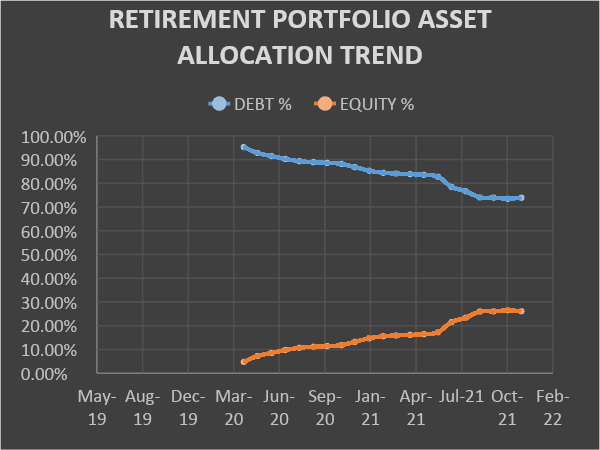
Debt Part of Retirement Portfolio – EPF
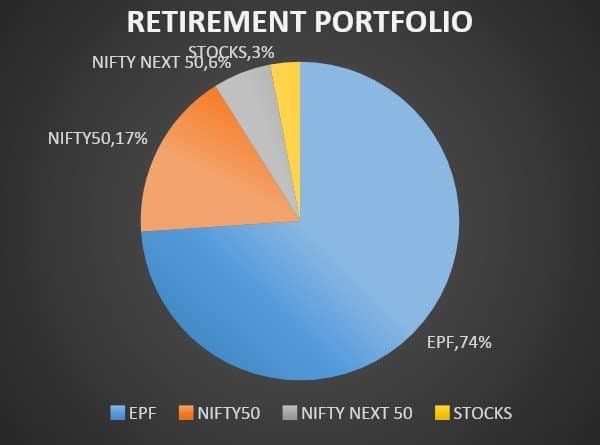
Equity Part of Retirement Portfolio – UTI Nifty Index Fund (75%) & UTI NN50 Index Fund (25%) – manual SIP every month. Direct stock investment started as an experiment with minimal allocation during last year.
The current Asset Allocation is as below.
Current Retirement Corpus is equivalent to 5.2 times the current yearly expenses (Expenses which are likely to be continued after retirement are considered) i.e. 5.2X. During the last year, the retirement corpus equivalent to one year of expenses was added, out of which retirement corpus equivalent to 6.5 months was added through investments and balance was added through returns.
Trivia – Equity portion XIRR is 26.1% (Manual SIP since Dec’2018)
2) Kid’s Graduation: Last month, we were blessed with a second baby boy. And the first son is 4.5 years old. So now the investment planning is slightly modified.
I had started investing for education corpus when the first son was 1.5 years old (November’2018) with 100% Equity Allocation. And the plan was to reduce equity allocation by 6.25% every year so that when he would be ready to go to graduation, all the corpus would be in debt instrument.
Now, I have decided to combine the graduation of both the kids as a single financial goal.
The revised Asset Allocation plan will be as below.
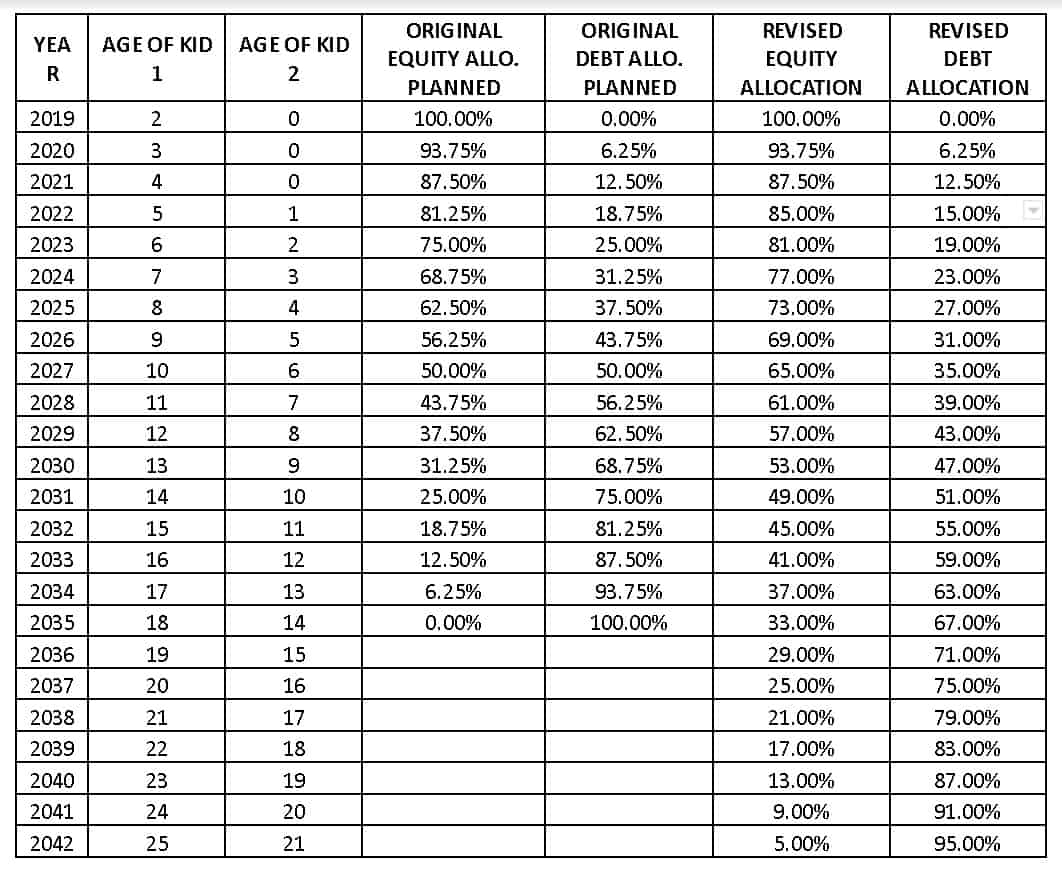
Frankly speaking, I really don’t know how this plan will pan out in future. But since time is on our side, I am taking a leap of faith. The withdrawal will start in 2035 & will go on until the graduation of the second son.
Returns expectations considered while doing the investment plan – Equity 10% & Debt 6%.
The growth of Kids’ Education Portfolio until now is as below.
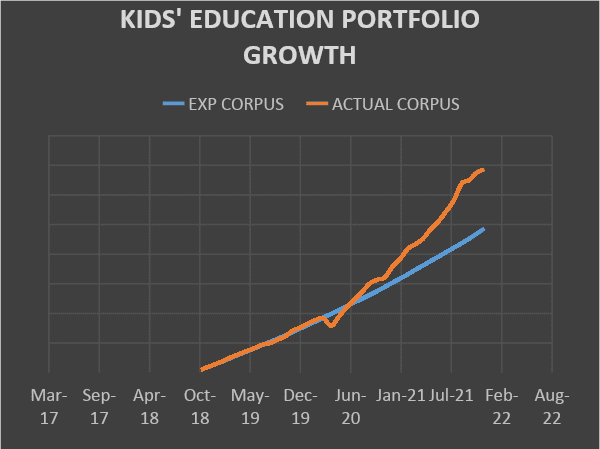
Since the investment journey is in the initial stage, asset allocation is being taken care of by adjustments in every month manual SIP in the Equity/Debt part. So until now, rebalancing is not done as such.
Debt Part of Kids Education Portfolio – PPF (15%) & ICICI Gilt Fund (1%). ICICI Gilt Fund is added recently so that it can be used for rebalancing in future considering the illiquidity of PPF.
Equity Part of Kids Education Portfolio – Parag Parikh Flexi Cap Fund (84%).
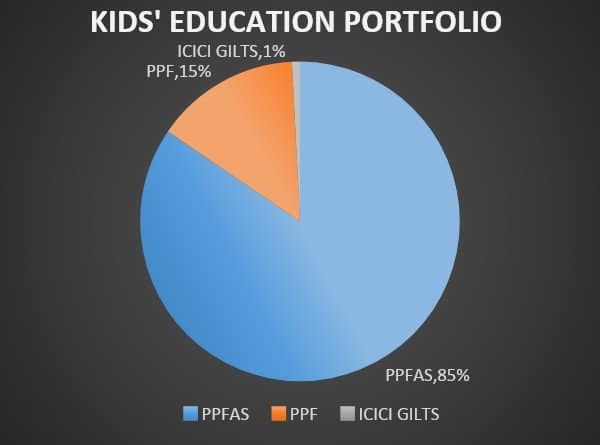
Trivia – XIRR of Parag Parikh Flexi Cap Fund is 38.1% & XIRR of ICICI Gilt Fund is 7.2%.
3) Car & Furniture – During last year’s audit, there was a short term goal of buying some furniture and a second-hand car. The goal is achieved. Corpus is in FD.
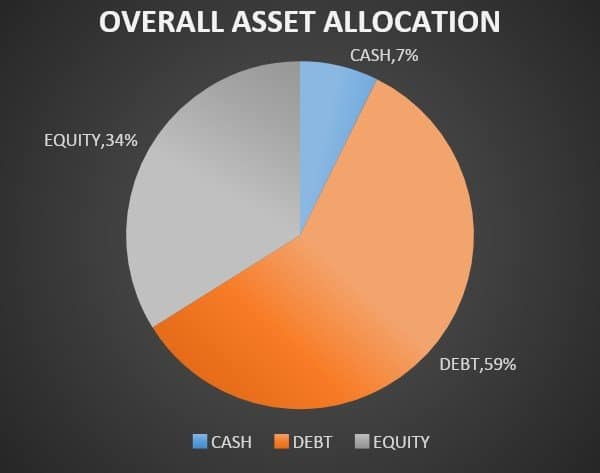
ASSETS- Since all assets are linked to a goal, it is straightforward to keep track. The current asset allocation is as below.
LIABILITIES – We have only one Loan, i.e. Home Loan, been running since 2017. During last year’s audit, I had planned to close it by 2027 with increased EMI. Due to some extra cash flow, we could prepay some amount and now we are planning to close it by 2025. Becoming debt-free as early as possible is an emotional requirement for me.
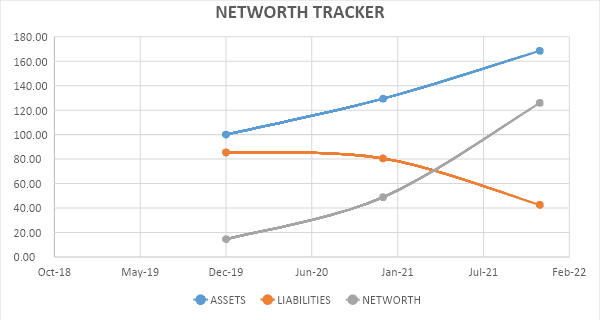
The Y-o-Y changes in Assets, Liabilities and Net-worth are as below.
PLAN FOR 2022:
- To increase emergency funds from the current four months’ expenses to 6 months’ expenses.
- To improve the equity portion in the retirement portfolio to 30% from the current 26%.
- To add retirement corpus equivalent to at least one year of expenses through investing alone.
- To continue investment for Kids’ education as per plan.
Thank you.
Reader stories published earlier
As regular readers may know, we publish a personal financial audit each December – this is the 2020 edition: How my retirement portfolio performed in 2020. We asked regular readers to share how they review their investments and track financial goals.
- First audit: How Suhas tracks his MF investments and reviews financial goals.
- Second audit: How Avadhoot Joshi evaluates his investment portfolio.
- Third audit: How a single mom is on track to financial freedom
- Fourth audit: How Gowtham started goal-based investing & took control of his money
- Fifth audit: Why my financial independence & early retirement plans were postponed by four years
- Sixth audit: How Abhisek funded his marriage & is on track to financial freedom.
- Seventh audit: How Rohit’s early struggles defined his investment journey
- Eighth audit: Why my investments are still on track despite job loss and lower-income
- Ninth audit: How a retirement planning calculation scared me to take action
- Tenth audit: I made several investment mistakes but have turned my life around.
- Eleventh audit: My net worth doubled in the last financial year thanks to patient investing!
- Twelveth audit: My financial journey: from novice to goal-based investor.
- Thirteenth audit: My journey: from a negative net worth to goal-based investing.
- Fourteenth audit: From Fixed Deposits to Goal-based investing in MFs.
- Fifteenth audit: My 10-year financial journey – mistakes made and lessons learnt.
- Sixteenth audit (part 1): How I achieved financial independence without mutual funds or stocks.
- Sixteenth audit (part 2): Lessons from my financial independence journey and future investment plans.
- Seventeenth audit: How I plan to achieve financial independence and move to my native place
- Eighteenth audit: I used the current bull run to reduce my mutual funds from 14 to 4!
- Nineteenth audit: How a conservative investor created his financial plan
- Twentieth audit: I plan to achieve financial independence by 46; this is my master plan
- Twenty-first audit: I have made many investment mistakes but am on course to financial independence by 45.
- Twenty-second audit: I felt worthless six years ago but have achieved financial stability today
- Twenty-third audit: My financial journey was directionless until age 40: this is how I made up for lost time
- Twenty-fourth audit: Why I increased equity MF investments by 275% and reduced PPF contributions.
- Twenty-fifth audit: How I track financial goals without worrying about returns
These published audits have had a compounding effect on readers. If you would like to contribute to the DIY community in this manner, send your audits to freefincal AT Gmail. They could be published anonymously if you so desire.