Last Updated on December 29, 2021 at 6:30 pm
In this edition of the reader audit, 29-year-old Mr Yo (name withheld on request) explains in detail how he has structured his money management in a systematic manner and how he tracks his financial goals without considering returns.
About this series: I am grateful to readers for sharing intimate details about their financial lives for the benefit of readers. Some of the previous editions are linked at the bottom of this article. You can also access the full reader story archive.
Opinions published in reader stories need not represent the views of freefincal or its editors. We must appreciate multiple solutions to the money management puzzle and be empathetic to diverse views. Articles are typically not checked for grammar unless necessary to convey the right meaning to preserve the tone and emotions of the writers.
If you would like to contribute to the DIY community in this manner, send your audits to freefincal AT Gmail dot com. They can be published anonymously if you so desire.
🔥Secure your future with our Robo-advisory tool trusted by over 3,500 investors and advisors. From effortless retirement planning to funding your children’s biggest dreams, turn your financial goals into reality. 🔥
Subscribe for money management solutions via email! (Link takes you to our email sign-up form) Join 32,000+ readers in our community.
👉 New Tool Alert! NaviPlan: A Privacy-Focused Multi-asset Tracker and Goal Planner 👈
Please note: We welcome such articles from young earners who have just started their investing journey (this edition is a good example. Also see, for example, audits by Suhas and Avadhoot linked below). Now over to Mr Yo.
Thank you for giving me the opportunity to write an article on your blog and helping me learn so many things. My main motivation to write this is to force myself to document my thought process at this time and revisit (and hopefully write) every year (at least once) to see the evolution.
About me: I’m an engineer who passed out in 2013 with an education loan of about 6 lacs and a lifetime commitment to donate at least 20000 to a charity. I belonged to a lower-middle-class family. In the early days managing 20k + education loan EMI took a lot of effort and toll on finances.
I did a few mistakes in the early days. One is not having emergency corpus ( and faced emergency 😊) and having a ULIP policy. Rest most of the young days were spent in prepayment of loans and charity. During the early phases of my career to take care of 80c (tax saving) I opened a PPF account and a ULIP.
The first mutual fund investments were done on an exploratory basis for 3k per month in regular plans (3 MFs 1k each). I probably experienced about 5-6 months of market. The emergency hit and I withdrew all (some with losses).
I finished my education loan payment in august 2017. After that, I started exploring more about investments and stumbled upon AIFW. And from there I read a lot of literature and watched videos. My interest in excel helped me to explore and enjoy spending time reading/watching/trying things.
Currently, I’m working with Chandan Singh Padiyar as my Fee-Only-advisor. I got married in 2019 November and have a daughter of 6 months now. I do not have any liabilities now. I’ve 4 dependents and a 20k minimum commitment for charity (currently about 26k).
Basics
- Term Insurance: 50x of current annual expense bought in December 2018
- Medical Insurance: office provided 3l + 15l, personal insurance of 10/15 + 20/30 is to be bought once I’m back to my working place city through an agent
- Contingency fund: 6 times monthly in-hand salary or 9 months of monthly expense + 3l of medical cash cover
- Personal accidental Cover: being a single earner (at least currently), I intend to have a PAI for about 50% of term cover
Goals
All the goals are colour-coded for ease of tracing. They are listed below:
- Orange shades: Retirement
- Yellow shades: Home
- Purple shades: Kid’s future
- Grey shades: Contingency
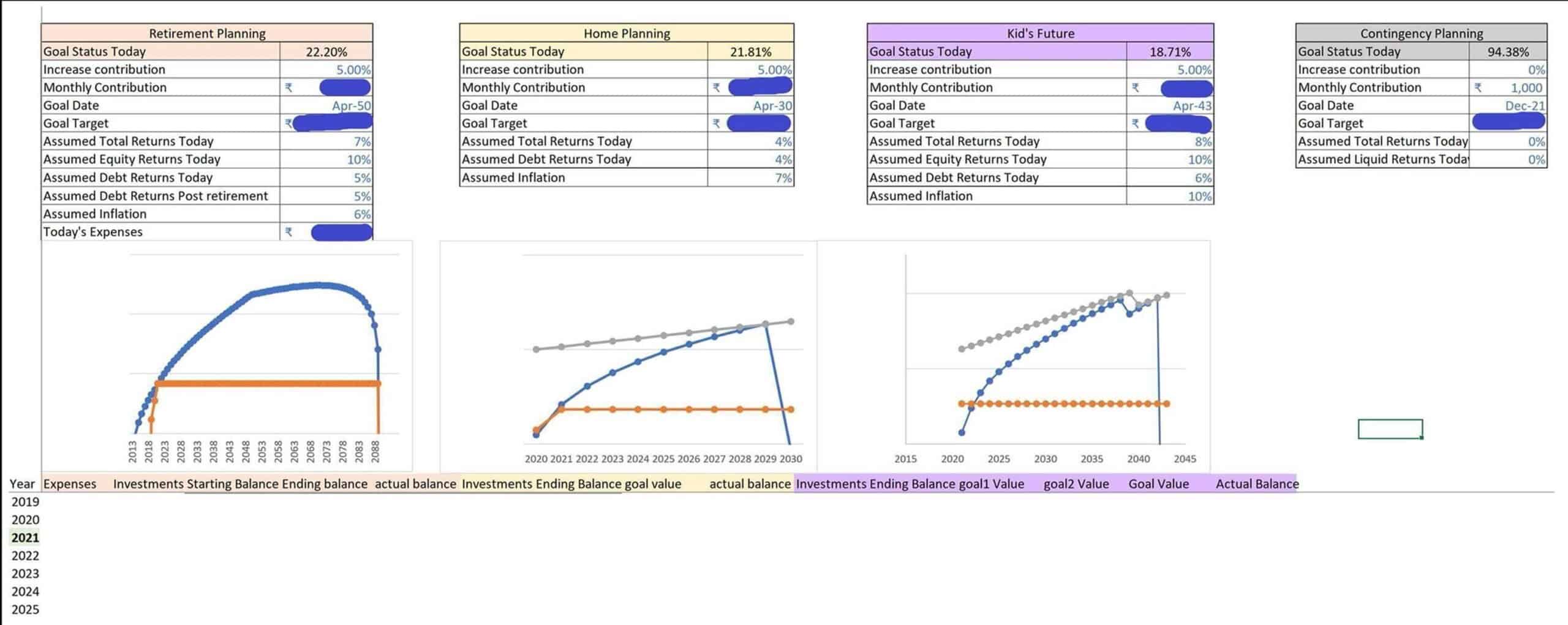
Assumptions, an overview of plans and the status of all goals is as below. All the graphs shown are plotted with the y-axis in log scale to appreciate the real rate of growth. The lower covered part shows the annual status of all goals as of 1st Jan of that year. Click on the image to zoom out.
The distribution of the goals across different accounts and statuses is as shown below. The left side shows all the goals, their current completion status, movement in the last month and their values (hidden). The central part shows the distribution across the assets in total networth with selectable filters from the top centre. Click on the image to zoom out.
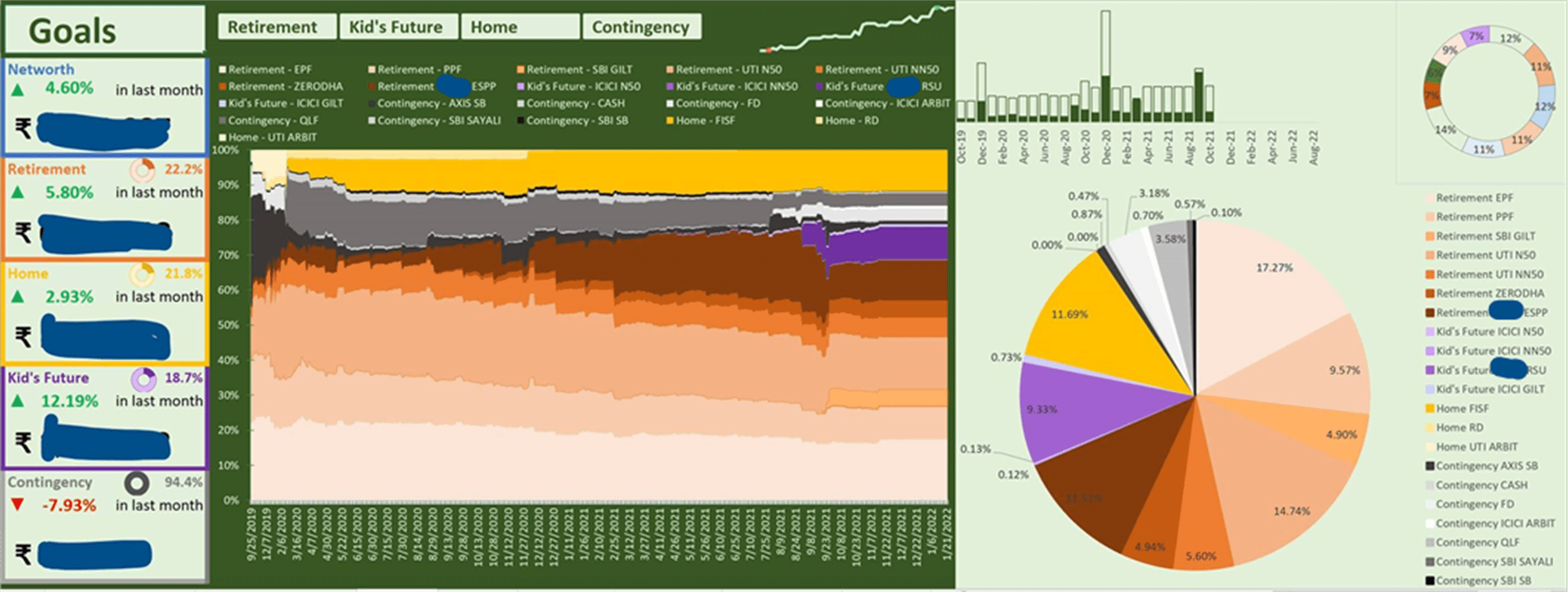
Next to it is networth movement in the last 50 days. On the right side, bar graphs show the salary across months. The outline shows the post-tax salary while the filled part shows tax deducted in that month. Next to it is stock portfolio allocation. The right bottom shows the asset allocation of today across accounts.
All mutual fund holdings are in the direct plan growth option. Equity mutual funds are only index funds (UTI and ICICI) with a target 60-40 allocation between the top 50 and next 50. In debt space, for very long term goals 10-year constant maturity gilt funds (ICICI + SBI) are used. For medium-term money market fund (franklin) and for short term liquid fund (quantum) and arbitrage funds (UTI + ICICI) are used.
Retirement
Intend to retire not before 55 (that is if the company keeps me). I can become Financially Free possibly much sooner, though I’m not targeting and trying for it. The last few years quick growth in the company has helped me move fast on this goal. The current corpus is equivalent to roughly 9x of current annual expenses.
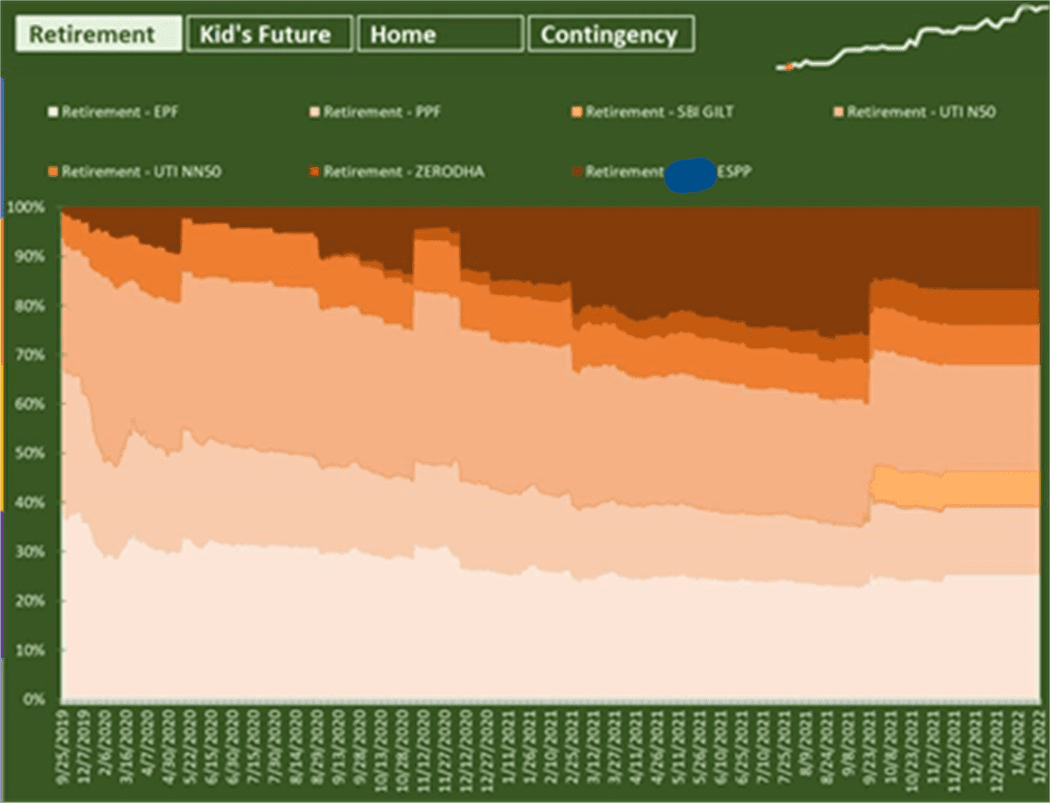
My asset allocation is a bit tricky due to large allotment towards company ESPP (employee stock purchase plan) allocation and large discounts/fast movement of stock. I only invest monthly for this goal through ESPP contribution and EPF (employee provident fund) contribution (both auto deducted from salary pre-credit to account).
The remaining accounts are updated every 6 months (or when very skewed) to the target allocation (or nearby it) by either selling company stocks or fresh capital infusion. I do some investments in direct equity as a hobby and expect 0% returns (not including any details as it is about a 1-year-old portfolio). Although it has grown its allocation significantly in the last 1 year I intend to cap it to a maximum of 7.5%. The evolution of asset distribution with time is as follows. Click on the image to zoom out.
Home
I intend to have roughly 50% of the purchase price of the home accumulated before I’d go to buy. This is a tentative plan and has been revised a couple of times. Hopefully, I can have all the money for the home ready and then get home to pre-close it anytime I wish to. I’m currently investing aggressively for this goal. In 2-3 years, expenses for my daughter’s day to day living would increase and I may not be able to allow sufficient priority to this goal then.
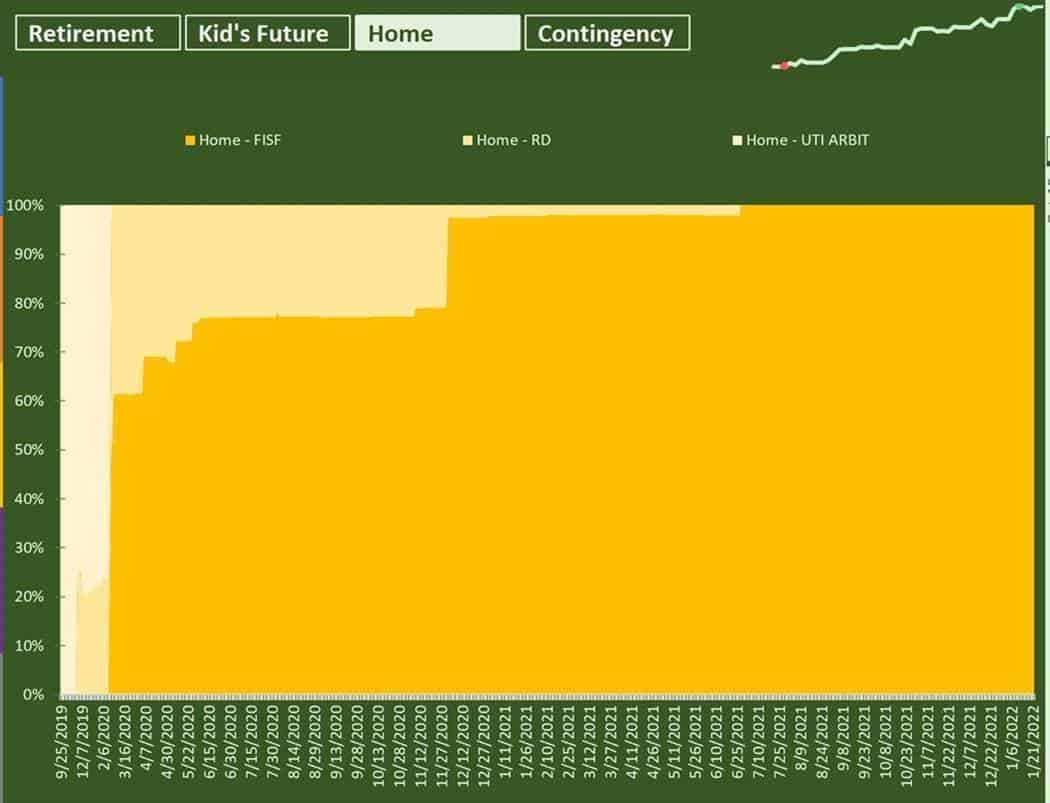
As it is a short term goal whole amount is kept in a debt fund (100% debt) with periodic inflows from the selling of company equity at opportune moments. In the early days, funds for this goal was shared with the emergency fund. But now it has been split once the emergency fund was sufficiently big. The evolution of asset distribution with time is as follows. Click on the image to zoom out.
Kid’s Future
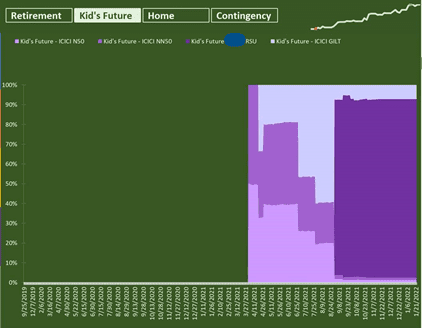
I intend to have a roughly single goal for all undergraduate expenses, marriage expenses and if sufficient then post-graduate expenses. I’ve not yet been able to decide if I want to plan for all the education or let her learn with an education loan. I’ve allocated all company RSU’s (restricted stock units) for this goal along with ICICI Nifty 50, Nifty Next 50 and gilt funds.
So as and when I get RSU’s my asset allocation goes for a toss. As this is a very new goal, the asset allocation is a bit too high towards equity. I intend to adjust it sometime in mid-December. Some amount would be distributed in this goal and some would be moved to the home goal. I’ve not yet decided the amounts for the split. The evolution of asset distribution with time is as follows. Click on the image to zoom out.
Thoda Gyaan: I believe there is nothing which can give growth better than salary. I’ve never switched my company in all these 8 years+. I believe real value can only be extracted from organizations as well as individuals only after a sufficiently long time (also I’m lazy).
I try to follow the same policy even for my holdings and do not intend to change them much. I personally don’t track either XIRR or CAGR or even investment amount. I only look at the movement of the portfolio month on month or even year on year.
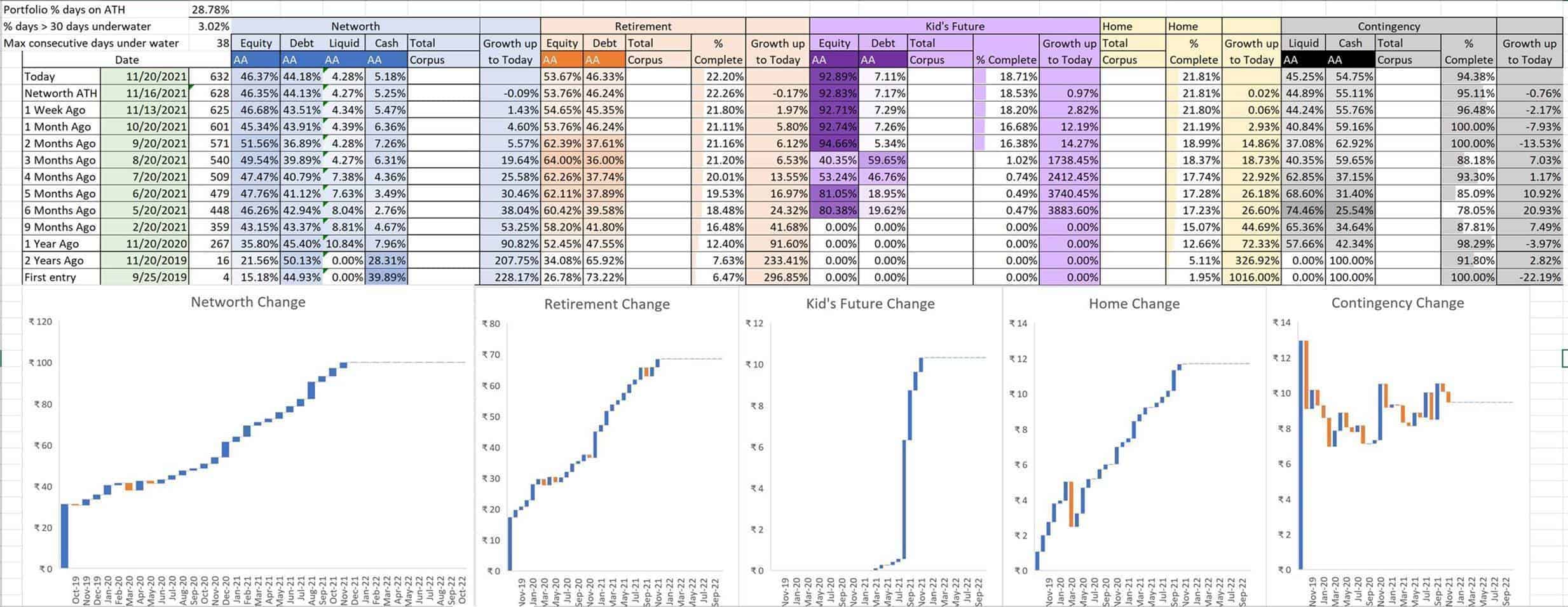
As long as the portfolio is growing at a steady pace it doesn’t matter if it is growing because of more investments or gains. The way I audit my goals at portfolio level with asset allocation and overall progress is by looking at the plan of goals graph y-o-y (first one in the goals section) and the growth of portfolio graph m-o-m below.
Being a conservative person I prefer to track portfolio level volatility or the risk by gauging 3 factors on the top left i.e. % days on all-time high (ATH), % days when the portfolio is below underwater more than 30 days and maximum consecutive days portfolio has been underwater. Colour shades that are equal to headers means the asset allocation is in line.
Lighter shades mean less risky and darker shades means more risk. Y-axis in the graphs below is calibrated to value 100 as today’s networth and other numbers are proportionately modified. The first entry is the starting value of all the goals before I started tracking using this tracker (25th September 2019). Click on the image to zoom out.
Upcoming plans:
- Get health insurance
- Get accidental insurance
- Rebalance kid’s future goal mid-December
- Rebalance Retirement goal mid-March (along with annual review with Chandan)
- Increase contingency fund
- Improve fractal stock allocation strategy
- Create a hard copy of the information (handbook) for my family to access everything in case of my non-availability
- Have a joint bank account
- Add nominations to all accounts
- Create a will
Reader stories published earlier
As regular readers may know, we publish a personal financial audit each December – this is the 2020 edition: How my retirement portfolio performed in 2020. We asked regular readers to share how they review their investments and track financial goals.
- First audit: How Suhas tracks his MF investments and reviews financial goals.
- Second audit: How Avadhoot Joshi evaluates his investment portfolio.
- Third audit: How a single mom is on track to financial freedom
- Fourth audit: How Gowtham started goal-based investing & took control of his money
- Fifth audit: Why my financial independence & early retirement plans were postponed by four years
- Sixth audit: How Abhisek funded his marriage & is on track to financial freedom.
- Seventh audit: How Rohit’s early struggles defined his investment journey
- Eighth audit: Why my investments are still on track despite job loss and lower-income
- Ninth audit: How a retirement planning calculation scared me to take action
- Tenth audit: I made several investment mistakes but have turned my life around.
- Eleventh audit: My net worth doubled in the last financial year thanks to patient investing!
- Twelveth audit: My financial journey: from novice to goal-based investor.
- Thirteenth audit: My journey: from a negative net worth to goal-based investing.
- Fourteenth audit: From Fixed Deposits to Goal-based investing in MFs.
- Fifteenth audit: My 10-year financial journey – mistakes made and lessons learnt.
- Sixteenth audit (part 1): How I achieved financial independence without mutual funds or stocks.
- Sixteenth audit (part 2): Lessons from my financial independence journey and future investment plans.
- Seventeenth audit: How I plan to achieve financial independence and move to my native place
- Eighteenth audit: I used the current bull run to reduce my mutual funds from 14 to 4!
- Nineteenth audit: How a conservative investor created his financial plan
- Twentieth audit: I plan to achieve financial independence by 46; this is my master plan
- Twenty-first audit: I have made many investment mistakes but am on course to financial independence by 45.
- Twenty-second audit: I felt worthless six years ago but have achieved financial stability today
- Twenty-third audit: My financial journey was directionless until age 40: this is how I made up for lost time
- Twenty-fourth audit: Why I increased equity MF investments by 275% and reduced PPF contributions.
These published audits have had a compounding effect on readers. If you would like to contribute to the DIY community in this manner, send your audits to freefincal AT Gmail. They could be published anonymously if you so desire.