Last Updated on December 29, 2021 at 5:59 pm
In the fourth edition of personal finance audits by readers, Gowtham Subramanian discusses how he has started goal-based investing, focusing on asset allocation and how it has made him feel more in control over his finances.
As regular readers may be aware, we publish a personal financial audit each December – this is the 2020 edition: How my retirement portfolio performed in 2020. This time, we asked regular readers to share how they review their investments and track financial goals.
- First audit: How Suhas tracks his MF investments and reviews financial goals.
- Second audit: How Avadhoot Joshi evaluates his investment portfolio.
- Third audit: How a single mom is on track to financial freedom
Gowtham has also shared an interesting analysis on “Passive income strategy with Automobiles” which will be published in the coming days.
Note No part of this article, particularly the goals, asset allocation and investment choices should be construed as investment advice. Kindly take stock of your needs and invest as per that. Each audit is different; some have a narrative; some a summary of actions. We request readers to focus on the benefits of structuring investments according to goals and the emotional benefits that come with it.
🔥Secure your future with our Robo-advisory tool trusted by over 3,500 investors and advisors. From effortless retirement planning to funding your children’s biggest dreams, turn your financial goals into reality. 🔥
Subscribe for money management solutions via email! (Link takes you to our email sign-up form) Join 32,000+ readers in our community.
👉 New Tool Alert! NaviPlan: A Privacy-Focused Multi-asset Tracker and Goal Planner 👈
I started my financial journey in Jan 2019 without any knowledge of Personal Finance. I started goal-based investing and asset allocation by June 2020 with Freefincal and the DIY community’s aid. Currently, I have set 4 goals for myself and decided on the tenure to achieve the same.
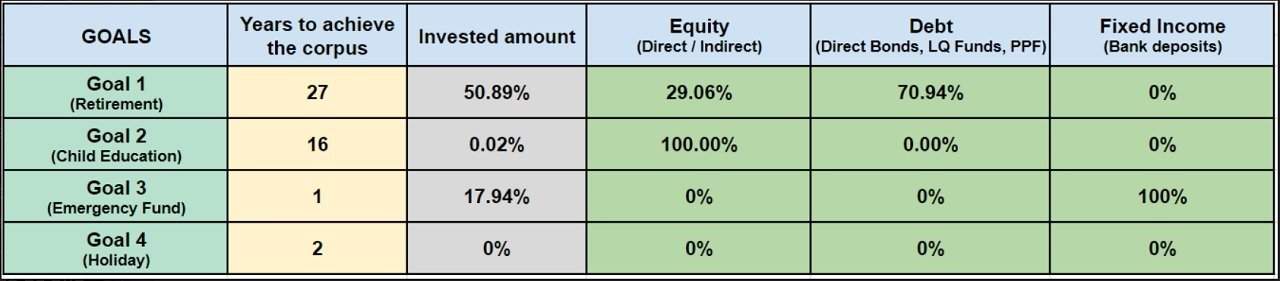
Goal 1 – Retirement
- Investment instruments – PPFAS Long Term Equity Fund and PPF
- Target asset allocation (Equity/Debt) – 60:40
- Asset allocation is currently 30:70. This is because the PPF account was started earlier and had accumulated some corpus before I began goal-based investing.
- I have achieved 50% of the target corpus for this year. For retirement alone, I track the target corpus year-wise since the required final corpus is baffling.
- There was no option to re-balance from debt to equity. Hence the strategy has to be tweaked.
Goal 2 – Child Education
- Investment instruments – UTI Nifty Index Fund
- Target asset allocation (Equity/Debt) – 70:30
- Asset allocation is currently 100% equity. Planning to accumulate a decent corpus in equity first and then add debt component gradually.
- Investing began around November 2020, and therefore the achieved corpus is negligibly low.
Goal 3 – Emergency Fund
- Investment Instruments – ICICI Bank Flexible RD.
- Target Asset allocation (Equity/Debt) – 20:80
- 20% of the total target corpus was achieved
- The returns were not great, but due to the need for instant redemption of funds I have been using the Flexi-RD
- Once 80% of the goal is achieved, planning to add equity.
Editor’s note: An investor may choose to include a small equity exposure to an emergency fund for appreciation if know what it means and as long as they do not include that equity with other goals.
Goal 4 – Vacation
- Investment Instrument – ABSL Liquid Fund
- No equity allocation. Planning to hold only liquid funds since the tenure is very short.
Resolutions for 2021
- Goal 1: Improve the asset allocation in the equity side, by reducing the PPF investment and redirect the same to PPFAS LTEF. Add a short – term debt fund to the mix for rebalancing.
- Goal 2: Add Nifty Next 50 Index fund to the portfolio with the 60:40 ratio (N50:NN50); A new PPF account for my spouse and invest the remainder into that account.
- Goal 3: Switch the investments into ABSL Liquid fund, and capital gains will be retained in the emergency corpus.
- Goal 4: Start investing from Jan 2021. Plan a vacation with good value for money.
Lessons learnt till Dec 2020
1. Don’t invest in an actively managed sectoral fund just by looking at past performance.
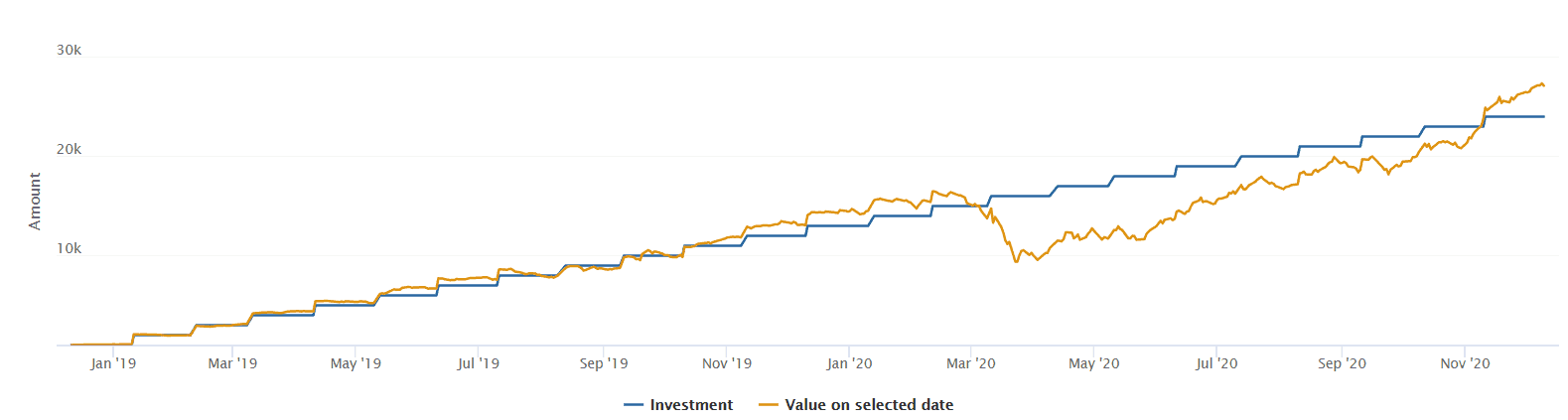
- Monthly SIP in ICICI Pru Banking and Financial services fund from Jan 2019 – May 2020. I redeemed the fund in November 2020.
- Concentration risk was very high, which I realized later in March 2020 when the stock market crashed due to COVID.
- The fund took a longer time to recover than NIFTY 50 and many other large-cap funds. Even NIFTY Auto which was adversely affected recovered sooner than the fund.
- Though 1.5 years time-frame is very low to assess the fund’s performance, the pre-COVID capital gains were also poor.
- I redeemed the funds without losses after six months.
- Reason for redeeming – Majority of the fund holdings were in HDFC. The HDFC was in the news for inadequate IT Infrastructure. Also, since I was planning to migrate to the Nifty 50 index fund, I completely redeemed the fund to avoid overlap.
2. Total cost of ownership of an ETF is high in comparison to MF units.
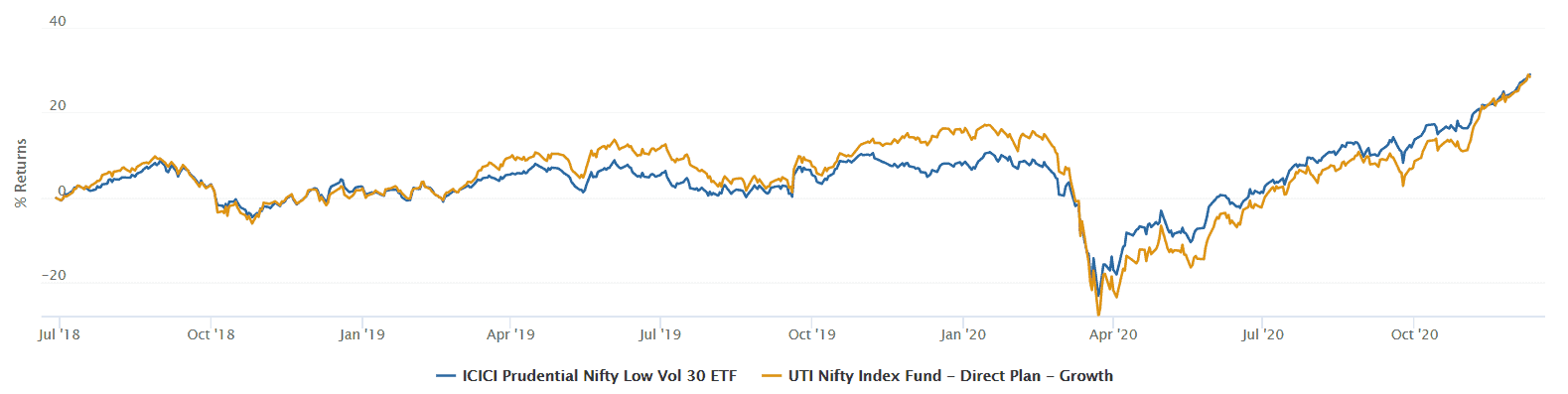
- Monthly SEP with ICICI Nifty Low Volatility 30 ETF from April 2020 – October 2020. Sold off the units in October 2020.
- I redeemed the ETF due to the high holding cost with ICICI Direct in AMC account maintenance charges and taxes.
- The ETF performance was good, but I wanted to switch to a discount broker from a full-service broker.
- Also, the performance comparison was made with the UTI Nifty Index Fund before redemption. As you could see from the past performance, both are consistent with market trends, and also the low volatility quotient of the ETF wasn’t that helpful.
- We could see that the UTI N50 has beat the ETF in terms of performance and has also recovered fast enough.
- Therefore, the inference was to invest in an ETF only when we have significant direct equity exposure. Small exposure to an ETF just for its sake doesn’t justify the incurred total cost of ownership.
To summarize, 2020 was a good year for my personal finance. I could learn and implement many things, and the feeling of financial secureness has definitely improved. Hoping to put my resolutions to action in 2021.