Last Updated on December 29, 2021 at 5:59 pm
I have been tracking the amount invested for my goals in the same Excel sheet for the last ten years (2011 to 2020). These are some lessons from the journey. This sheet is only for tracking the amount invested and not its current market value.
Between 2010-11, my retirement planning cash flow projection was in place, and it was scary to look at. The monthly investment was lesser than what the calculator said (with unrealistic fixed asset allocation!). More importantly, I had to set the annual increase in investments to 10%.
That is if I invest Rs. 10,000 each month in one next, the next year it would be 10% more and so on. This was the only way to reduce the gap between the initial investment required and the initial investment made.
The catch was future investments quickly increased. At 10% a year, the investment would double every seven years or increase by 50% every 4-5 years. If our income does not grow as fast or our expenses grow faster, we cannot increase our investments by 10% a year.
🔥Secure your future with our Robo-advisory tool trusted by over 3,500 investors and advisors. From effortless retirement planning to funding your children’s biggest dreams, turn your financial goals into reality. 🔥
Subscribe for money management solutions via email! (Link takes you to our email sign-up form) Join 32,000+ readers in our community.
👉 New Tool Alert! NaviPlan: A Privacy-Focused Multi-asset Tracker and Goal Planner 👈
This uncertainty is common, but we can only invest what we can. What matters is, starting early; investing as much as possible; increasing the investment as much as a possible and yearly review.
If I look back the investments made it in the initial years, it seems trivially small. That is the power of non-linear growth (just trying to avoid the compounding word!). We shall only consider the invested amount and how it has increased year to year. The status of their market value is reported here: How my retirement portfolio has performed in 2020: personal finance audit.
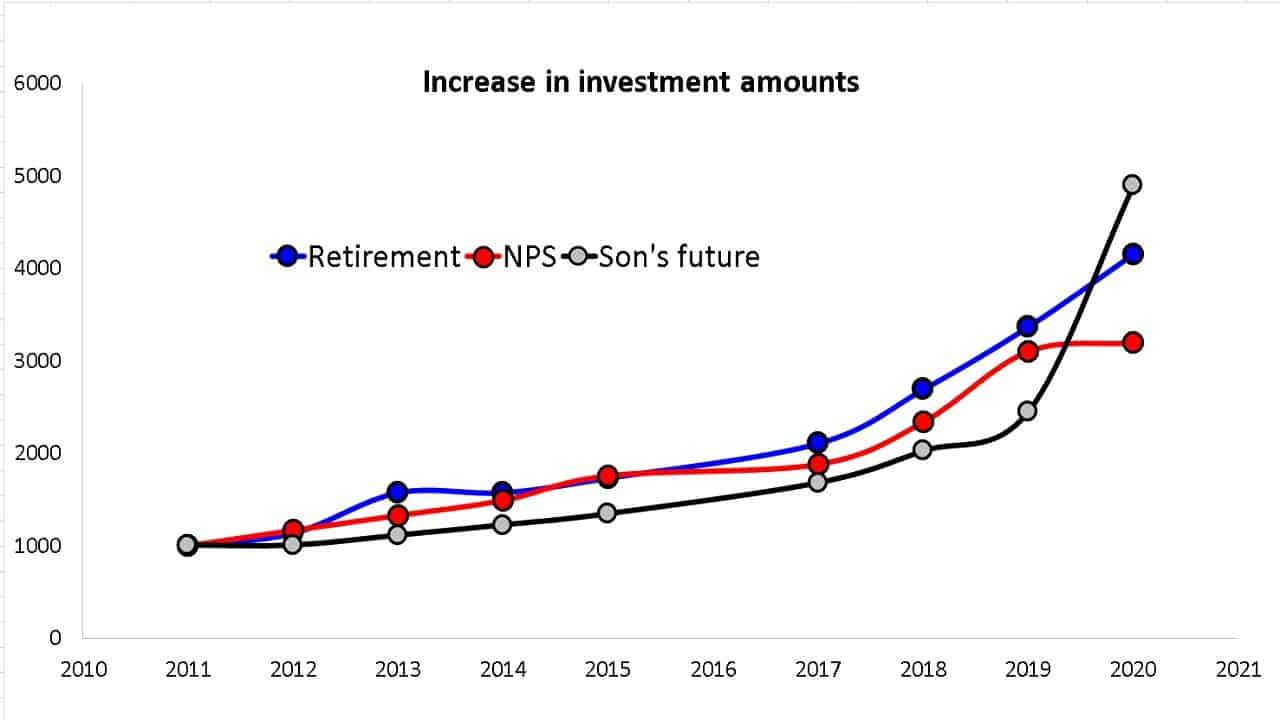
Take the case of NPS – this is a mandatory deduction where I have little control (and have not made any manual investments). From 2011, this is the rate at which NPS contributions have increased from Dec to Dec. These include two pay commissions and a promotion. Data for the year 2016 is missing, probably lost that file due to a hard disk crash. An investment of Rs. 1000 in 2011 has gradually increase to an investment of Rs. 3200 in 2020 – MF guys would call this a step-up SIP.
| Year | NPS |
| 2012 | 17% |
| 2013 | 14% |
| 2014 | 12% |
| 2015 | 18% |
| 2017 | 7% |
| 2018 | 24% |
| 2019 | 33% |
| 2020 | 3% |
This is quite incredible and should be more or less the same for all central govt employees. The catch is the pay grade. It increases non-linearly and is not populated at the top.
It is like the question I like to pose: Two friends A and B start investing simultaneously. Twenty years later, A’s return after tax (CAGR) is 13% and B’s 8%. Who is the better investor? It is tempting to assume it is A, but it all depends on the investment made. A may have got more returns, but B the higher corpus. So returns alone do not give you the full picture. The investment made matters – in this case, it is the paygrade from which the NPS deduction is made.
While corporate employees might salivate at these growth numbers, most central govt employees would tell it is peanuts – but that is how it is. Also see: How my salary has grown over the years. The increase has already slowed down and will be the same for the next few years due to the pandemic.
The growth in the invested amount for NPS, Retirement (NPS + PPF + equity MF, excluding direct equity) and my son’s future portfolio (equity MF + PPF) is shown below.
Observations and lessons
- The amount we invest is more important (and the time over which it is invested) that the return we get.
- We cannot plan for our long-term goals without assuming investment will increase in future. A 10% year on year investment is a bit optimistic but just about manageable.
- Even that rate of increase would look daunting initially, but we will have to put our head down and keep investing (with a plan + yearly reviews)
- There were months I could not invest, and there were years I could not increase the investment. It is essential to keep track of these and make up for it later.
- The sheet I use for tracking the investment amount (not market value) is available here: How tracking investments instead of expenses changed my life!
- If there is one reason for my financial independent status, it is disciplined tracking and systematic increase in investments without worrying about returns.
- Naturally, not all of us have the same income levels and cash outflow (expenses + debt) and not all of us can invest at the same pace, and some of us may get financial independent decades later or not at all. Despite all this, try, we must and fill our cups as much as we can without cribbing about opportunities others got clueless about their personal circumstances.
- We can only deal with the cards we are dealt with. Hard work and toil without expectation is known to change the deck.
- I have seen this baffling argument: If my cup is never going to be full, then it might as well be empty. Surely this deserves an award!
- Each time our salary increases, it is essential to ensure expenses do not increase at the same pace or at least a faster speed. That is just a fancy way of saying live with your means.
- A mountaineer must plan but cannot be looking up to see “how much more” every few minutes. Big journeys begin with small steps. The problem is, in a 1000-step journey, we expect results five steps later.
- If you are a young earner reading this, track your invested amount more frequently than their market value; keep expenses at bay; increase investments at least 5% a year; Wait a decade to see the difference!