Last Updated on December 29, 2021 at 5:57 pm
I compare the returns of my stock portfolio as on 8th Jan 2021 with that of the Nifty. The portfolio is relatively young, and therefore the returns numbers you see would mellow down with age. The critical point of this is exercise is to see how my version of lazy investing fares against the Nifty.
Rob Arnott in a 2013 paper titled The Surprising Alpha from Malkiel’s Monkey and Upside-Down Strategies reported that 96/100 “monkey throwing darts” simulations beat the index.
“Malkiel’s Monkey” refers to Burt Malkiel whose quote from A Random Walk Down Wall Street is well known.
A blindfolded monkey throwing darts at a newspaper’s financial pages could select a portfolio that would do just as well as one carefully selected by experts
While I do not want to discuss such a monkey-portfolio’s efficacy, I can say with certainty mine is one such money portfolio. And this money seems to have beat the “market” (as on date) by nothing more than a stroke of luck.
🔥Secure your future with our Robo-advisory tool trusted by over 3,500 investors and advisors. From effortless retirement planning to funding your children’s biggest dreams, turn your financial goals into reality. 🔥
Subscribe for money management solutions via email! (Link takes you to our email sign-up form) Join 32,000+ readers in our community.
👉 New Tool Alert! NaviPlan: A Privacy-Focused Multi-asset Tracker and Goal Planner 👈
I got the confidence to invest in stocks after evaluating the performance of low volatility indices. I told myself I am not going to do any stock analysis or research. A quick check of company health, a brief review of volatility and buy. If I cannot accept a stock within a few minutes, I am wasting time and money. This is the simple strategy used reproduced from My stock portfolio analysis: total return 22.58%.
Caution: No part of this article should be treated as investment advice. I started investing in stock after my goal-based investing was in place.
Stock picking strategy
- Choose stocks with little or no evaluation or analysis.
- Choose low volatile stocks with sound financial health (low debt min requirement)
- Choose stocks that tend to trade close to their all-time highs (approx momentum indicator). See for example A list of stocks that have traded close to their “all-time high:
- Do not be afraid to pick expensive stocks – both in absolute price and valuation. Note: Value investing may sound intelligent and enticing, but it is essentially riskier. I neither have the age to take on such a risk, nor the qualitative insights to pick stocks that the market has shunned but will be discovered sooner than later. To appreciate the risk associated with value investing and why it is more qualitative than quantitative, see this analysis: Is it time to exit ICICI Value Discovery & Quantum Long Term Equity?
- When in doubt, ask your wife when she is just about to fall asleep in the afternoon.
- Do not fear dividends (or dividend taxation): I had (extremely) small exposures to (only) dividend payers like IOC and CoalIndia; Have no problem with such stocks; I removed them only to trim down the portfolio and exploit their capital losses – offset them with rebalancing gains from my son’s portfolio.
- What matters primarily is company health. Whether it is a dividend payer or not is incidental. That is, it makes no sense to say no to a company only because it pays huge dividends! Just as it makes no sense to sell a stock because it has increased dividend payout.
- All stock investors over a period of 10 plus years will receive dividends whether they like it not. There is no choice, unlike mutual funds.
- Dividends are not something “extra” in terms of returns/performance but do represent real profit. It can serve as a source of income for an older investor: How to build the ideal retirement portfolio.
- Peaceful sleep is the best form of realised gains: hence the importance to business health, low volatility, reasonable momentum (not all stocks in my portfolio will check all these boxes).
Related videos: How to buy your first stock without breaking your head
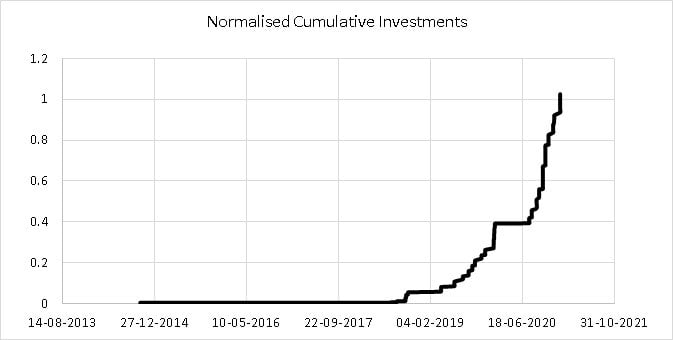
This is the normalised cumulative investment made. A good chunk of the investment is quite recent, and therefore the returns should not be taken too seriously. The only point to evaluate is if it is worth investing more into this money portfolio instead of buying the index.
Portfolio Weights Jan 2021
These include investments made yesterday. I see this as a form of low volatility passive investing. The weights change in an uncontrolled manner and are only modified by future investments. No specific sector/industry analysis was carried out, making it a true blue monkey portfolio.
| Stock | Weight |
| HINDUNILVR | 17.8% |
| ASIANPAINT | 17.7% |
| TCS | 14.8% |
| INFY | 11.1% |
| PIDILITIND | 10.5% |
| HDFCBANK | 9.7% |
| DABUR | 7.9% |
| COLPAL | 4.6% |
| ITC | 3.2% |
| MARICO | 1.3% |
| WIPRO | 1.3% |
Portfolio vs Nifty
The CAGR numbers are inflated because of the young age of the portfolio and the recent market movement. It will not last (abs returns do not depend on time and are even more meaningless!) The comparison with Nifty is only approximate.
| Abs Return | CAGR | |
| Capital Gains | 24.93% | 38.65% |
| Dividends | 1.05% | 1.75% |
| Total | 25.98% | 40.40% |
| UTI Nifty | 17.43% | 27.81% |
| Nifty TRI | 17.74% (approx) |
The same investments and redemptions were made with UTI Nifty Direct plan growth option and the Nifty TRI. The NIFTY TRI CAGR could not be computed with my sheet. And absolute gain is only approximate.
The dividends obtained in the stock portfolio are assumed to be not declared or internally reinvested in the UTI Nifty index fund or Nifty TRI.
Verdict: Monkey wins round one.