Last Updated on December 29, 2021 at 5:09 pm
ICICI Prudential Value Discovery fund has frustrated its investor for quite a while now. In fact, has failed to beat its benchmark for the last five years at the time of writing. The same is true for Quantum Long Term Equity Value Fund also. Is it time to exit these funds? Is the answer to this question a simple “yes/no” or are there other considerations. We consider the ICICI Value Discovery fund’s performance and portfolio history along with Quantum Long Term Equity to see what we can learn.
In a poll conducted at Facebook Group, Asan Ideas for Wealth and on Twitter, I had asked: Are you okay if your fund manager deviates from the investment mandate to improve performance or is the mandate more important?
“The mandate/strategy is more important” option got 195 votes. ”

Clearly, the majority believe the investment mandate is important. Question is, how many are invested in these two funds!
🔥Secure your future with our Robo-advisory tool trusted by over 3,500 investors and advisors. From effortless retirement planning to funding your children’s biggest dreams, turn your financial goals into reality. 🔥
Subscribe for money management solutions via email! (Link takes you to our email sign-up form) Join 32,000+ readers in our community.
👉 New Tool Alert! NaviPlan: A Privacy-Focused Multi-asset Tracker and Goal Planner 👈
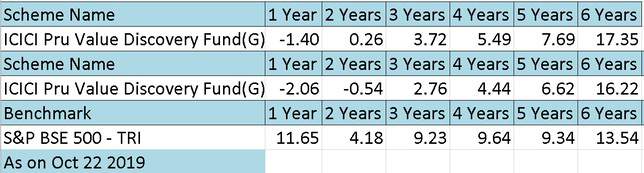
The trailing returns of Value Discovery versus BSE 500 Total Returns Index are shown in the table below. Notice the big drop in performance from “the last six years” entry to “the last five years entry”.
On the face of it, an active fund failing to beat the benchmark over the last 1,2,3,4 and 5 years must be labelled as an underperformer and it is time to exit. However, there is always a lot more beneath the surface and that is what we shall explore here.
At least, in this case, AUM is unlikely to be the reason for underperformance. In Sep 2018, the AUM was Rs. 16,477.28 crores. This dropped to Rs. 15,095.61 crores in Sep 2019. A fall of 8% compared to a return of -1.4%. So inflow has dropped and redemptions have increased.
Trailing Returns of ICICI Value Discovery and Quantum Long Term Equity
The first row corresponds to the direct plan, the second regular plan.
For Quantum Long Term Equity the trailing return underperformance is worse.
| Duration Years | Quantum Long Term Equity Value Fund(G)-Direct Plan | S&P BSE SENSEX – TRI |
| 1 | 1.69 | 16.95 |
| 2 | -0.03 | 10.99 |
| 3 | 3.66 | 13.00 |
| 4 | 7.64 | 10.61 |
| 5 | 6.81 | 9.21 |
| 6 | 12.06 | 12.61 |
| 7 | 11.47 | 12.64 |
| 8 | 12.33 | 12.72 |
| 9 | 9.03 | 9.16 |
| 10 | 11.71 | 10.35 |
| 11 | 16.66 | 15.03 |
| 12 | 10.75 | 7.93 |
| 13 | 12.30 | 10.60 |
The most illuminative graph is the market history of the ICICI and Quantum funds compared with a Nifty index fund (as a proxy for the NIfty).
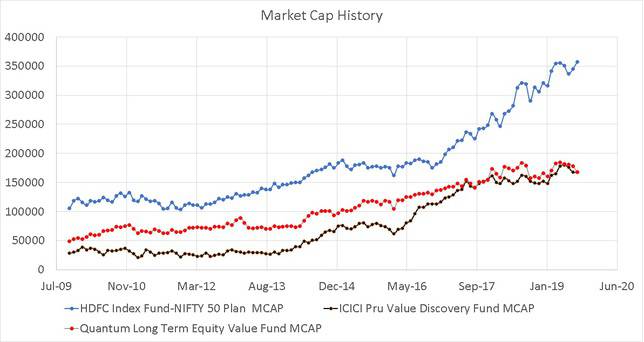
Many would tell that a few stocks in the NIfty or Sensex (or BSE 500) have propped up the index in the past few months. Evidence of that is clearly seen above. While the market cap of the Nifty has zoomed up sharply in mid-2016, the move in these two value funds has been rather sedated.
We can also look at the PE, PB and Div Yield histories of these funds. Keep in mind, a value-oriented fund is expected to have a lower PE, lower PB and higher dividend yield compared to a broad market index. Of course, most value funds tend towards growth style investing or a blend.
PE, PB, Div Yield History
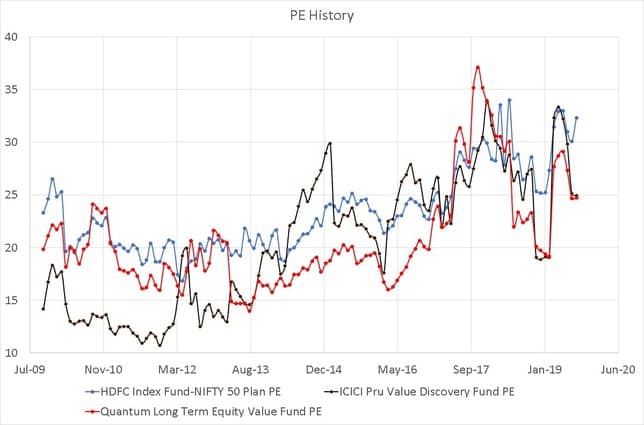
The Quantum fund has typically had a lower PE portfolio than the Index. Value Discovery had taken a relatively blended approach. The same is true with PB and dividend yield as well.

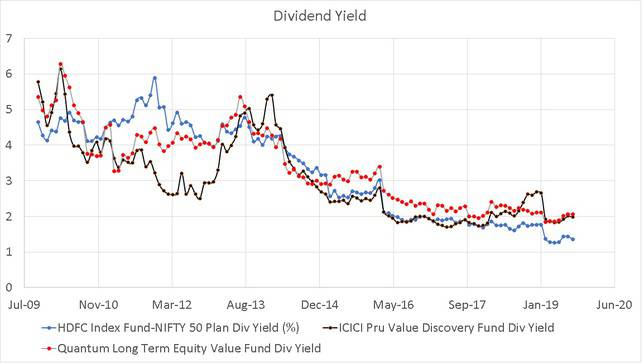
The index upward movement resulting in higher PE, PB and lower div yield also matters. The point is that both funds have little correlation with the index movement. This is both good and bad.
Value-Oriented Funds Portfolio Style
Shown below is the PE, PB and Div Yield of value-oriented funds as of Sep 2019.
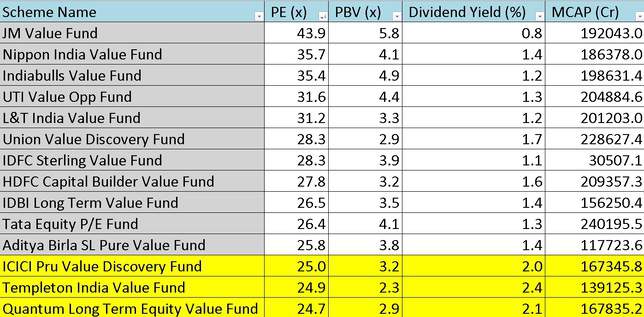
Notice that the three funds in yellow have the lowest PE, lowest PB and highest DIv Yield and reasonably low market cap. This shows that these funds as on date the most value-oriented funds in the category. So they have stuck to their investment mandate and paid the price for it. Other funds have taken a growth approach to please their investors, most of whom only look at returns. For further details, check this video.
Nifty 500 vs Nifty 500 Value 50
The Nifty 500 Value 50 index picks 50 value stocks from Nifty 500 with criteria like low PE, low PB and high div yield. This is how the rolling returns fare over 3 and 5 years.
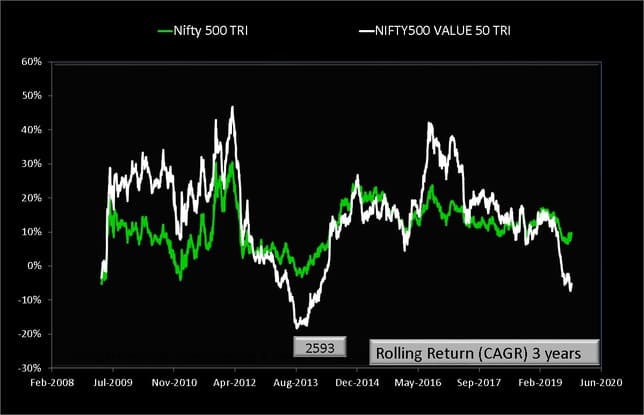
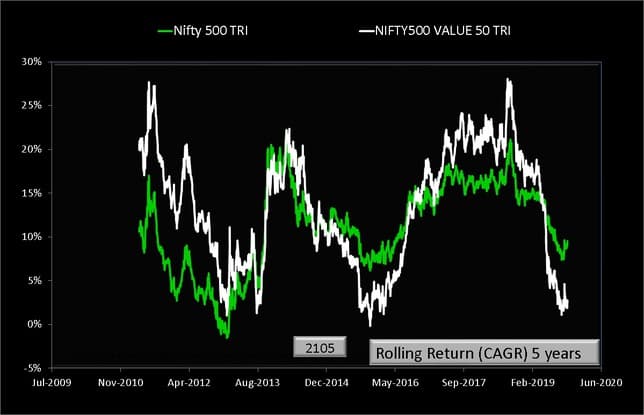
Clearly the value strategy comes tagged with periodic underperformance. The ICIC and Quantum funds practice an active value strategy. So let find out how they fare against both these indices.
Performance vs Nifty 500 Index
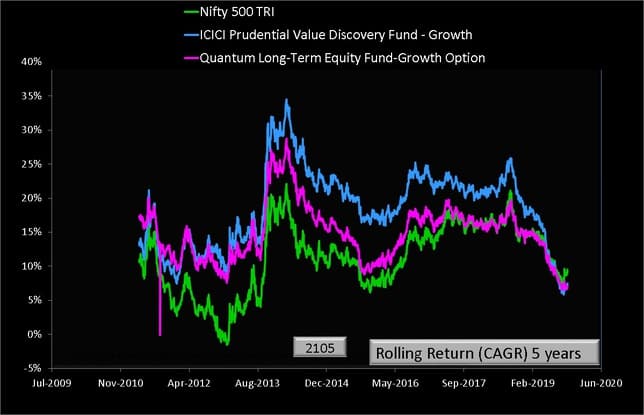
We can understand investors are so disappointed with Value Discovery. When the market moved up in late 2013, the fund had a relatively higher PE and PB indicative of a growth-oriented or blended approach. Then when there was a subsequent shift to a value style, the three-year return outperformance tanked as shown below.
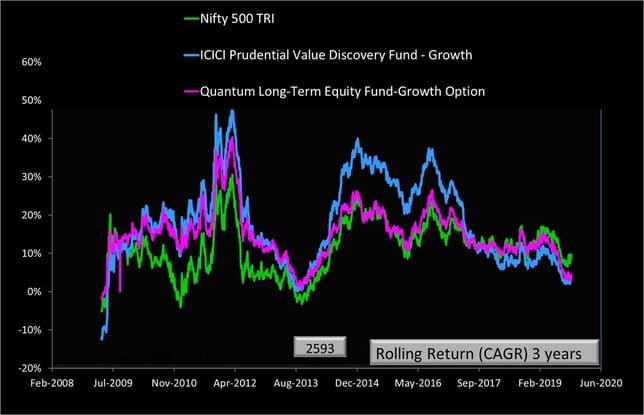
Over five years the ICICI fund has had a better record than Quantum. So those who wish to keep the faith can do so.
Performance vs Nifty 500 Value 50 Index
Both funds have fared considerably better against the Nifty 500 Value 50 Index (also see the video).
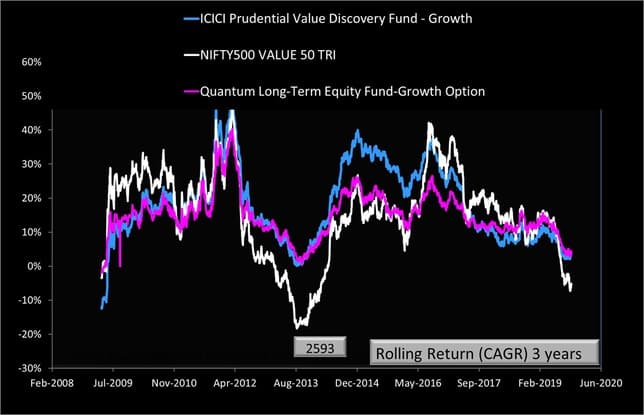

As an investor, I am tempted to use Nifty 500 as the benchmark. As an analyst, I think the algorithmic value index is a better choice for active value-oriented funds and that both funds should consider a change to this benchmark.
What should Investors do? Is it time to exit?
Now answer the question again: Are you okay if your fund manager deviates from the investment mandate to improve performance or is the mandate more important?
- If the mandate is more important, ask if you can handle a “value strategy”. If yes, then stick with these two funds. If no, exit.
- if returns are more important, then exit the two funds. I do not, however, know what will keep you satisfied though.
A value-oriented fund is strictly for diversification. In a diversified portfolio, not all funds should perform at the same time!! So “value” will underperform sometimes and growth sometimes lowering overall portfolio volatility. Question is, are investors – especially those want a bit of this and a bit of that in the name of diversification – mature enough to understand this? Probably not.
Value-oriented funds and dividend yield funds are strictly for those who understand the basics of portfolio management and understand how to quantify diversification. See for example This is my portfolio vs Sensex, Nifty Next 50: Want to Check yours?