In this edition of the reader story, we meet a 28-year-old who has created an elaborate retirement strategy to navigate the stormy waters of the IT industry.
About this series: I am grateful to readers for sharing intimate details about their financial lives for the benefit of readers. Some of the previous editions are linked at the bottom of this article. You can also access the full reader story archive.
Opinions published in reader stories need not represent the views of freefincal or its editors. We must appreciate multiple solutions to the money management puzzle and empathise with diverse views. Articles are typically not checked for grammar unless necessary to convey the right meaning to preserve the tone and emotions of the writers.
If you would like to contribute to the DIY community in this manner, send your audits to freefincal AT Gmail dot com. They can be published anonymously if you so desire.
Please note: We welcome such articles from young earners who have just started investing. See, for example, this piece by a 29-year-old: How I track financial goals without worrying about returns. We have also started a new “mutual fund success stories” series. This is the first edition: How mutual funds helped me reach financial independence.
🔥Secure your future with our Robo-advisory tool trusted by over 3,500 investors and advisors. From effortless retirement planning to funding your children’s biggest dreams, turn your financial goals into reality. 🔥
Subscribe for money management solutions via email! (Link takes you to our email sign-up form) Join 32,000+ readers in our community.
👉 New Tool Alert! NaviPlan: A Privacy-Focused Multi-asset Tracker and Goal Planner 👈
I want to share my financial planning journey. I’m 28 yrs of age, working in a mid-sized corporate (IT – Services) company as a Software Developer. I started my career six years back in 2017 with a miniscule package of 2 LPA (14K/m in-hand) in a product-based company, worked there for four years to gain knowledge in my tech stack and made two back-to-back job switches in the last two years to bump my salary to 23 LPA (1.3L/m in-hand). Now, my skill set (React & Angular) has some good demand in the job market as of now (but not sure about the future). So, I would assume that my salary has peaked at this point and will stay at the same level or at least closer for the next 10-12 years before going down drastically. Yes, we need to update and adapt to the changes. But that will only ensure job safety and not guarantee the same salary levels. I got married last year and have a newborn daughter now.
I have one-year expenses (& 2 years of insurance premiums & school fees required) as an emergency corpus – 8L (6L in FDs, 1L each in PPFAS Liquid Fund and SBI Savings Fund)
I have my Max Life-Term Insurance of 25L (I felt that is enough as my wife is also working in a corporate) and Star Comprehensive Health Insurance of 5L for myself and my family and the cover provided by my company. Also, I am planning to take a Super top-up after five years.
I tried out my retirement planning in Excel with 6% inflation, assumed returns for the first few years, and gradually took it down further. I can clearly see that early retirement is not possible. Also, I can’t deny the harsh reality of the IT industry, where forced retirement is a clear possibility. So, I came up with a hybrid approach of making sure I accumulate the retirement corpus before the point of forced exit and disruption in the salary levels (assuming it to be 2035) and try to find at least some kind of a low-paying job (with PF contributions) or a source of income without touching the corpus till I reach 60. Please find the Retirement corpus accumulation table below
(Note: The Savings Amount includes the PF contributions [= employee + employer – pension]. And only PF is considered post-2035. Also, the drop in the savings amount in 2023,24 in the table is considering the recession.)
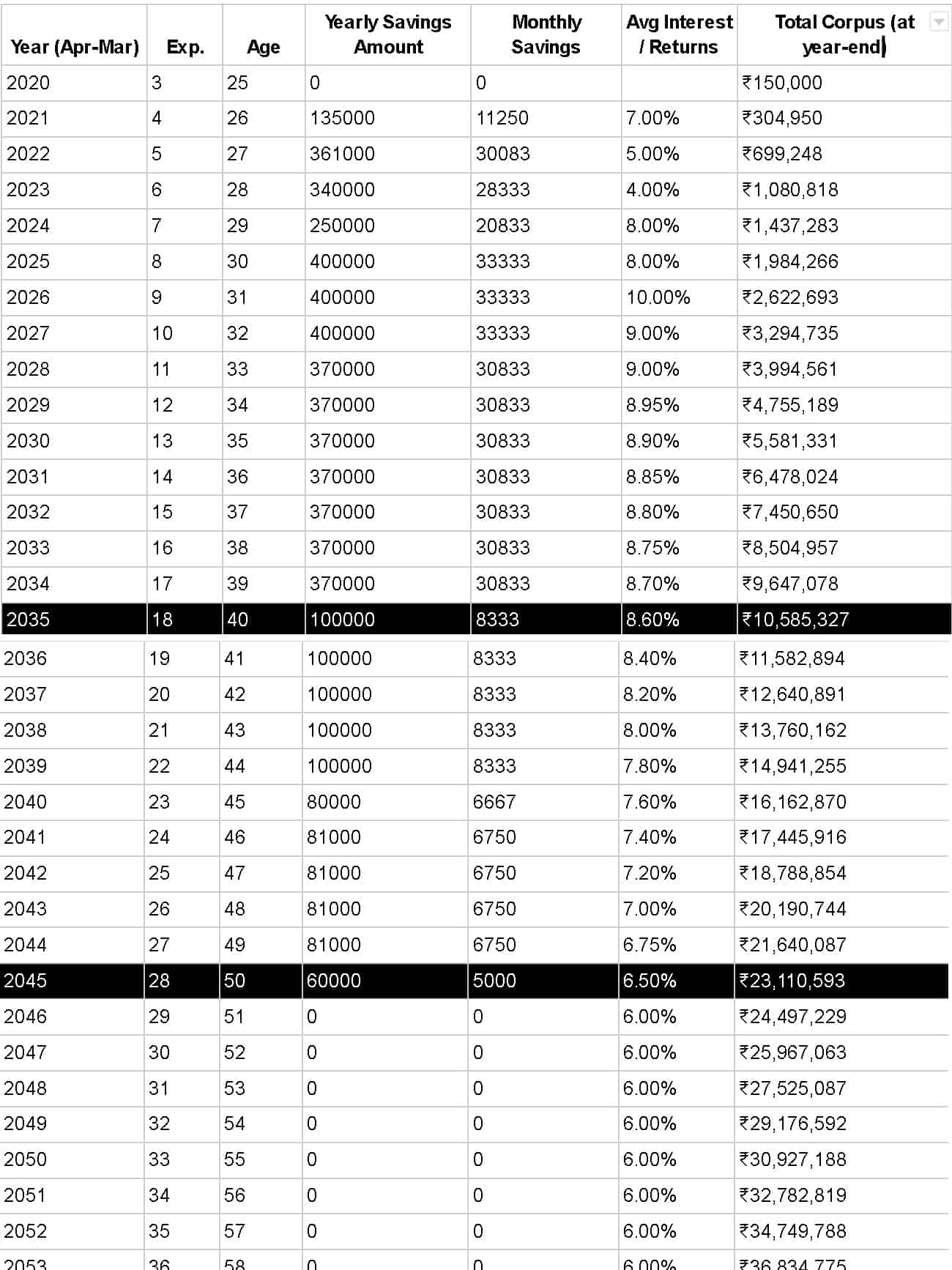
So, the accumulated corpus is 4.1 Crores at 60, lasting 22 years (approx). Before jumping into corpus spending. Let us look at the current asset allocation and corpus accumulated on July 2023.
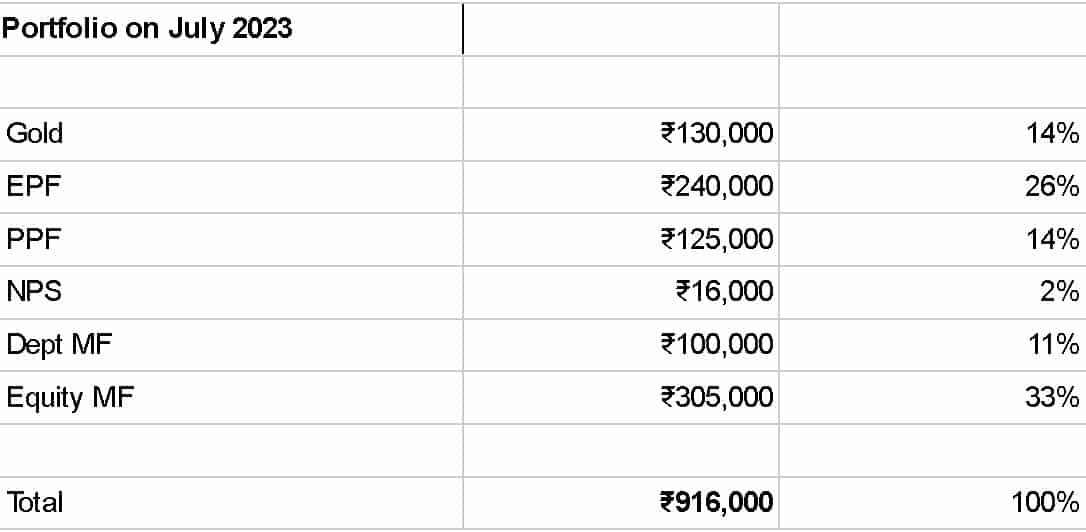
I have the following Equity & Debt MFs –
- HDFC Developed World Index Fund – 1.15L
- ICICI Global Advantage Fund – 90K
- DSP Tax Saver Fund – 43K
- Parag Parikh Tax Saver Fund – 57K
- HDFC Money Market Fund – 1L
In the future, I plan to replace both the Tax savers with a simple HDFC Nifty Index fund, as the Old Tax regime doesn’t work for me anymore after the recent changes. Also planning to add SBI Magnum Gilt Fund. In the long term. I don’t want to deal with too many AMCs and plan to shrink to just a couple of AMCs (HDFC & SBI) with good online support (App & website). Yes, the equity allocation is slightly low.
It has been diversified globally to reduce risk (in the long term) as I had to deal with the aversion of my spouse towards the stock market (a story of a relative losing everything in stock trading). I had to explain the differences and the need for equity and everything somehow to take the equity allocation to this 33%. I made a few mistakes at the beginning of this journey, like buying Gold at its peak in Sept 2021, getting into NPS (I will get out from NPS soon once eligible), etc. Hoping not to repeat them here or in other portfolios.
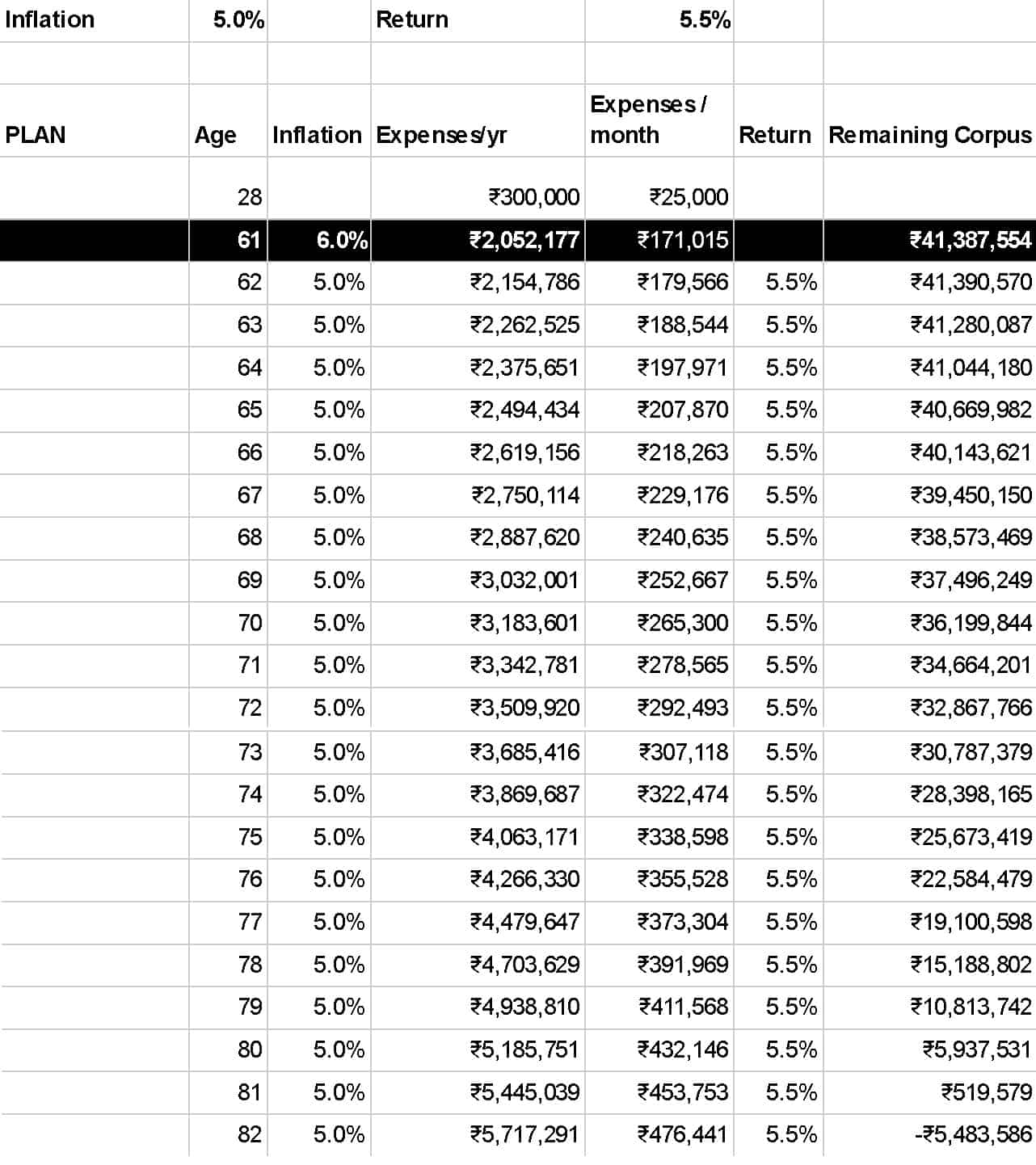
Coming to the corpus spending part, I have assumed a monthly expense of 25k per month (I will inherit an apartment in the future, so I didn’t consider my current rent during retirement), 5% inflation and a 0.5% return more than the inflation. Please find the table below.
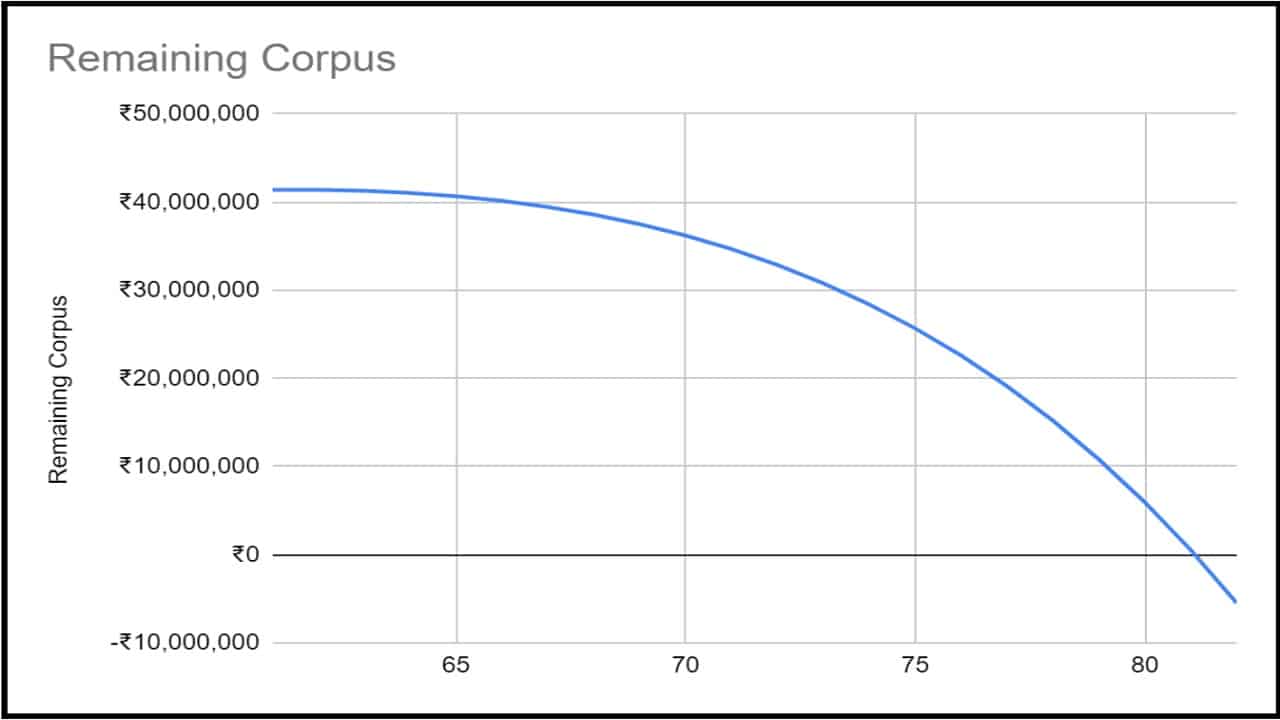
Yes, it doesn’t look too good, as it only covers up to 82 yrs. But that’s the maximum I can make it with so many uncertainties and as I have to deal with other goals such as my child’s education, marriage, etc. (which is even more important), which I will discuss in a different article. It appears there is a possibility of some minimal level of financial dependency on my child during retirement. But if things go as per plan, I will have at least some level of security.
Reader stories published earlier:
As regular readers may know, we publish a personal financial audit each December – this is the 2020 edition: How my retirement portfolio performed in 2020. We asked regular readers to share how they review their investments and track financial goals.
- First audit: How Suhas tracks his MF investments and reviews financial goals.
- Second audit: How Avadhoot Joshi evaluates his investment portfolio.
- Third audit: How a single mom is on track to financial freedom
- Fourth audit: How Gowtham started goal-based investing & took control of his money
- Fifth audit: Why my financial independence & early retirement plans were postponed by four years
- Sixth audit: How Abhisek funded his marriage & is on track to financial freedom.
- Seventh audit: How Rohit’s early struggles defined his investment journey
- Eighth audit: Why my investments are still on track despite job loss and lower-income
- Ninth audit: How a retirement planning calculation scared me to take action
- Tenth audit: I made several investment mistakes but have turned my life around.
- Eleventh audit: My net worth doubled in the last financial year, thanks to patient investing!
- Update: How I achieved investing nirvana.
- Twelveth audit: My financial journey: from novice to goal-based investor.
- Thirteenth audit: My journey: from a negative net worth to goal-based investing.
- Fourteenth audit: From Fixed Deposits to Goal-based investing in MFs.
- Fifteenth audit: My 10-year financial journey – mistakes made and lessons learnt.
- Sixteenth audit (part 1): How I achieved financial independence without mutual funds or stocks.
- Sixteenth audit (part 2): Lessons from my financial independence journey and future investment plans.
- Seventeenth audit: How I plan to achieve financial independence and move to my native place
- Eighteenth audit: I used the current bull run to reduce my mutual funds from 14 to 4!
- Nineteenth audit: How a conservative investor created his financial plan
- Twentieth audit: I plan to achieve financial independence by 46; this is my master plan
- Twenty-first audit: I have made many investment mistakes but am on course to financial independence by 45.
- Twenty-second audit: I felt worthless six years ago but have achieved financial stability today
- Twenty-third audit: My financial journey was directionless until age 40: this is how I made up for lost time
- Twenty-fourth audit: Why I increased equity MF investments by 275% and reduced PPF contributions.
- Twenty-fifth audit: How I track financial goals without worrying about returns
- Twenty-sixth audit: I am 24 and started investing 1Y ago, but what am I investing for?
- Twenty-seventh audit: How we plan to achieve a retirement corpus 50 times our annual expenses.
- Twenty-eighth audit: I thought equity investing was a gamble, but now I aim to hold 60% equity for retirement
- Twenty-ninth audit: My journey: From 5 lakhs in debt to building a corpus worth six years in retirement
- Thirtieth audit: My investment journey: From random purchases to a goal-based portfolio
- Thirty-first audit: My investment journey: from product-driven to process-driven
- Thirty-second audit: How a young couple is trying to balance travelling and investing
- Thirty-third audit: My journey: From Rs. 30 bank balance to financial independence
- Thirty-fourth audit: Our journey: From scratch to a net worth of 18 times annual expenses.
- Thirty-fifth audit: From a net worth of Rs. 6000 to auto-pilot goal-based investing
- Thirty-sixth audit: How I retired from corporate bondage at 46, two years ago!
- Thirty-seventh audit: How I learnt to keep it simple and build a net worth 19 times my annual expenses
- Thirty-eighth audit: How Abhineeth plans to achieve financial independence and build a house.
- Thirty-ninth audit: How Sahil plans to achieve financial independence by efficient tracking
- Fortieth audit: My Journey to a Ten Crore Portfolio
- Forty-first audit: Burdened with debt for several years, I am now aggressively investing in equity
- Forty-second audit: From Engineer to Librarian after Financial Independence and Early Retirement (FIRE)
- Forty-third audit:I lost six months’ income in F&O and ditched it for systematic investing
These published audits have had a compounding effect on readers. If you would like to contribute to the DIY community in this manner, send your audits to freefincal AT Gmail. They could be published anonymously if you so desire.