Last Updated on October 5, 2025 at 2:43 pm
In October 2022, we explained why we badly need an aggressive hybrid index fund! The situation remains the same ten months after SEBI announced a Mutual Funds Lite (MF Lite) framework for passively managed schemes of Mutual Funds, which includes passive Hybrid Funds.
We determine how easy/hard it is to beat the CRISIL Hybrid 35+65 – Aggressive Index consistently. The index comprises the S&P BSE 200 TR (65%) and the CRISIL Composite Bond Fund Index (35%).
Disclaimer: Fund performance reports present return and risk analysis of a fund, along with representative benchmarks, and do not constitute investment recommendations. It must be expressly understood that the data below reflect only past performance and are in no way an indication of future performance. Our investment recommendations are here: Handpicked List of Mutual Funds (PlumbLine).
We shall use three metrics for the analysis.
🔥Secure your future with our Robo-advisory tool trusted by over 3,500 investors and advisors. From effortless retirement planning to funding your children’s biggest dreams, turn your financial goals into reality. 🔥
Subscribe for money management solutions via email! (Link takes you to our email sign-up form) Join 32,000+ readers in our community.
👉 New Tool Alert! NaviPlan: A Privacy-Focused Multi-asset Tracker and Goal Planner 👈
1 Rolling return outperformance consistency: the fund returns are compared with category benchmark returns over every possible 3Y,4Y, and 5Y period. The higher the outperformance consistency, the better. Suppose 876 fund returns were compared with 876 benchmark returns, and the fund has beaten the benchmark 675 times. The consistency score will be 675/876 ~ 77%.
2 Downside performance consistency over every possible 3Y,4Y, 5Y. Higher, the better. This is defined using the downside capture ratio and measures how much of a benchmark’s monthly losses (if monthly return < 0) a fund captures. A downside of 80% means a fund has captured only 80% of the index losses. Read more: Do active mutual funds offer downside protection? Or is it a myth?
A score of 50% means that 5 out of 10 times, the Fund performed better than the category benchmark when the benchmark was moving down. This is a measure of risk protection. It is computed from rolling downside capture data. Read more: An introduction to Downside and Upside Capture Ratios.
To qualify as a “consistent performer,” the fund should have a return outperformance consistency or a downside protection consistency of 70% or more.
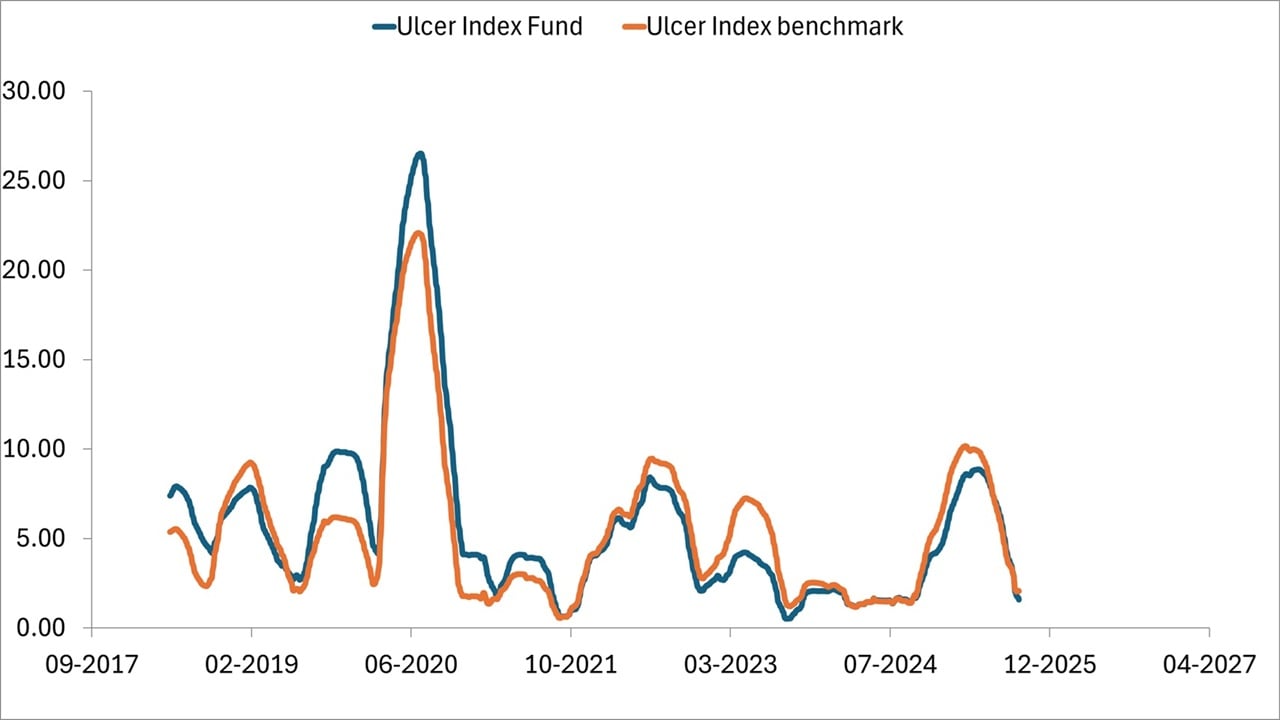
3 Ulcer Index outperformance consistency (aka Ulcer score). This is a 90-day rolling average of the Ulcer Index. This is a measure of how much the fund fell from a peak when compared to an index. You want the fund to fall lower than the index. A fund that shows this charecteristic consistently will have a high Ulcer Score. So we want high Ulcer scores – at least 60-70%. This is a typical graph used to compute the Ulcer score. In the graph, the high values corresponds to higher drawdowns and higher holding stress.
- The total number of funds: 29
- The number of funds with rolling return outperformance consistency greater than 70%: 10
- The number of funds with downside protection consistency greater than 70%: 1
- The total number of funds: 29
- The number of funds with rolling return outperformance consistency greater than 70%: 7
- The number of funds with downside protection consistency greater than 70%: 0
Ulcer Score
- This is available up to 10 years.
- For years, 6,7,8,9 and 10, the maximum Ulcer score is only 50%. This means the funds were more stressful to hold than the index as they fell more from a peak.
- Only one fund managed an Ulcer score of 60% or more over 3,4 and 5 years.
That is quite a poor performance. This is why we feel an aggressive hybrid index fund is badly needed This would passively offer the so-called “free lunch” benefit of diversification (equity + bonds) at low cost and better performance than most actively managed funds in this category. See: Why is diversification the only free lunch in investing?
Free lunch means that by substituting 35% of stocks with bonds, we have reduced the risk but not the return (typically). This means asset allocation (or, in this case, an aggressive hybrid index) enables us to get a better risk-adjusted return (return obtained per unit risk taken). See: Aggressive Hybrid Funds vs Low Volatility Index Funds: Which is better?
Please note: We are referring to an index fund and not a fund of fund which invests in ETFs. The FOF NAV will track the price of the underlying ETFs. If the ETF price deviates significantly from its NAV and not corrected fast enough, it will affect the FOF. The best option is an index fund.