It is time for my personal financial audit! Each December I take stock of my portfolio, investments and where I stand with respect to my goals. The idea behind this exercise is to encourage similar action among readers. My success (if I can call it that) is the residue of luck (therefore market-linked) and consistency and what follows is written with gratitude and not with the intention to boast.
Accountability: This is the archive of personal finance audits published before 2013 audit, 2014 audit, 2015 audit, 2016 audit, 2017 audit, 2018 audit. During the Dec 22 Chennai investor meet, I was asked about the fund used for retirement planning. Members of the audience remembered what they were faster than me!
Sharing portfolio details with readers brings in a new level of responsibility. I cannot make random purchases because that would look silly in the audit! After a decade of trial and error, this annual task checks if the “flow” in the right direction! Thank you.
🔥Secure your future with our Robo-advisory tool trusted by over 3,500 investors and advisors. From effortless retirement planning to funding your children’s biggest dreams, turn your financial goals into reality. 🔥
Developments in 2019 The biggest change is the growth of my direct stock portfolio. I rebalanced my son’s future goal portfolio a few weeks ago. Other than that, it has been a quiet year so far.
Equity: Mutual funds: 93.7%, Stocks: 6.67% (up from 2% last year)
Fixed Income: NPS 82%, PPF (self, spouse): 18%
NPS Investments
This is the default set up of the NPS with 85% fixed income and 15% equity. Most of the fixed income is gilts.
SBI PENSION FUND SCHEME – CENTRAL GOVT 34.00% UTI RETIREMENT SOLUTIONS PENSION FUND SCHEME- CENTRAL GOVT 33.00% LIC PENSION FUND SCHEME – CENTRAL GOVT 33.00%
XIRR from 08-Mar-2010 to 24-Dec-2019 is 9.71% Note NPS contributions between Aug 2006 to Feb 2010 were kept in a holding account earning 8% a year until the NPS was “ready” and then invested into the NPS.
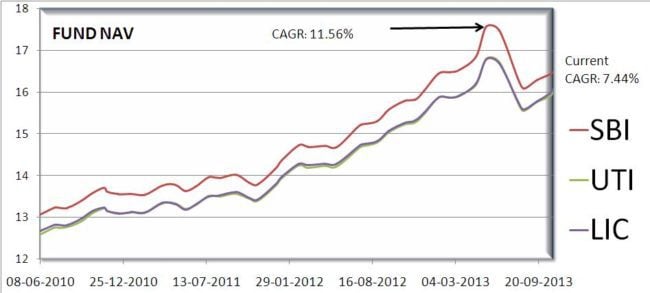
NPS was a bumpy ride with incidents such as this (overnight 2% increase in interest rate). Which is my investors should never forget that NPS are mutual funds subject to market risks
Mutual Fund Investments
HDFC Balanced. XIRR: 11.24% (consolidated after the merger, using my tracker) Weight: 40.4%
Parag Parikh Long Term Equity Fund XIRR: 13.8% Weight 37.4%
Quantum Long Term Equity: XIRR 7.15% Weight: 21.9%
Overall XIRR since inception: 11.6%
Last year all three funds were in equal proportions but due to Quantums prolonged underperformance, its weight has gone down without redeeming but by shifting investments. I am considering a shift from Quantum to ICIC Multi-Asset but I have still not finalised it.
Why not index funds? At my age (I am 45) and at my portfolio size, I value guaranteed lower volatility more than a chance of outperformance or low-cost market returns. It is for this reason, I prefer hybrid funds than index funds. Quantum has given me fantastic volatility protection but the dip in returns has been too much for too long.
Portfolio Analysis
I keep pointing out that “returns do not matter“. We need to evaluate what is the corpus actually worth.
If X is my annual expense, my retirement corpus is about 31.4X. This means that I can beat inflation for 30-31 years if my retirement corpus earns a post-tax return equal to inflation. See video below for details.
If I quit my job now, I can generate an inflation-protected income for about 35+ years with a bucket strategy (depending on market conditions)
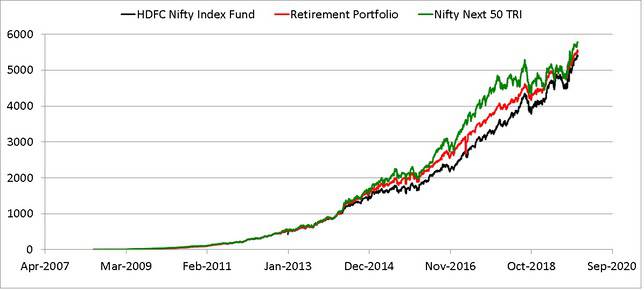
My portfolio is in red. The black line is an HDFC Nifty index fund with the same investment and same date. This would have given pretty much the same overall XIRR (113%) as my entire portfolio!!
The green line is NIfty Next 50 TRI (same investments, same date). This would have returned 13% XIRR but clearly is a lot more volatile. Regular readers would recall that last year Nifty Next 50 was lower than my portfolio. So do not get any ideas other than the efficacy of a simple index fund. My hindsight can be your foresight.
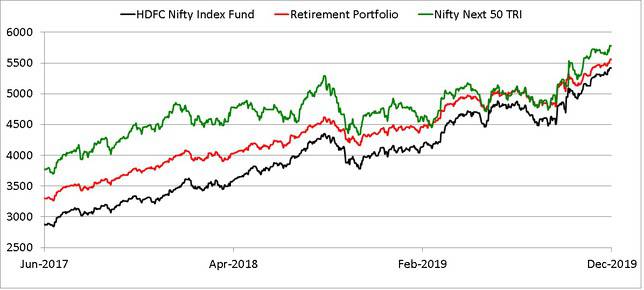
This is a closer look at the same graph.
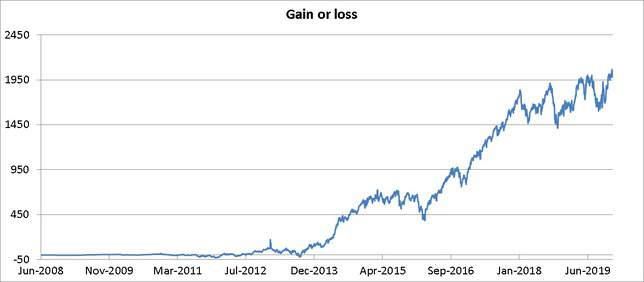
This is the gain or loss in the portfolio. Please note that all numbers in the y-axis are normalised and have no specific meaning!
After five years of “mutual fund Sahi Hai” investing, my grand gain was minus one lakh! It is good to know this only in hindsight! If I had bothered to do this calculation in Dec 2013, I might have pulled out before the big rally that changed my life.
The fall of the retirement portfolio from all-times compared with HDFC Nifty Index fund is shown below. During big falls, the portfolio has typically lower.
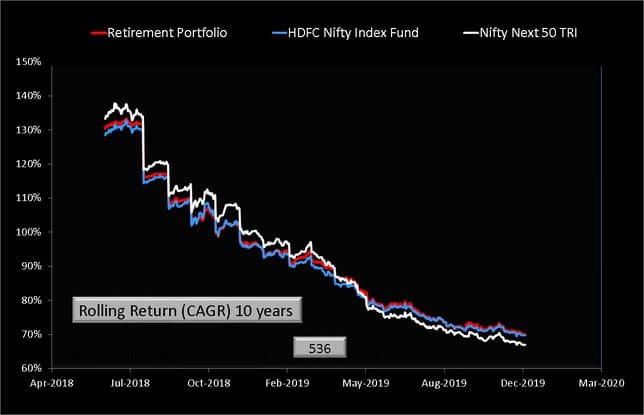
This is the rolling return over ten years (treat as absolute gain). Noticed how NIfty Next 50 has fallen. The portfolio has not significantly deviated from NIfty and just about managed to stay a “touch” above.
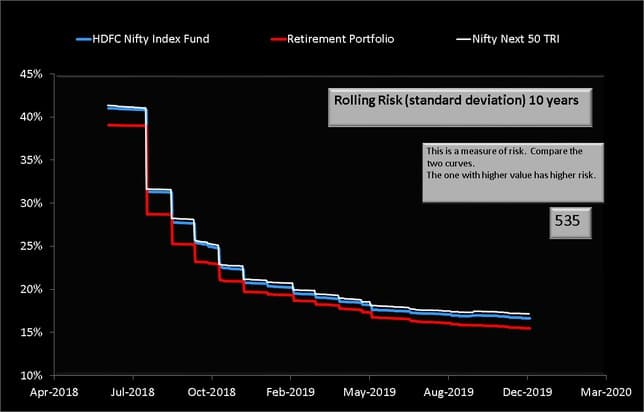
The rolling volatility over ten years is shown below. The portfolio has consistently been lower in volatility with a bit more return.
Stock portfolio
This is my experimental stock portfolio. Half of it is filled with low volatility stocks with positive momentum (not momentum stocks with low volatility!) and the other half with high dividend stocks. Kindly do not attempt to copy this. I have the luxury to fool around with this although as you can see I am playing it fairly safe.
Symbol
Holdings Buy Value
HINDUNILVR
28%
HDFCBANK
24%
ASIANPAINT
11%
COLPAL
9%
INFY
4%
TCS
4%
ITC
3%
HINDPETRO
3%
DABUR
3%
COALINDIA
2%
PIDILITIND
2%
IOC
2%
VEDL
2%
MARICO
2%
WIPRO
1%
Child’s Education
I have been investing for my son’s future since Dec 2009 (a month before he was born). Then it was an 18-year old goal and now it has become an 8-year old goal. So more caution becomes necessary.
PPF (in his name) + I also use my mothers PPF (which doubles as her tax planning instrument). However, none of the PPF accounts is maxed out. I prefer to pay a little exta tax for my mother than lock money up in PPF
ICIC Equity arbitrage XIRR 6.8%. This is used for rebalancing and gradually accumulate the corpus as the goal nears.
Analysis: my son’s future needs
The 40% fixed income allocation is now enough to fund a UG degree comfortably plus a little bit PG perhaps. My son is not yet 10. Going forward, my goal is to increase the fixed income allocation so that the cost of UG + PG degree is taken care as per current expenses. If I can manage this for as long as possible, there is no reason to worry about a market crash close to the goal deadline.
I have shown that a step-wise reduction in equity well before the goal deadline is a simple way to reduce risk and achieve a target corpus, but you can also play it by the ear if you have some confidence.
I am perhaps a good example of how a person’s risk appetite increases as net worth increases.
With respect to retirement, my goal is to stay close to 10-11% XIRR and reduce risk even further. The same is also true for my son’s education portfolio.
The only disadvantage with my stock portfolio is I might be holding these stocks in mutual funds as well, but not much can be done about it. Let us see how it pans out.
If you any questions or comments, please use the comment box below.
Do share this article with your friends using the buttons below.
Create a complete financial plan with our Robo-advisor!
Trusted by 3500+ investors and advisors! Use code robo25 for a 20% discount!