Last Updated on September 5, 2022 at 4:50 pm
UTI S&P BSE Low Volatility Index Fund is an open-ended scheme tracking the S&P BSE Low Volatility TRI. In this review, we evaluate the pros and cons of investing in this fund currently in its new fund offer period.
Regular readers may be aware that we have proclaimed the benefits of low volatility investing for a few years now. See Nifty Low Volatility 50: A Benchmark Index to watch out for (July 2016). We publish a low volatility + momentum stock screener each month and also update the performance of the direct equity portfolio based on this idea.
Now with UTI S&P BSE Low, Volatility Index Fund investors have a way to passively track a low volatility index. Although an index fund is more expensive than an ETF (ICICI has a low volatility based ETF), price-nav deviations particularly during periods of market stress determine returns more than cost. See ETFs vs Index Funds: Stop assuming lower expenses equals higher returns! Also, see ICICI Prudential Nifty Low Vol 30 ETF FOF Review.
There are several considerations investors should be aware of before taking UTI S&P BSE Low Volatility Index Fund seriously. Let us get to that after we look at the performance of the underlying index.
🔥Secure your future with our Robo-advisory tool trusted by over 3,500 investors and advisors. From effortless retirement planning to funding your children’s biggest dreams, turn your financial goals into reality. 🔥
Subscribe for money management solutions via email! (Link takes you to our email sign-up form) Join 32,000+ readers in our community.
👉 New Tool Alert! NaviPlan: A Privacy-Focused Multi-asset Tracker and Goal Planner 👈
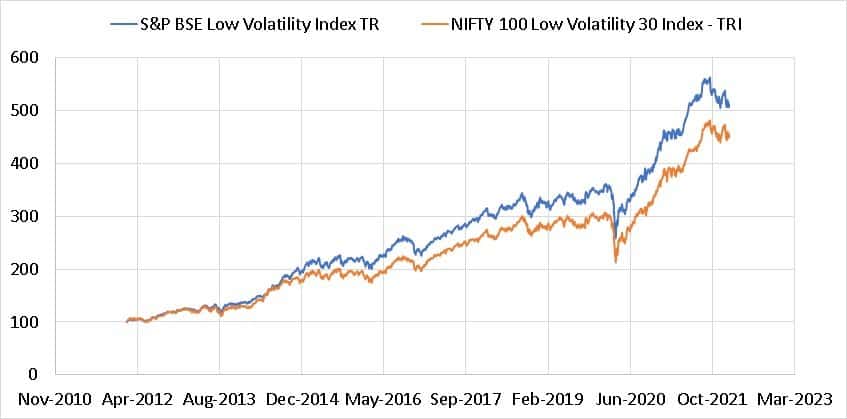
The S&P BSE Low Volatility Index has 30 companies from the S&P BSE LargeMidCap with the lowest volatilities, as measured by standard deviation. Each stock cannot have a weight of more than 5%. So this naturally acts like an equal-weight index reducing concentration risk. In contrast, the Nifty 100 Low Volatility 30 index limits itself to the large cap universe. This does not however mean the two indices are significantly different in terms of risk or reward.
This is the growth over the last 10 years.
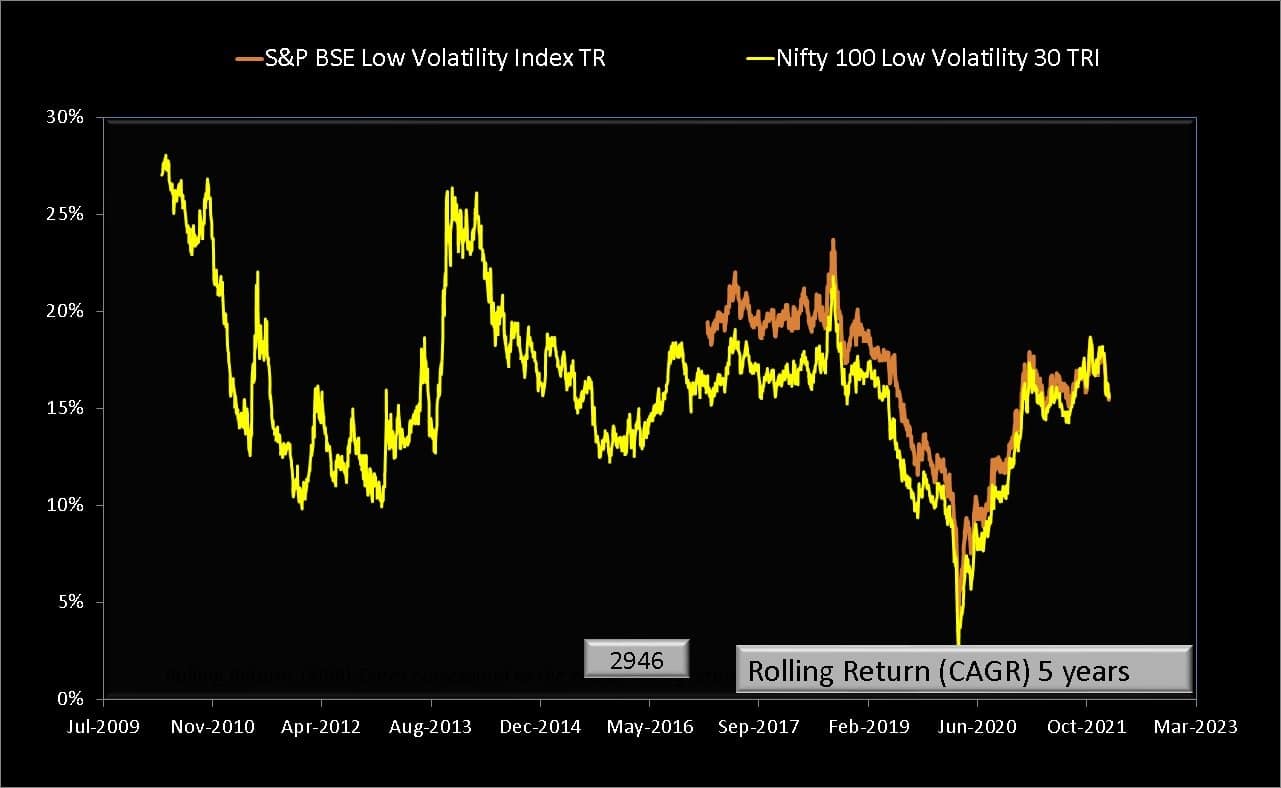
These are the 5Y rolling returns. There is not enough history to discern a difference between the two indices.
S&P BSE Low Volatility Index TR the index tracked by UTI S&P BSE Low Volatility Index Fund is compared with S&P BSE LargeMidCap TR and S&P BSE SENSEX (TR)over the last ten years
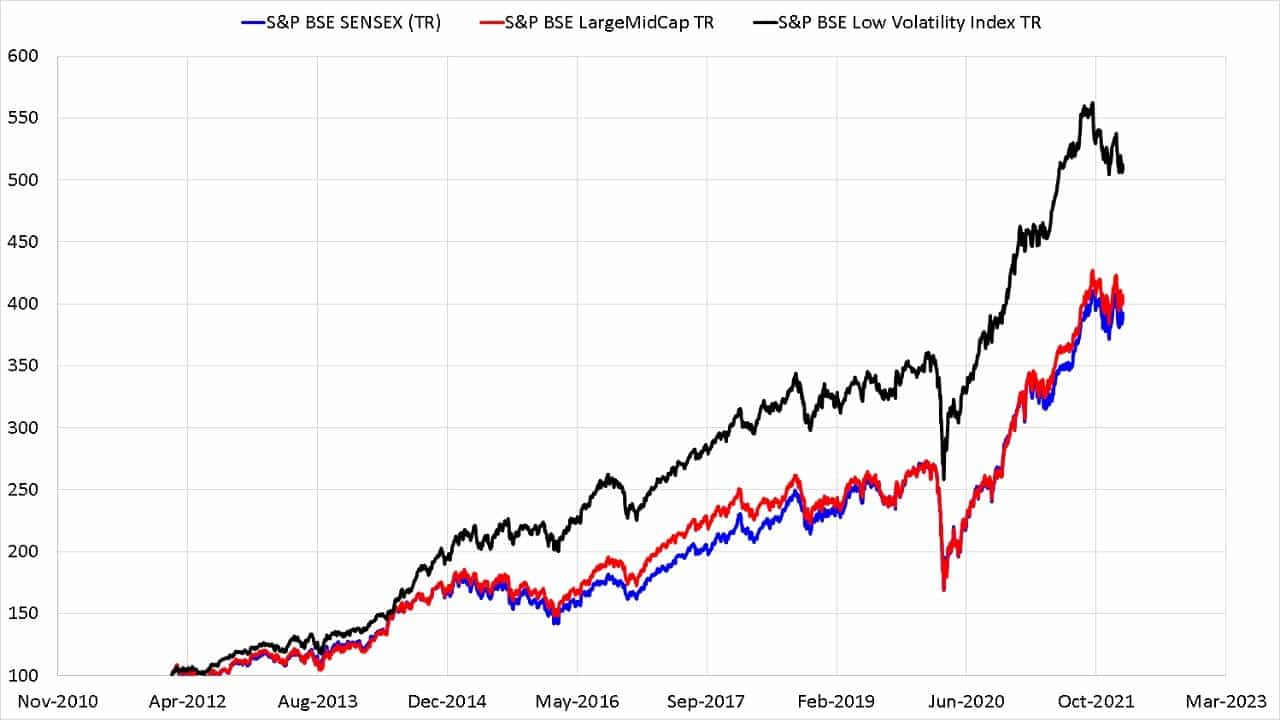
It may look rosy when viewed like this, we need to look at the rolling returns. We can only do so over 5 years as there is not enough history available in the public domain.
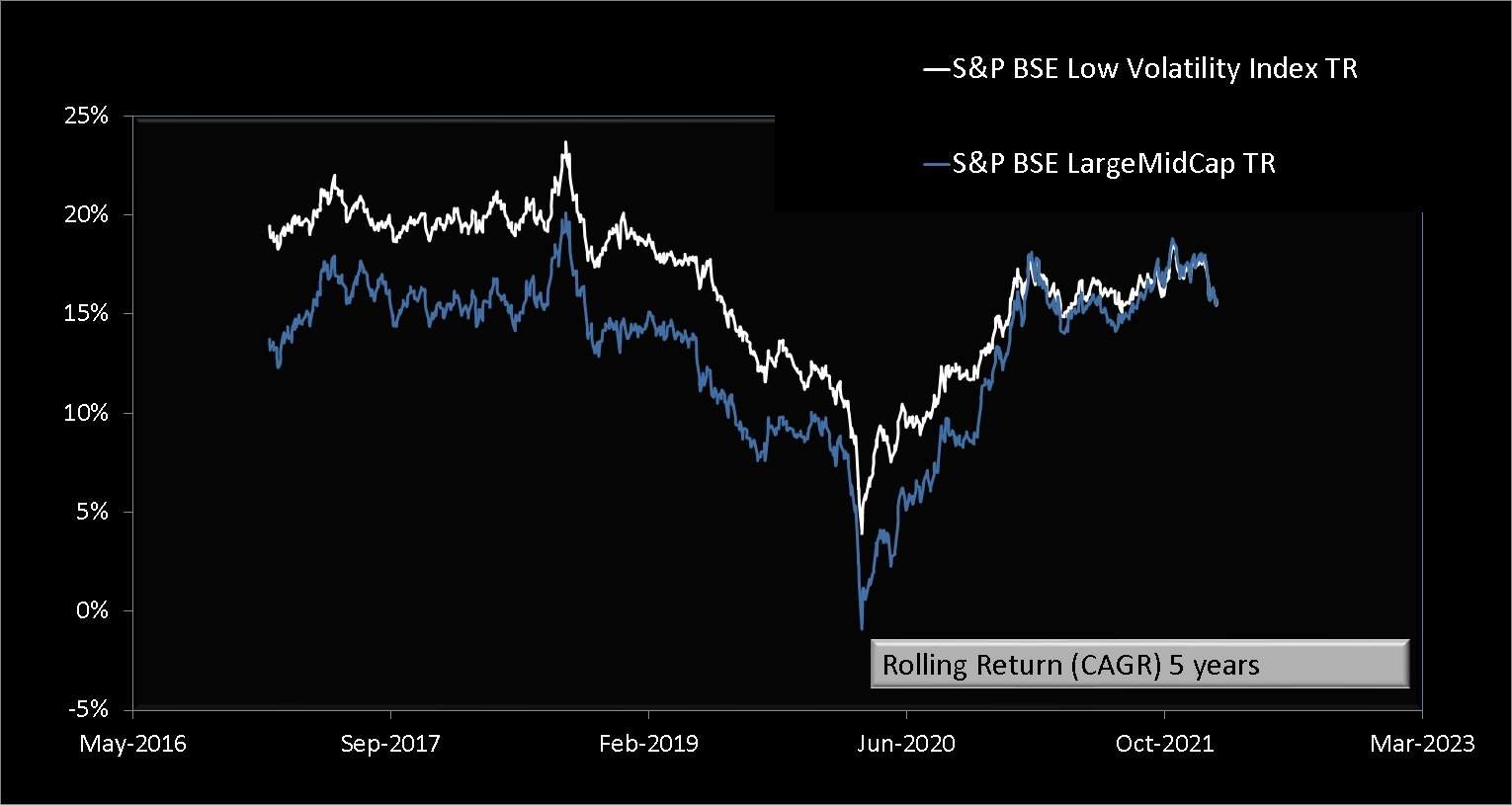
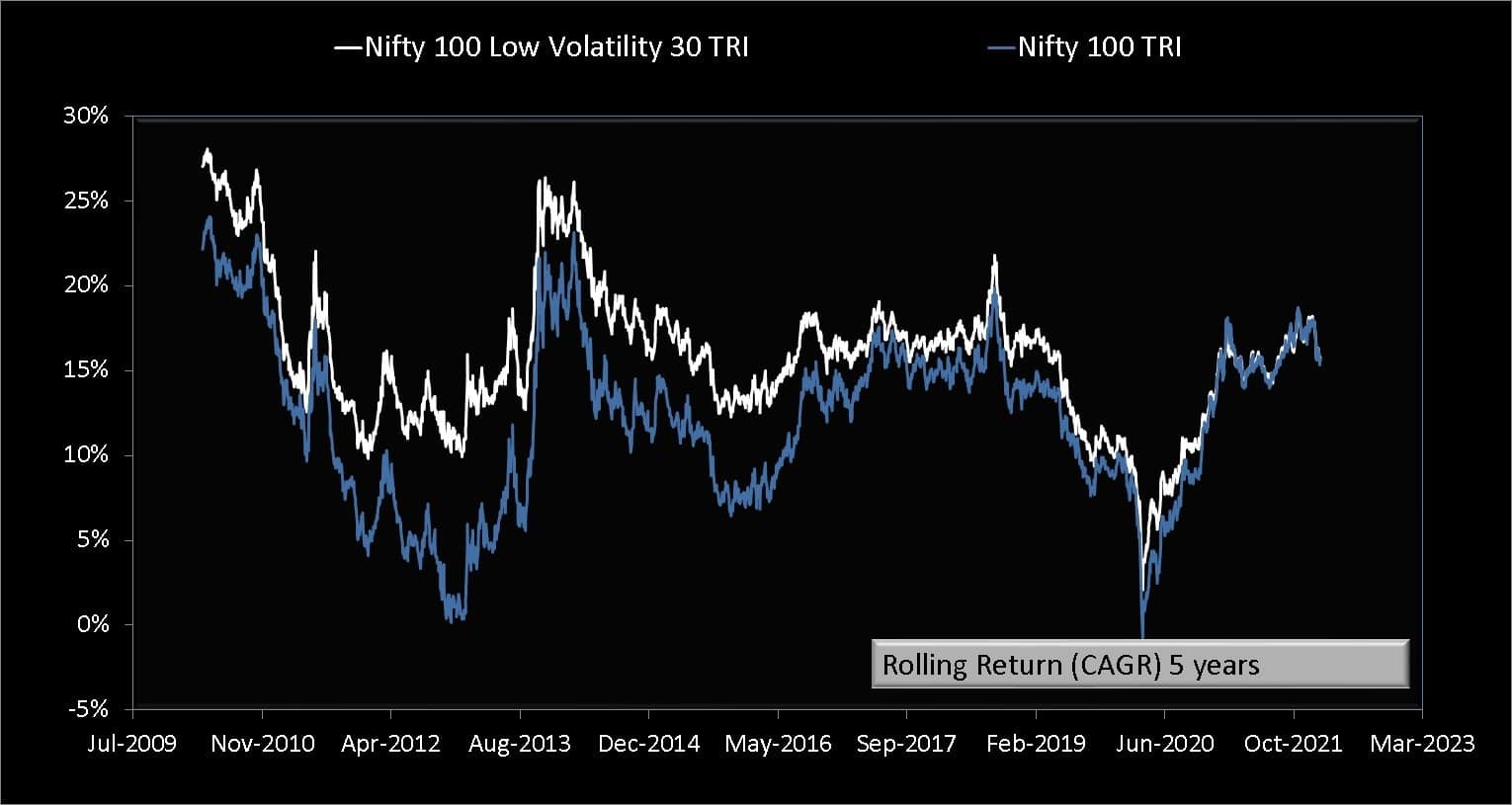
In both cases, the low volatility has typically outperformed the base index except over the last few months as noted earlier – Nifty 100 Low Volatility 30 vs Nifty 50: Return difference at an all-time low
This underperformance is a first for the low volatility indices. This means the past performance of low volatility as a “factor” or as an “return anomaly” may not be as robust in the future. Considering the fact that UTI S&P BSE Low Volatility Index Fund is likely to be 2-4 times more expensive than a Nifty or Sensex index, the margin of underperformance will be higher.
Unexpected underperformance is a common problem with all factor indices. They have been “designed” to produce good results with past data but there is not enough market history in India to check if an idea works consistently well. Also, see: Data Mining in Index Construction: Why Investors need to be cautious
That said, among all the factors, lower volatility than the base index is a simple guarantee. This means the return of the low volatility index per unit risk taken is likely to be higher than that of the base index.
Stated in other words, the low volatility index has a reasonable chance of producing better risk-adjusted returns than the base index. The fund management fee will however play a crucial role here as mentioned above.
The 5Y rolling standard deviation of S&P BSE Low Volatility Index TR is compared with Nifty 100 Low Volatility 30 TR and S&P BSE LargeMidCap TR and S&P BSE SENSEX (TR)
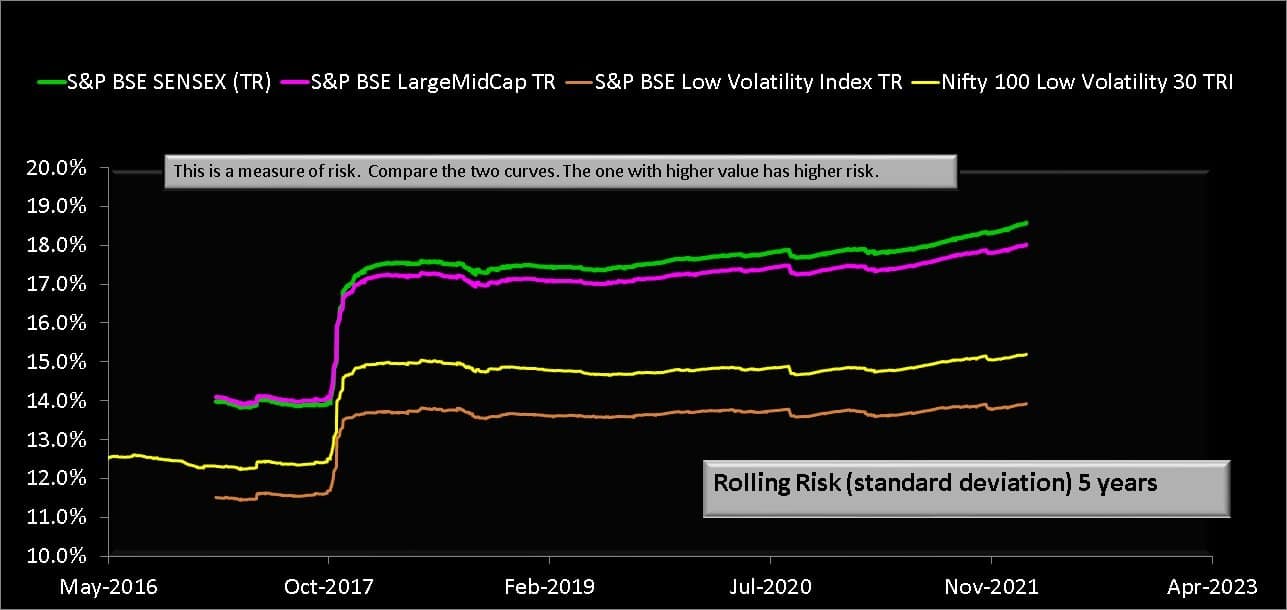
The lower volatility (and therefore better risk-adjusted returns before expenses) is thus a guarantee. When the index is placed into an open-ended fund, its expense ratio, in- and outflows therefore tracking error will determine the user benefit
This is the case with the US low volatility index too. The returns are not different from S&P 500 but the lower volatility is guaranteed and therefore better risk-adjusted returns. Data is available here: Low volatility stock investing – Does it work? Higher returns at lower risk?
Compared to the momentum factor which chases after higher risk in the hope of higher absolute reward, the low volatility factor chases lower volatility in the hope of higher absolute reward.
In the former case, if the higher risk does not pay, we are left with a poor outcome – lower absolute return and lower risk-adjusted return at a higher fee. In the latter case, if the lower risk does not produce higher absolute returns, it at least has a reasonable chance of producing better risk-adjusted returns (subject to tracking error and fees). Also see: UTI Nifty200 Momentum 30 Index Fund: Who should invest?
Now, volatility or the daily up and down price movement is only one way to look at risk. What about a fall from a maximum aka drawdown?
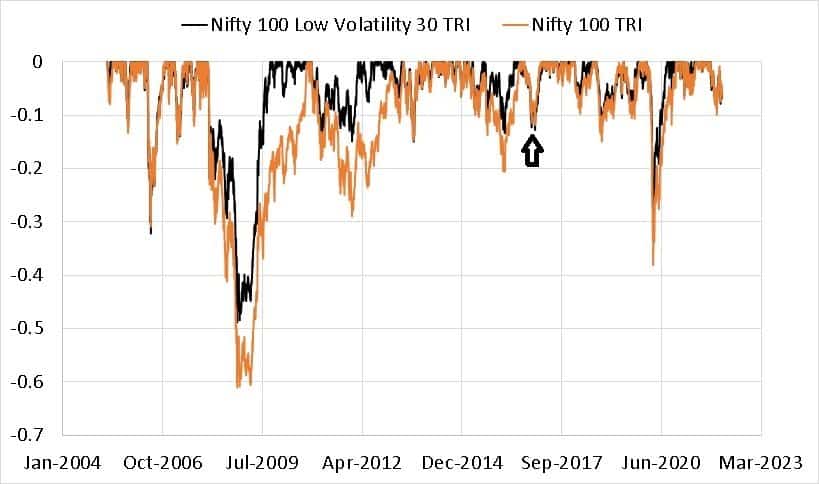
The low volatility index does well on this count too, although a lower drawdown wrt the base index is not a guarantee (the arrow is one such instance).
Investors must clearly understand that UTI S&P BSE Low Volatility Index Fund is a passively managed active mutual fund with the Nifty or Sensex or the S&P BSE LargeMidcap as its benchmarks. That is the index curator chooses the stock basket (different from a market index) based on a set of rules and not the fund manager. This is of course true for all factor-based or quant-based passive funds. The curator may change these rules if the past performance does not extrapolate into the future!
Will I invest? I was on the lookout for a fund in my retirement portfolio as it is too heavy on Parag Parikh Flexicap (the intake stoppage has come at a good time for me!). See Portfolio Audit 2021: How my goal-based investments fared this year.
I have always preferred Quantum Long Term Equity for its low volatility. With UTI S&P BSE Low Volatility Index Fund I get that at a lower fee and lower fund manager risk. So from that point of view, this offering from UTI seems like a good fit for me, perhaps even a replacement for the Quantum fund.
Please note that I have the means to evaluate portfolio volatility and drawdown as a time series (daily data published annually in December as ‘audits’). I have always valued low volatility and risk-adjusted returns above bare returns. Therfore I have taken a chance and invested in this fund. (See 2021 audit linked above for other portfolio holdings).
This is a decision based on personal circumstances. Kindly do not take this as a recommendation to invest. If anything, it is a recommendation to consider your circumstances carefully.
It is only a chance because, as mentioned above, a good index packaged into an ETF or fund can still be a bad index fund. Also, Siva from Facebook group Asan Ideas for Wealth has warned several times that low volatility does not mean low drawdown and its returns are also cyclic. To quote him: “when US (Global) interest rates rise Low Vol will lose, high beta will gain and when rates fall, Low Vol gains and high beta falls”
So far, we have not seen such a correlation with interest rates for the Indian scenario but it is still early days and the future could be different. At the very least we can apply the freefincal axiom, “nothing works forever”. So the past performance shown above may mean little when we start investing in UTI S&P BSE Low Volatility Index Fund (or any other fund for that matter). And it will be an expensive chance to take with this.
Five years from now, it may so happen that the absolute return of UTI S&P BSE Low Volatility Index Fund is lower than that of the S&P BSE LargeMidCap.
Question is, am I willing to take this chance? Am I at a stage in life where I can afford to take it? My answer (based on my personal circumstances and preferences) is yes. I took a chance and invested in Parag Parikh Flexicap during its NFO period so this will not be the first silly decision I have made (at that point in time no one could have predicted its future performance).
We recommend that investors interested in UTI S&P BSE Low Volatility Index Fund evaluate its position in their portfolio and invest only if necessary. I am considering it only because there is a place for it in my retirement portfolio.
In summary, UTI S&P BSE Low Volatility Index Fund is an expensive choice only for those who appreciate the past performance disclaimer, and the value of risk-adjusted returns and do not expect higher than market returns at all times. Low volatility investing is only for those who appreciate that returns are in hindsight and risk in real-time (the journey).